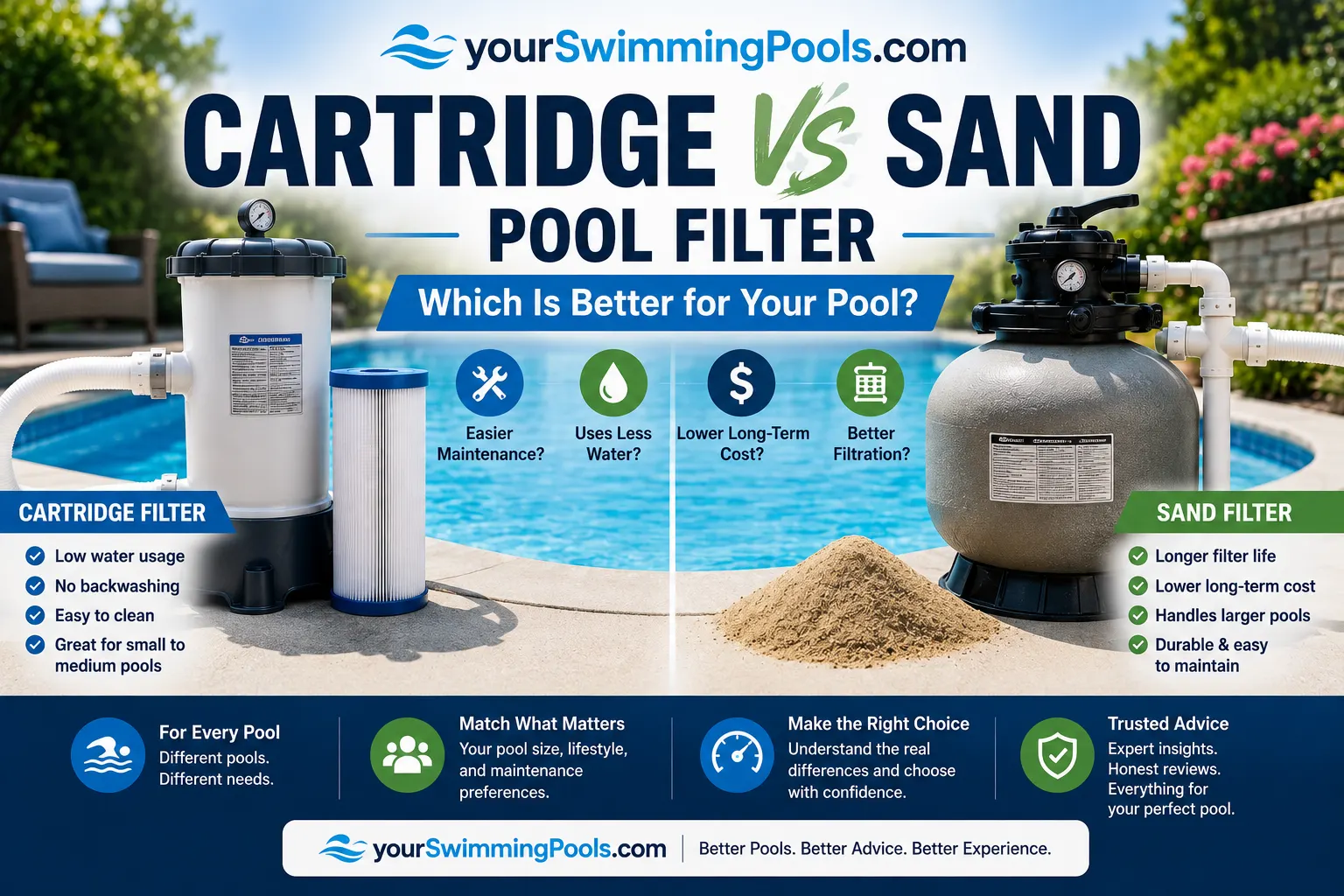
Neither type is categorically better. A cartridge filter and a sand filter solve the same problem (keeping pool water clear) through fundamentally different maintenance bargains, and the right pick depends on your pool, your plumbing, and how you actually want to spend your time. This page lays out the real trade-offs with model-specific evidence rather than repeating the generic “sand is easier / cartridge filters finer” summary that appears on most comparison pages.
The one-line answer
If your pool is small to mid-size and you would rather pull a cartridge and rinse it than deal with backwashing and sand, choose cartridge. If you want longer intervals between maintenance and you are fine with occasional backwashing (which discharges pool water), choose sand. Everything below explains why that conditional answer holds and when it breaks down.
What most comparisons leave out
Most cartridge-vs-sand articles repeat the same three claims: sand filters finer, cartridge is easier, sand lasts longer. All three are oversimplifications.
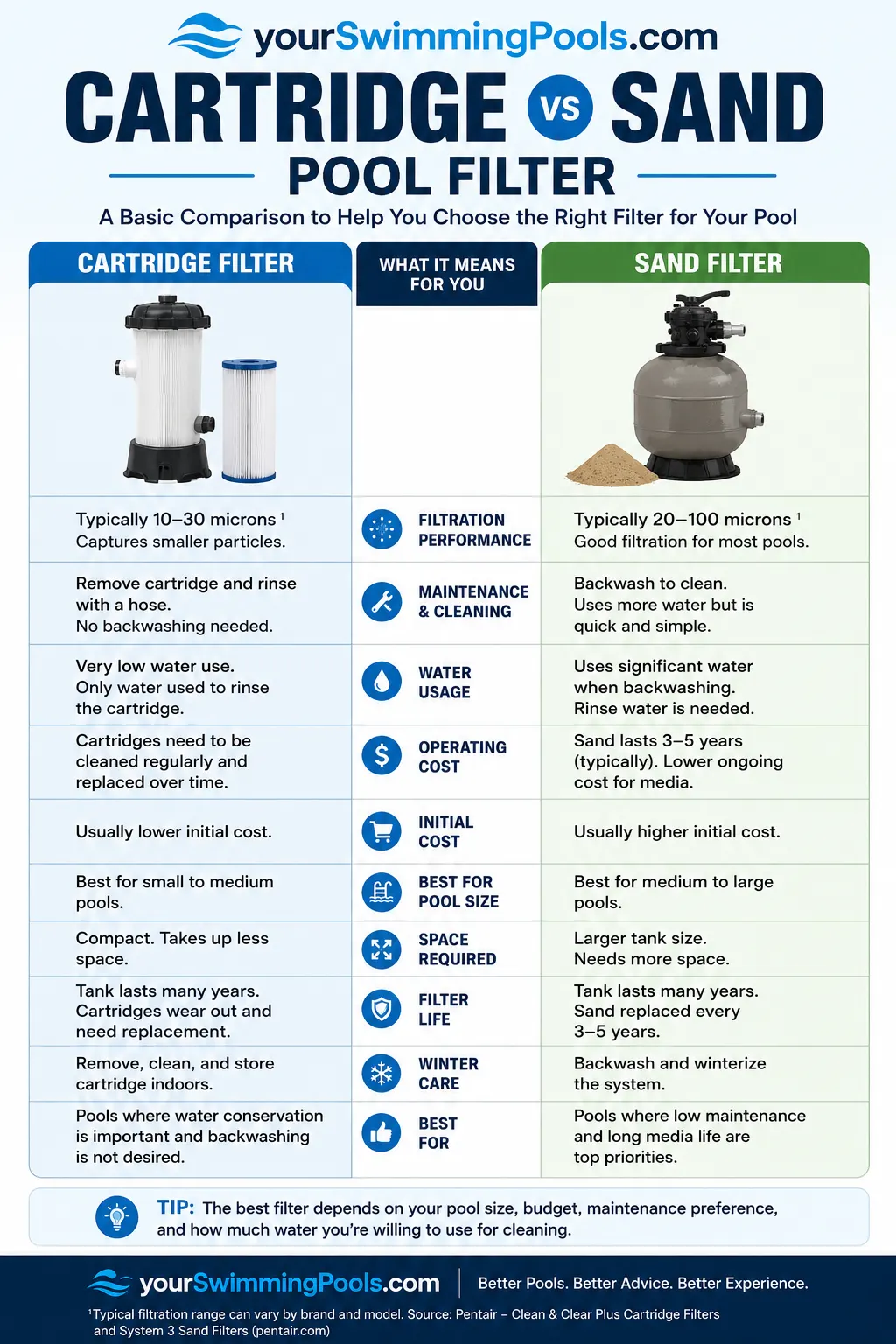
“Sand filters finer” is backwards. Cartridge filters can generally capture smaller particles than traditional sand filtration, but the actual range depends on the filter design and manufacturer. For example, Pentair lists 10 to 30 micron performance for one cartridge family, while its traditional sand comparison gives 20 to 100 microns. Advanced sand technologies can perform finer than conventional sand. The point is that as a category, cartridge tends to filter finer than sand, but do not treat any single micron number as universal.
“Cartridge is always easier” depends on your definition of easy. A cartridge is simpler to understand (pull it out, hose it off, put it back), but it needs attention more often. Sand needs less frequent attention (backwash when pressure rises), but the backwash process itself is more involved and discharges pool water. The question is your preference for frequent-but-simple or infrequent-but-involved.
“Sand lasts longer” conflates two different things. Sand media lasts several seasons before it needs replacing (Intex states up to 5 years for the SX2800). Cartridge life varies substantially with the filter, pool load and cleaning routine. Some manufacturers specify frequent replacement intervals: for the Intex Type B used by the C2500, Intex recommends replacement every two weeks for maximum efficiency. What is true is that between media changes, sand needs almost no manual work, while a cartridge needs periodic rinsing. That is the real maintenance difference.
The decision factors that actually change the answer
Pool type and size
For above-ground pools, both types work. The verified ranges from our reviewed products show significant overlap:
The Intex C2500 cartridge pump covers 4,000 to 15,200 gallons. The Intex SX2800 sand system covers 5,500 to 17,200 gallons. So for a pool between 5,500 and 15,200 gallons, either system fits the manufacturer’s rated range, and the choice comes down to maintenance preference rather than capacity.
Below 5,500 gallons, the cartridge has more headroom. Above 15,200 gallons, the sand system is the only one of this pair that reaches.
For in-ground pools, all three major filter technologies (sand, cartridge and DE) are used. Sand filters like the Hayward W3S244T2 ProSeries are particularly common where owners want multiport-valve backwashing and longer intervals between manual cleaning, while cartridge and DE systems remain common alternatives.
Water use
Sand filters discharge pool water during backwashing. How much depends on how often you backwash and how long each cycle runs, but it is real water loss that you refill and rebalance chemically.
Cartridge filters do not discharge pool water during cleaning. You pull the cartridge, rinse it with a hose, and put it back. The water stays in the pool.
If you are in a region where water is expensive or restricted, or if refilling and rebalancing after every backwash is a hassle, the cartridge does not require discharging pool water during routine cleaning, which is a genuine advantage.
If water is not a constraint and you would rather backwash for a few minutes than scrub a cartridge by hand, a sand system can require less effort per maintenance cycle, but the cycle itself is more involved and discharges pool water.
Maintenance workload in practice
This is where most comparisons are too generic. Here is the real rhythm for each type, drawn from the manufacturer documentation for the products we have verified:
Cartridge (e.g. Intex C2500 26633EG): The system has a gauge indicator that shows when the cartridge needs attention. You pull the Type B cartridge, rinse it with a hose, and reinsert it. Intex recommends replacing the Type B cartridge every two weeks for maximum efficiency. In practice, many owners rinse and reuse for longer, but the manufacturer interval is two weeks. A spare cartridge lets you swap and clean at leisure.
Sand (e.g. Intex SX2800 26647EG): You backwash through the 6-function valve when pressure rises above the clean baseline. A backwash cycle runs until the sight glass (or discharge water) runs clear, typically a few minutes. Then a brief rinse cycle, and back to filter. Between backwashes, the system needs no manual work. The sand itself lasts up to 5 years with regular backwashing, per Intex.
The practical difference: a cartridge system asks for small, frequent effort (rinse every week or two). A sand system asks for infrequent, slightly more involved effort (backwash every few weeks or when pressure says so). Neither is hard, but they suit different temperaments.
Pump and filter compatibility
This is rarely discussed in comparison articles, but it matters.
A combo unit (pump and filter sold together, like the C2500 or SX2800) is pre-matched. The pump flow and the filter are designed to work together.
A standalone filter (like the Hayward W3S244T2) needs to be paired with a compatible pump. Oversizing the pump for the filter, or undersizing it, causes real problems: too much flow can damage the filter or push debris through it, and too little flow gives poor circulation. Our filter sizing and pump sizing pages cover this in detail.
The key point for this comparison: if you are buying an above-ground combo unit, the cartridge-vs-sand decision is purely about maintenance preference and pool size, because the pump is already matched. If you are building a separate equipment pad (typically in-ground), compatibility is a real consideration, and sand is a common pairing for standalone in-ground systems, particularly where backwashing through a multiport valve is desired.
Replacement and ongoing costs
We are not building a full cost comparison here (that is a separate page), but the cost structures are genuinely different:
Cartridge: the ongoing cost is replacement cartridges, and the replacement interval varies substantially by filter, cartridge, pool load and maintenance routine. The cartridge itself is inexpensive per unit, but you buy them repeatedly.
Sand: the ongoing cost is replacement sand, which you buy every several seasons (up to 5 years for the SX2800 per Intex). Sand is cheap in bulk. But backwashing uses pool water, which costs money to refill and rebalance chemically.
Neither is dramatically more expensive over time. The shapes of the cost are different (frequent small cartridge purchases vs infrequent sand plus ongoing water/chemical top-ups), and which matters more depends on your local water cost and how often you backwash.
Where each system has a clear advantage
Cartridge wins when
You have a small to mid-size above-ground pool (under about 15,000 gallons) and want the simplest possible setup. You are in an area with expensive or restricted water and do not want to discharge pool water during cleaning. You prefer pulling a cartridge and rinsing it to dealing with a multiport valve and backwash hose. You want finer particle filtration than traditional sand (actual micron range varies by model and manufacturer).
Sand wins when
You have a mid-size to larger above-ground pool and want the longest intervals between maintenance. You are comfortable with occasional backwashing and the water loss that comes with it. You want several seasons between media changes rather than frequent cartridge purchases. You are building an in-ground system where sand is the standard filter type.
Where each system can be the wrong choice
Cartridge is the wrong choice if you have a large pool at the top or beyond the rated range: the cartridge clogs faster, and you spend more time rinsing than filtering. It is also the wrong choice if you will not actually rinse the cartridge when it needs it, because a dirty cartridge restricts flow and raises pressure, which stresses the pump.
Sand is the wrong choice if you cannot or will not backwash: a sand filter that is never backwashed channels, loses filtration quality, and eventually fails. It is also the wrong choice if local rules prohibit backwash discharge to the ground or storm drain, because the water has to go somewhere.
Decision table
| Factor | Cartridge | Sand | Better fit for |
|---|---|---|---|
| Particle filtration | Generally finer (e.g. 10 to 30 microns, varies by model) | Generally coarser (e.g. 20 to 100 microns for traditional sand) | Cartridge tends to filter finer, but check the specific model |
| Cleaning method | Pull, rinse with hose, reinsert | Backwash through multiport valve | Preference: frequent-simple vs infrequent-involved |
| Water use during cleaning | None (cartridge rinsed outside the pool) | Discharges pool water | Cartridge, if water is expensive or restricted |
| Media/element life | Replacement interval varies by filter, pool load and routine (Intex Type B: every two weeks per manufacturer) | Sand lasts up to 5 years (Intex SX2800 claim) | Sand, for longer media life |
| Routine effort | More frequent cleaning (interval depends on filter, pool load and manufacturer recommendations) | Less frequent (backwash when pressure rises) | Sand, for least frequent effort |
| Above-ground combo | Common (e.g. Intex C2500, 4,000 to 15,200 gal) | Common (e.g. Intex SX2800, 5,500 to 17,200 gal) | Either, depending on pool size and preference |
| In-ground permanent | Used but less common at typical in-ground sizes | Common choice (e.g. Hayward W3S244T2 ProSeries) | Sand is a common choice, but cartridge and DE are also widely used |
| Pump matching | Pre-matched in combo units | Pre-matched in combos; standalone needs sizing | Same for combos; sand for standalone in-ground |
| Main downside | Frequent cartridge rinsing and replacement | Backwash water loss and rebalancing | Depends on which downside you prefer |
Conditional recommendations
For an above-ground pool under 5,500 gallons (using the Intex models as examples): the C2500 cartridge covers this range comfortably. A sand system like the SX2800 starts at 5,500 gallons, so cartridge is the natural fit at this size for these specific models.
For an above-ground pool between 5,500 and 15,200 gallons (where these Intex models overlap): either works for the C2500 and SX2800 specifically. Pick based on your preference for rinsing a cartridge or backwashing occasionally. If water cost matters, lean cartridge. If you want the least frequent effort, lean sand. Other brands and models will have different rated ranges.
For an above-ground pool above 15,200 gallons (using these examples): the SX2800 sand system reaches 17,200 gallons, while the C2500 cartridge tops out at 15,200. That illustrates why the actual model’s rated range matters more than simply choosing cartridge or sand.
For an in-ground pool: sand is particularly common (multiport-valve backwashing, longer intervals), but cartridge and DE systems are also used. Match the filter type to your plumbing, pump flow, and maintenance preference.
Products on this site that fit
If you have decided on cartridge for an above-ground pool, our Intex C2500 review covers the model we have verified for 4,000 to 15,200 gallons.
If you have decided on sand for an above-ground pool, our Intex SX2800 review covers the model verified for 5,500 to 17,200 gallons, and our Bestway 58498E review covers a smaller-pool sand option for 300 to 11,200 gallons.
If you need an in-ground sand filter, our Hayward W3S244T2 review covers the ProSeries 24-inch top-mount filter.
For help matching a filter to your pool’s volume and pump, see filter sizing and pump sizing.
Sources and model documentation
The manufacturer-specific claims on this page are drawn from these sources. We link to them so you can verify the figures yourself.
Intex C2500 (26633EG) product page and Type B cartridge replacement recommendation: Intex C2500 product page. Intex SX2800 (26647EG) product page: Intex SX2800 product page. Pentair filtration technology comparison (micron ranges): Pentair filtration comparison. Intex Type B cartridge replacement interval: Intex Type B cartridge documentation.
General micron ranges cited in this article (10 to 30 for cartridge, 20 to 100 for traditional sand) are from Pentair’s published filtration comparison and will vary by brand, model, and filter condition.
Frequently asked questions
Does a sand filter save water compared to a cartridge?
No. A sand filter uses more water, because backwashing discharges pool water that you then refill. A cartridge filter’s cleaning process (pulling and rinsing the cartridge) does not remove water from the pool.
Is a cartridge filter always easier to maintain?
Not necessarily. It is simpler (rinse vs backwash), but it needs attention more often. If “easier” means “less time spent per month,” sand often wins because backwashing is infrequent. If “easier” means “simpler each time,” cartridge wins.
Can I use any pump with any filter?
No. The pump’s flow rate must match the filter’s design flow. Combo units (pump and filter sold together) are pre-matched. Standalone filters need a correctly sized pump. Oversizing or undersizing causes real problems. See our filter sizing page.
Does filter type alone determine water clarity?
No. Water clarity depends on the filter, the pump’s circulation, chemical balance, run time, and whether the system is properly sized for the pool. A perfectly clean cartridge on an undersized pump, or a sand filter that is never backwashed, will both give poor results.
