Pool filters
Pool Filter Size Calculator
Enter your pool's volume and your target turnover time. The calculator gives you the required flow in GPM and GPH. That number is the starting point for matching a filter and pump, not the final answer by itself.
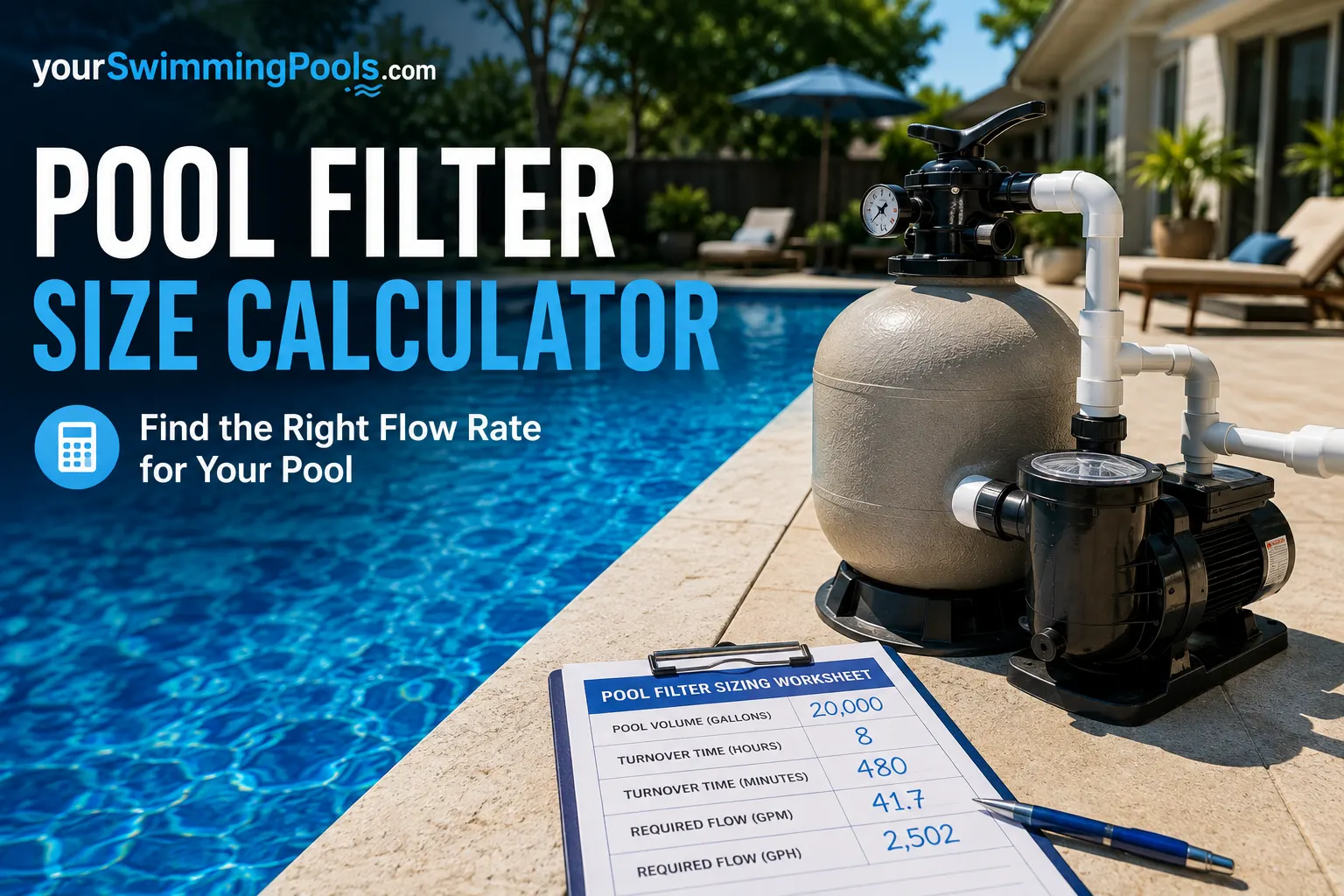
Calculate your required flow
Enter your pool volume, choose a turnover time, and see the flow your system needs to deliver.
These are calculation options, not universal recommendations. Choose a turnover target appropriate for your pool, equipment and operating conditions.
Pool volume helper (rectangular pool)
Length (ft) x Width (ft) x Average Depth (ft) x 7.48 = approximate gallons
This is an estimate for a rectangular pool. Round, oval, and irregular shapes use different formulas. If your pool manufacturer provides a volume, use that instead.
This is a calculated required flow based on your inputs, not a measurement of actual pump or system flow. Actual flow depends on plumbing, fittings, equipment, and system resistance.
Before you buy: four checks
Filter flow rating
The filter's published flow capacity should be sufficient for your calculated required flow, while staying within the manufacturer's operating limits for that model.
Pump delivered flow
The pump must deliver the required GPM through your actual plumbing, not just on the box label. Check the pump's performance curve at your estimated system resistance.
Plumbing and equipment
Pipe, fittings, valves, heaters and cleaners add hydraulic resistance, which can reduce the flow the pump delivers at a given operating speed.
Manufacturer limits
Both filter and pump must operate within the manufacturer's published limits for the exact model. Do not exceed the filter's rated maximum flow.
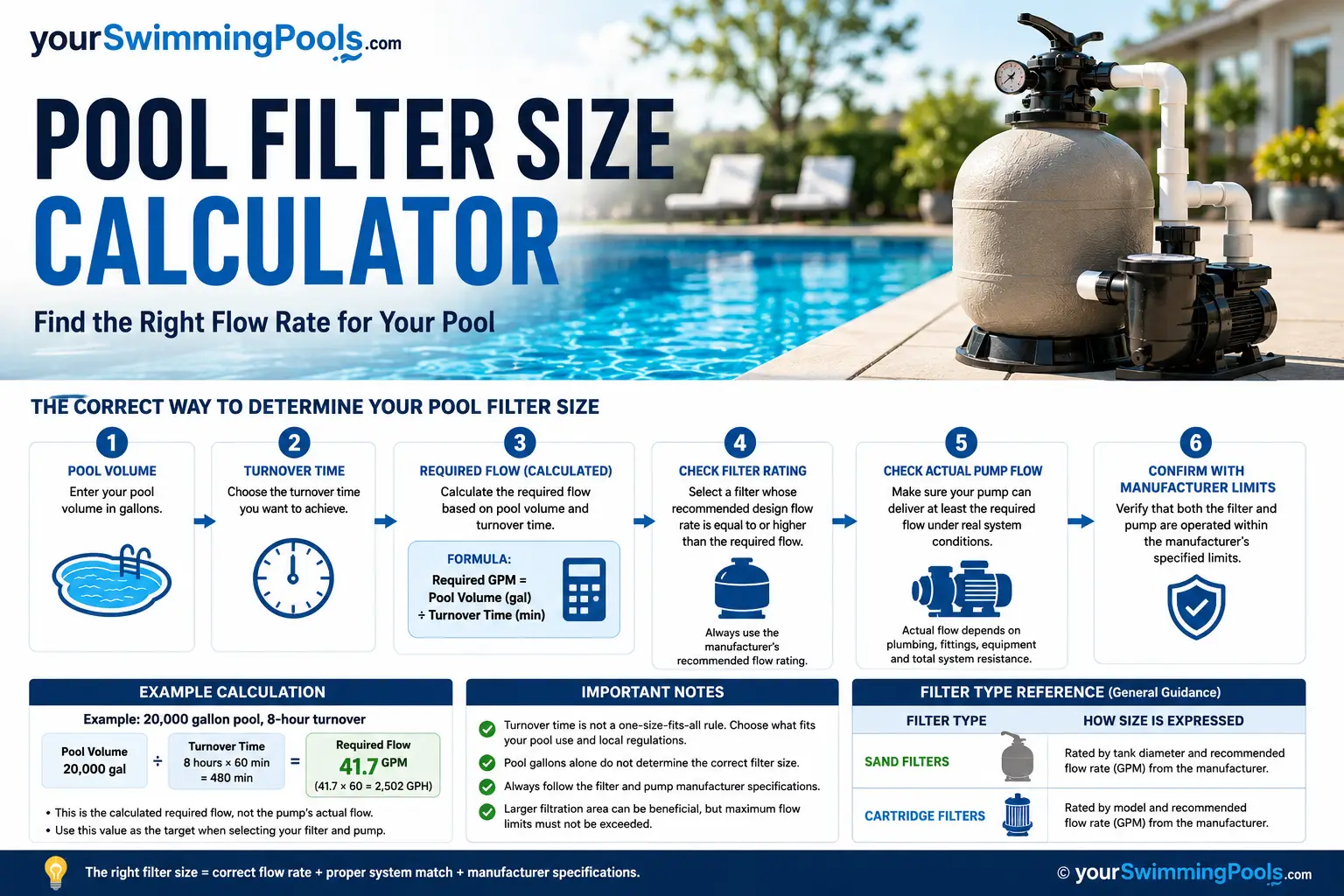
How the calculation works
Required GPM = pool volume (gallons) / turnover time (minutes). For a 20,000 gallon pool at 8-hour turnover: 20,000 / 480 = 41.7 GPM, equivalent to 2,500 GPH. That is the flow your system needs to sustain to circulate the full volume within the chosen time.
What the result tells you
The number is the calculated flow required to complete one full turnover within the time you selected. Use it as the target when checking the manufacturer's specifications for the specific filter and pump models you are considering.
What the result does not tell you
It does not tell you what flow your pump actually delivers through your plumbing, because that depends on pipe diameter, pipe length, fittings, valves, elevation, and any equipment (heater, cleaner, salt cell) in the loop. A pump rated at 60 GPM on the box may deliver considerably less in a real installation. Check the pump manufacturer's performance curve at your estimated system head to see the actual operating flow.
GPM and GPH: do not mix them
1 GPM = 60 GPH. Some manufacturers rate filters and pumps in GPM, others in GPH. The calculator shows both so you can match either convention. If a filter is rated at 2,500 GPH, that is 2,500 / 60 = 41.7 GPM. Always convert before comparing specifications from different brands.
Reference examples (at 8-hour turnover)
| Pool volume | Required GPM | Required GPH |
|---|---|---|
| 10,000 gal | 20.8 | 1,250 |
| 15,000 gal | 31.3 | 1,875 |
| 20,000 gal | 41.7 | 2,500 |
| 30,000 gal | 62.5 | 3,750 |
These are calculated from the formula at an 8-hour turnover. A faster turnover raises the required flow; a slower turnover lowers it. The choice of turnover time depends on pool type, usage, and local conditions, not a universal rule.
Common calculation mistakes
- Confusing GPH with GPM. A pump rated at 2,500 GPH is 41.7 GPM, not 2,500 GPM. Mixing the units leads to wildly oversized or undersized equipment.
- Using calculated flow as actual pump flow. The calculator tells you what the system needs. The pump's actual delivered flow through your plumbing is a different, usually lower, number.
- Sizing from pump horsepower. Two 1.5 HP pumps from different manufacturers can deliver very different GPM. Size from flow, not horsepower.
- Ignoring manufacturer flow limits. Every filter has a rated maximum. Exceeding it pushes particles through the media and raises pressure.
- Assuming one turnover chart fits all pools. A pool with heavy debris or heavy bather loads may benefit from faster turnover. A lightly used pool may be fine with slower. The chart is a reference, not a prescription.
Products on this site as sizing examples
For a worked example of how manufacturer-rated flow translates to a pool range: the Intex SX2800 (26647EG) is rated at 2,800 GPH pump flow and 2,150 GPH in-pool system flow for 5,500 to 17,200 gallons. The Intex C2500 (26633EG) is rated at 2,500 GPH for 4,000 to 15,200 gallons. Those are combo units where the pump and filter are pre-matched, so the sizing calculation confirms the manufacturer's range rather than replacing it.
For the full sizing methodology (why the calculator is only Step 3 of a five-step process), see How to Choose the Right Pool Filter Size. For help deciding between cartridge and sand before sizing, see Cartridge vs Sand Pool Filter.
Sources
The turnover formula (Required GPM = Volume / Turnover minutes) is standard pool industry practice documented in Pentair/Sta-Rite pool training material. Model-specific turnover capacities for cartridge systems are published on the Pentair Clean and Clear filter specifications page, and for sand systems on the Pentair Sand Dollar filter specifications page. Product specifications cited are from the manufacturer listings we have verified: Intex C2500 product page, Intex SX2800 product page.
Related topics
- How to Choose the Right Pool Filter SizeThe five-step sizing method: volume, turnover, required flow, pump matching, and manufacturer limits.
- Cartridge vs Sand Pool FilterThe real trade-offs between cartridge and sand, with model-specific evidence.
- Cartridge FiltersHow cartridge filtration works and who it suits.
- Sand FiltersWhen sand is the better choice, and its trade-offs.
- Pump SizingMatch pump flow to your pool and filter without oversizing.
- Best Pool Filters for Above-Ground PoolsOur current above-ground filter picks and how we chose them.
- Best Sand Filter for In-Ground PoolsOur current in-ground pick with the evidence behind it.