If you have already calculated the flow your pool needs, the next question is usually “what do GPM, GPH and turnover actually mean, and which flow number should I trust?” The short version: GPM is gallons per minute, GPH is gallons per hour, and turnover is how long it takes to circulate a volume of water equal to your pool at a given flow rate. The part that trips people up is not those definitions. It is that the flow your calculator asks for, the flow a pump is rated at, the flow your assembled system actually delivers, and the flow figure printed on your filter are four different numbers. They are related, but they are not interchangeable, and using one where you meant another is the most common flow-rate mistake.
What GPM means
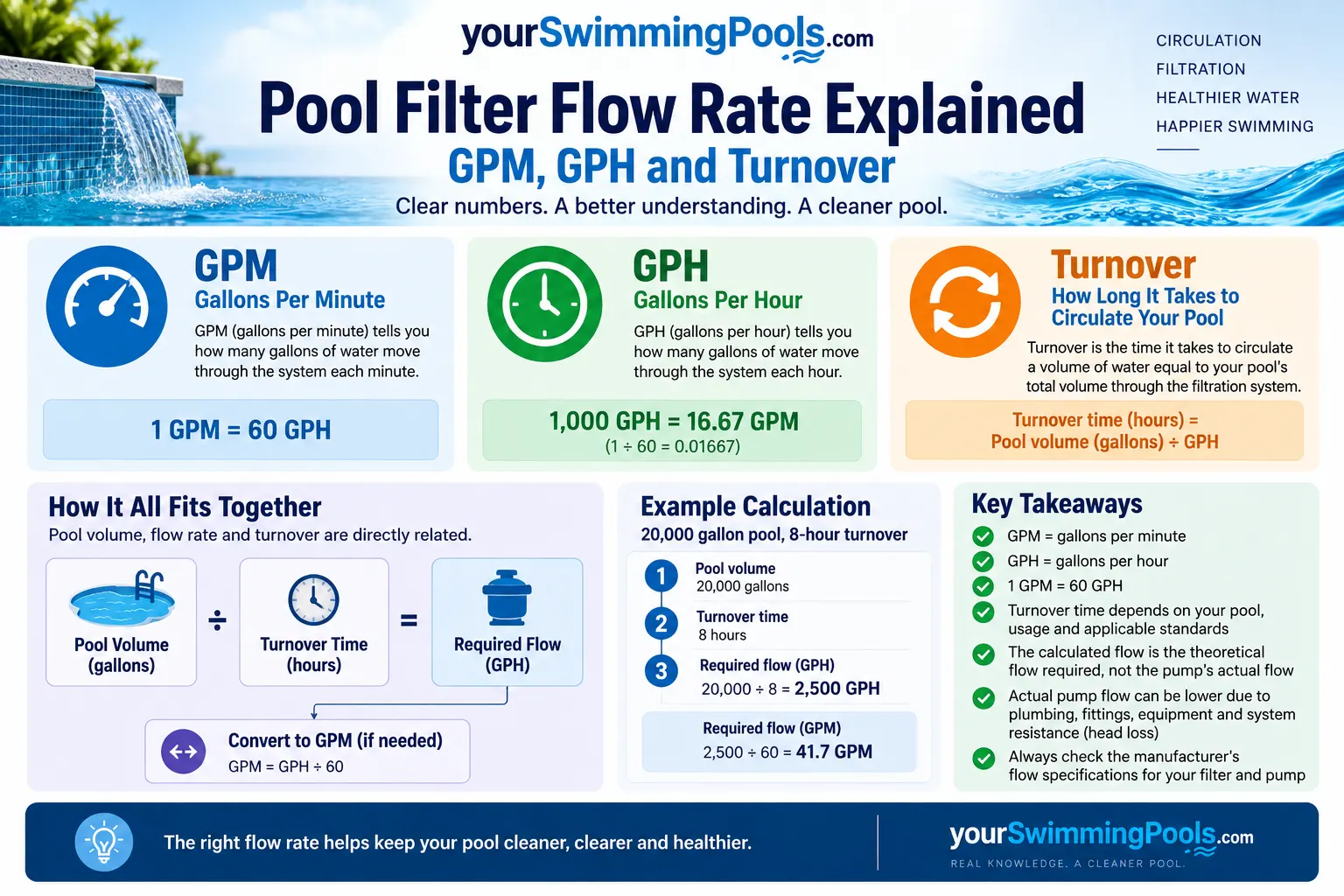
GPM stands for gallons per minute. It counts how many gallons of water pass a point in the system in one minute. If a system is flowing at 40 GPM, then 40 gallons move past that point every minute it runs.
One detail is worth stating precisely, because it feeds the confusion later on the page: a flow rate can be measured or calculated at different points, depending on the method and instrumentation. A flow meter plumbed into your return line reports flow at that spot. A figure worked out from pool volume and a target turnover time is a calculation, not a reading taken from your returns. So “40 GPM” only means something once you know where the number came from and what it describes.
What GPH means
GPH stands for gallons per hour. It is the same idea as GPM, scaled up to an hour.
- 1 GPM = 60 GPH
- 1 GPH = 1/60 GPM
For example, 40 GPM multiplied by 60 is 2,400 GPH. One thing GPH is not: it is not the number of gallons in your pool. GPH is a rate (gallons each hour), while pool volume is a fixed quantity (gallons total). Mixing those two up produces turnover numbers that make no sense, which is exactly the mistake the next section is built to prevent.
What turnover means
Turnover time is how long it takes to move a volume of water equal to your pool through the system at a given flow rate:
Turnover time = pool volume / flow rate
For a 20,000 gallon pool at 2,500 GPH: 20,000 / 2,500 = 8 hours.
Here is the part most articles skip. Turnover does not mean every molecule of water passes through the filter exactly once, and it does not assume the pool is perfectly mixed. In a real pool, water short-circuits between the return and the skimmer, dead spots form in corners and behind ladders, and some water cycles through many times while other water lingers. Turnover is a circulation calculation based on volume and flow. It is a useful planning figure, not proof that every part of the pool was filtered equally. That is why no single turnover time is universally correct for every pool. The right target depends on your pool, its use, and any standards that apply where you live.
How GPM, GPH and turnover connect
Pool volume, flow rate and turnover time are three views of the same relationship. Rearrange one formula and you get the others:
- Required GPH = pool volume / turnover time in hours
- Required GPM = pool volume / turnover time in minutes
- Turnover (hours) = pool volume / GPH
- GPM x 60 = GPH, and GPH / 60 = GPM
Every conversion on this page comes from that last pair. Nothing here is a lookup you have to trust blindly.
Calculated required flow
If you used our filter sizing calculator, the flow figure it returns is a calculated required flow: a target worked out from your pool volume and a turnover time you chose.
Required GPM = pool volume / (turnover hours x 60)
For a 20,000 gallon pool at 8-hour turnover: 20,000 / 480 = 41.7 GPM, which is 41.7 x 60 = 2,502 GPH (the exact figure is 41.6667 GPM, or 2,500 GPH before rounding).
Read that as a target. It is not a measurement of what your pump moves, and it is not what your system delivers once real plumbing is attached. It tells you what you are aiming for, which is the first of four numbers you should keep separate.
Which flow number do you actually need?
| Your question | The relevant number |
|---|---|
| How much flow does my pool need? | Calculated required flow |
| How does this pump compare to that one? | Rated pump flow (read the curve, not just the max) |
| Is my system delivering enough? | Actual system flow |
| Am I safe for my filter? | Filter flow specification |
The four flow numbers, and why they are not the same
This is the distinction the rest of the page exists to make clear. When people say “my flow rate,” they could mean any of four things:
- Calculated required flow. What the math says you need for a chosen pool volume and turnover time. A target, not a measurement. Example: the 41.7 GPM above.
- Rated (published) pump flow. What the manufacturer states the pump can move under specified conditions. Usually a favorable, low-resistance figure.
- Actual system flow. What the installed, assembled system actually delivers once real pipe, fittings, the filter, and any extra equipment are in the loop. This is the one you live with.
- Filter flow specification. The manufacturer’s stated operating, design, or maximum flow for that specific filter model. A boundary or a design point, not a description of your flow.
These four routinely differ, and you do not have to take that on faith. Intex publishes two of them for the same product. For the Intex SX2800 sand filter pump (model 26647EG), Intex lists a 2,800 GPH pump flow and a 2,150 GPH in-pool system flow. That is one manufacturer, one product, stating a rated pump number and a lower real-system number that differ by 650 GPH, before your own plumbing enters the picture. You can see the numbers side by side on our Intex SX2800 review.
Required flow vs actual system flow
Your actual flow is shaped by everything the water has to travel through:
- Pipe diameter
- Pipe length
- Fittings and elbows
- Valves
- Filter condition, clean versus loaded
- A heater in the loop
- An automatic cleaner
- Elevation and equipment placement
- Overall system resistance, also called head loss
Every one of these adds resistance, and resistance moves the flow you actually get. There is no honest universal number for how much they cut it. Two pools with identical pumps can deliver very different actual flow because their plumbing differs. The principle is what carries across every system: more system resistance means less actual flow. For matching the equipment sides to each other, see how to choose the right pool filter size, which walks through the full system-matching method rather than repeating it here.
Pump-rated flow vs actual flow
Several pump numbers get treated as if they were the delivered flow. They are not.
Horsepower is a motor rating. On its own it does not tell you how many GPM the pump will deliver, and there is no reliable “1 HP equals X GPM” rule, because two pumps of the same horsepower from different makers can move different flow through the same plumbing. Published maximum flow is usually a best-case figure measured under low resistance, which your system rarely matches. The number that actually predicts delivered flow is the pump’s performance curve read against your system’s resistance. For choosing a pump around that idea, see pump sizing.
Pump curves and system resistance
A pump does not have a single flow rate. It has a range that depends on how hard it has to push. In plain terms:
- Lower system resistance leads to higher possible flow.
- Higher system resistance leads to lower possible flow.
A manufacturer’s pump curve plots exactly that: flow on one axis, resistance (head) on the other. Where the curve crosses your system’s resistance is the operating point, and that operating point is the flow you actually get. This is why a pump advertised at a high maximum can deliver noticeably less once it is connected to real pipe, a filter, and fittings. The pump did not underperform. It is simply operating further along its own curve. We are not printing specific GPM and head values here, because a real curve is model-specific and should be read from the exact pump’s documentation rather than generalized to every pump.
Filter flow specifications
Filters carry manufacturer-specified flow characteristics, and the terminology is not standardized across brands. Depending on the model and maker, you may see a maximum flow rate (an upper operating limit), a recommended or design flow (the flow the filter is intended to run at), or an operating range. These labels can mean different things from one manufacturer to the next, so read the specification for your exact model rather than assuming a single universal rule. It is also why “just match the pump GPM to the filter GPM” is too simplistic to rely on: the two numbers are defined differently and measured under different conditions.
Operating above a filter manufacturer’s published maximum can exceed the filter’s intended operating limits and may reduce effective filtration or increase equipment stress, depending on the filter design. That upper limit exists for a reason. For how cartridge and sand filters differ in how they express and handle flow, see cartridge vs sand pool filter.
Why filter pressure is not a flow meter
A filter pressure gauge is one of the most misread numbers in pool care. Higher pressure does not automatically mean higher flow. Often it means the opposite: a dirty or restricted filter raises resistance, which shifts the operating point and can reduce flow while pressure climbs.
Pressure is genuinely useful as a diagnostic, especially the change from your clean baseline, which is the standard cue to clean or backwash. But a pressure reading is not a direct flow measurement unless the system is specifically instrumented and calibrated for that purpose. There is no universal “10 PSI equals X GPM” conversion that holds across pool systems. If your gauge is reading high, high filter pressure covers what to check.
Turnover time vs pump runtime
“An 8-hour turnover” and “run the pump for 8 hours” sound identical but are not the same claim. A turnover calculation assumes a specific flow rate. If your actual flow is lower than the flow the calculation assumed, reaching that same calculated turnover takes longer than the clock number suggests.
So there is no single correct daily runtime that fits every pool, and one turnover is not automatically enough for every situation. Runtime depends on your actual delivered flow, your pool’s use, and local standards. Treat turnover as a flow-based calculation, not a fixed number of hours to set and forget.
Variable-speed pump considerations
With a variable-speed pump, flow changes as speed changes, and lower RPM generally means lower flow. That is precisely why a single “GPM” figure cannot describe a pump that runs at several speeds through the day. The actual flow at any given speed still depends on your system’s resistance and the pump’s curve, so there is no universal RPM-to-GPM conversion to memorize. For where the higher upfront cost of these pumps can pay back, see variable-speed pumps.
Worked examples
These are arithmetic examples showing how required flow moves when turnover time or volume changes. They are not universal operating recommendations.
Example A. 20,000 gallons, 8-hour turnover. 20,000 / 8 = 2,500 GPH. 2,500 / 60 = 41.7 GPM.
Example B. 20,000 gallons, 10-hour turnover. 20,000 / 10 = 2,000 GPH. 2,000 / 60 = 33.3 GPM.
Example C. 30,000 gallons, 8-hour turnover. 30,000 / 8 = 3,750 GPH. 3,750 / 60 = 62.5 GPM.
Compare A and B: the same pool with a longer turnover needs less flow. Compare A and C: a larger pool at the same turnover needs more flow. The required number is driven entirely by volume and the turnover time you choose.
GPM to GPH reference table
Every row is simply GPM multiplied by 60.
| GPM | GPH |
|---|---|
| 10 | 600 |
| 20 | 1,200 |
| 30 | 1,800 |
| 40 | 2,400 |
| 50 | 3,000 |
| 60 | 3,600 |
| 70 | 4,200 |
| 80 | 4,800 |
| 100 | 6,000 |
Common flow-rate mistakes
“My pump is rated at 60 GPM, so my system flows 60 GPM.” Not necessarily. System resistance sets the actual operating point, which usually sits below the rated maximum.
“60 GPM tells me my turnover.” Not on its own. Turnover needs both flow and pool volume. Without the volume, a flow rate says nothing about turnover time.
“High filter pressure means high flow.” No. Pressure and flow are related through the whole system, but pressure alone is not a flow measurement, and rising pressure often signals restriction and lower flow.
“My calculator says 42 GPM, so I need a 42 GPM filter.” The calculation is a required-flow target, not a complete filter choice. Filter selection also depends on the model’s rated flow and how it is measured, and on the pump that feeds it.
“My pump is 1.5 HP, so I know the flow.” Horsepower is a motor rating, not a delivered-flow figure. Size and predict flow from the pump curve, not from horsepower.
Practical takeaway
Keep the four numbers separate and you avoid nearly every flow-rate error. Use calculated required flow as your target. Read rated pump flow as a best case, not a promise. Expect actual system flow to be the real, usually lower, number your plumbing produces. And treat the filter flow specification as a limit or design point for that exact model. When you need the calculation itself, the filter sizing calculator turns your volume and turnover target into a required flow, and if your flow already seems off, pool pump problems is the place to start.
Sources
The turnover relationship (turnover time = pool volume / flow rate) and the GPM-to-GPH conversion (GPM x 60 = GPH) are standard pool arithmetic, documented in Pentair and Sta-Rite pool training material, and every calculation on this page was verified before publishing. The rated-versus-system flow illustration uses Intex’s own published figures for the SX2800 (model 26647EG): a 2,800 GPH pump flow and a 2,150 GPH in-pool system flow, as documented on the manufacturer listing and captured in our Intex SX2800 review. Pump-curve behavior (flow varies with system resistance) is standard centrifugal-pump engineering; read the curve for your exact pump model from that manufacturer’s own specification document rather than generalizing one curve to all pumps.
Frequently asked questions
How do I calculate my pool turnover?
Divide pool volume by flow rate in matching units. A 20,000 gallon pool at 2,500 GPH gives an 8-hour calculated turnover. Remember this uses an assumed flow rate, so if your actual delivered flow is lower, the real time to circulate that volume is longer.
Is GPM or GPH better for pool equipment?
Neither is better. They describe the same flow at different time scales, and you convert between them with GPM x 60 = GPH. Match whichever unit the specification you are comparing uses so you are not comparing a per-minute number against a per-hour one.
Does higher GPM mean better filtration?
Not on its own. Pushing water faster than a filter’s rated flow can actually reduce how well it captures particles, and it can exceed the filter’s limits. More flow is not automatically cleaner water.
Does my filter pressure tell me the flow rate?
No. Pressure is a helpful diagnostic, especially compared against your clean baseline, but it is not a flow measurement, and there is no universal PSI-to-GPM conversion that applies to every pool.
