Most pool filter sizing articles give you a chart: 10,000 gallons = this filter, 20,000 gallons = that filter. Those charts are useful starting points, but they skip the steps that actually determine whether the filter works well in your system. Pool volume is one input. The complete sizing decision also includes your required turnover, the flow your pump actually delivers, the filter manufacturer’s flow limits, and the resistance in your plumbing. This page walks through that full process so you can verify a filter choice rather than just trust a chart.
Why pool gallons alone are not enough
A gallon number tells you how much water the filter must process. It does not tell you how fast it must process it, whether your pump can deliver that speed, or whether the filter can handle that flow without exceeding its pressure limits. A 20,000 gallon pool with a long plumbing run, a heater, and an automatic cleaner in the loop needs a very different system from a 20,000 gallon pool with short, straight plumbing.
If you size only from gallons, you risk two common mistakes: a filter that is technically rated for the volume but cannot handle the real flow, or a filter paired with a pump that pushes water through it faster than the manufacturer intended.
The five-step sizing method
Step 1: Start with your pool volume
If you do not know your pool volume, measure length, width, and average depth in feet and multiply by 7.5 for a rectangular pool (length x width x average depth x 7.5 = gallons). Oval and round pools use slightly different formulas. This number is your starting input.
Step 2: Choose your turnover target
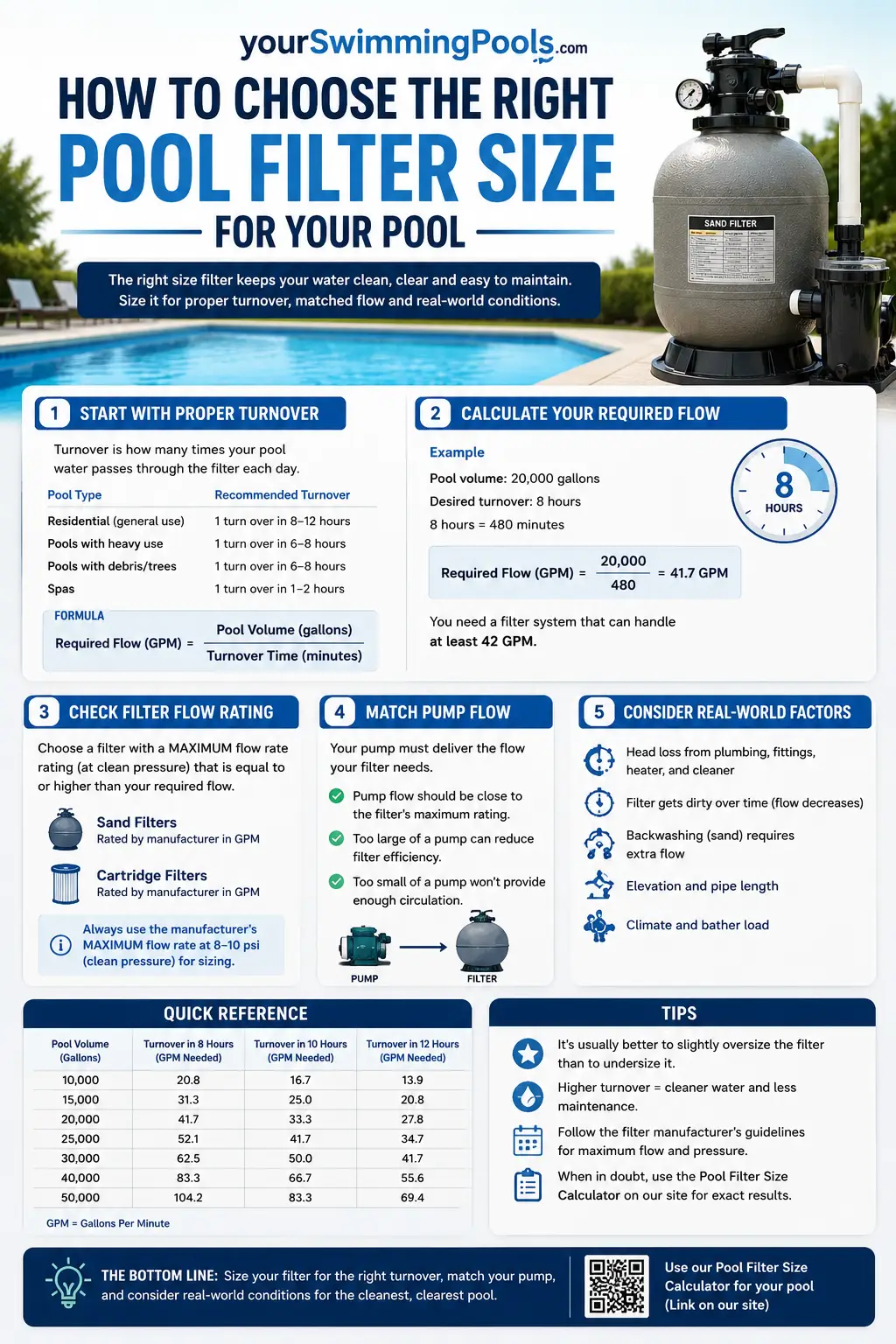
Turnover is how many times per day the entire pool volume passes through the filter. For residential pools, one full turnover every 8 to 12 hours is the common range. Pools with heavy use or heavy debris (trees, bathers, pets) benefit from a faster turnover (6 to 8 hours). Spas typically need 1 to 2 hour turnover.
The turnover target you choose directly sets the flow your system needs. Faster turnover means more flow, which means a larger filter and pump.
Step 3: Calculate the required flow
This is straightforward arithmetic, but it is where most sizing articles stop too early.
Required flow (GPM) = pool volume (gallons) / turnover time (minutes)
For a 20,000 gallon pool at 8-hour turnover:
8 hours x 60 = 480 minutes
20,000 / 480 = 41.7 GPM
That means you need a filter system that can sustain at least 41.7 gallons per minute. This is a calculated requirement, not a claim that any specific pump or filter will deliver exactly 41.7 GPM in your installation.
Quick reference (at 8-hour turnover):
| Pool volume | Required flow |
|---|---|
| 10,000 gal | 20.8 GPM |
| 15,000 gal | 31.3 GPM |
| 20,000 gal | 41.7 GPM |
| 25,000 gal | 52.1 GPM |
| 30,000 gal | 62.5 GPM |
These are calculated from the formula above, at an 8-hour turnover assumption. A 10-hour turnover lowers the required flow; a 6-hour turnover raises it. Our filter sizing calculator lets you adjust the turnover and see the result instantly.
Step 4: Match the filter’s flow rating
Every filter has a manufacturer-rated maximum flow, usually stated in GPM at clean (low) pressure. Your calculated required flow from Step 3 should fall at or below that rated maximum.
Operating a filter above its rated flow can exceed the filter’s intended operating limits and may reduce effective filtration or increase system pressure, depending on the filter design. A filter running right at its maximum with no margin will hit that limit as soon as the media loads up.
How cartridge and sand sizing differ: cartridge filters are typically rated by square footage of filter area and a maximum GPM. Sand filters are typically rated by tank diameter, sand bed area, and a design or maximum flow in GPM. The numbers are not interchangeable between types. Pentair, Hayward, and Intex each express capacity slightly differently, so always check the specific manufacturer’s specification for the exact model rather than applying one brand’s sizing convention to another.
Step 5: Confirm the pump can deliver
The filter’s flow rating sets a ceiling. The pump’s actual delivered flow determines whether you reach your required GPM.
This is the step most sizing charts skip entirely, and it is where real-world sizing problems happen. A pump rated at 60 GPM on the box does not deliver 60 GPM through your actual plumbing. Real flow drops with every foot of pipe, every elbow, every valve, every heater or cleaner in the line, and the elevation difference between the pool surface and the equipment pad.
What to check:
The pump manufacturer usually publishes a performance curve (flow vs head/pressure). Find your estimated system resistance on that curve and read the actual delivered flow. That number, not the headline GPM, is what your filter actually receives. If you are buying a combo unit (pump and filter sold together, like the Intex C2500 or SX2800), the manufacturer has pre-matched the pump and filter, so this step is largely handled for you.
If the pump’s real delivered flow is less than your required GPM from Step 3, the pool will not turn over fast enough regardless of the filter size. If the pump’s delivered flow exceeds the filter’s rated maximum, the filter is being pushed beyond its design.
The four real-world factors charts leave out
Plumbing resistance and head loss
Every foot of pipe, fitting, valve, heater, and cleaner adds resistance that reduces flow. Long runs of small-diameter pipe lose more flow than short runs of larger pipe. This means two pools with the same volume can need very different pump and filter combinations depending on the equipment pad layout.
Filter condition over time
A clean filter operates at its rated flow. As debris loads the media, pressure rises and effective flow drops. Sand filters handle this by backwashing, which temporarily restores flow. Cartridge filters handle it by pulling and rinsing the cartridge. Either way, the filter’s real average flow over a maintenance cycle is lower than its clean-pressure maximum.
Equipment in the loop
A heater, salt cell, automatic cleaner, or water feature each add resistance. When you add equipment after sizing, the pump delivers less flow through the filter. If you plan to add equipment later, factor it into the original sizing rather than discovering the flow loss afterward.
Climate and bather load
Pools with heavy bather loads, pets, or heavy tree debris may need faster turnover (6 to 8 hours instead of 8 to 12). Sizing to 8 hours is a common residential baseline, but if your pool runs hard, sizing to 6 hours gives the system headroom.
Common sizing mistakes and what they cause
Sizing only from gallons (ignoring flow): the filter may be rated for the volume but the pump cannot deliver enough flow for a proper turnover, or the pump pushes too much flow through a small filter.
Choosing a filter from pump horsepower: horsepower is an input, not an output. Two 1.5 HP pumps from different manufacturers can deliver very different flow at the same system resistance. Always size from GPM, not HP.
Oversizing the pump but not the filter: the pump pushes water through faster than the filter can handle. Pressure rises, filtration quality drops, and you may damage the filter tank or internals.
Assuming a bigger filter is always better: a larger filter can lower operating pressure and extend the interval between cleanings, which is genuinely useful. But a larger filter does not fix an inadequate pump. If the pump cannot deliver the required flow, adding filter area does not help circulation. The system needs both sides matched.
Ignoring the manufacturer’s maximum flow: every filter has a rated maximum for a reason. Exceeding it does not give you “extra filtration.” It gives you bypassed particles and high pressure.
When slight oversizing makes sense
Choosing a filter with somewhat more capacity than the minimum required flow is common practice. A larger filter area means lower operating pressure at the same flow, which can extend the interval between backwashes or cartridge cleanings and reduce stress on the system.
The key word is “somewhat.” The pump still has to deliver the required flow, and the filter must not be so oversized that the pump cannot circulate water effectively through it.
Do not treat oversizing as a universal rule or a substitute for proper sizing. It is a practical margin, not a design method.
How to sanity-check before buying
Before committing to a filter, run through this checklist:
- Your pool volume is known (measured, not estimated from “it looks like a 15,000 gallon pool”).
- You have chosen a turnover target (8 hours is the common residential baseline).
- You have calculated the required GPM from the formula.
- The filter’s manufacturer-rated flow meets or exceeds that GPM.
- The pump’s actual delivered flow (from its curve, not its box label) meets the required GPM.
- The pump’s delivered flow does not exceed the filter’s rated maximum.
- You have accounted for equipment in the loop (heater, cleaner, salt cell).
- The manufacturer’s specification is for the exact model, not a product family.
If all eight checks pass, the sizing is sound. If any one fails, adjust before buying.
Our filter sizing calculator handles Steps 2 through 4 automatically once you enter your pool volume and turnover target.
Products on this site that illustrate sizing
For a worked example of how rated flow translates to a pool range: the Intex SX2800 (26647EG) is rated at 2,800 GPH pump flow and 2,150 GPH in-pool system flow, and Intex states it suits 5,500 to 17,200 gallons. The Intex C2500 (26633EG) is rated at 2,500 GPH for 4,000 to 15,200 gallons. Those are combo units where the pump and filter are pre-matched.
For a standalone in-ground example: the Hayward W3S244T2 is a 24-inch ProSeries sand tank that needs a separately purchased pump. The buyer must confirm the pump’s delivered flow falls within the filter’s design flow, which Hayward publishes in the ProSeries specification sheet.
For help deciding between cartridge and sand before sizing, see Cartridge vs Sand Pool Filter.
Sources
The turnover formula (Required GPM = Volume / Turnover minutes) is standard pool industry practice, documented in Pentair and Sta-Rite pool training material. Model-specific turnover capacities at 8, 10, and 12 hours are published on the Pentair Clean and Clear cartridge specifications and Pentair Sand Dollar sand filter specifications pages. Product specifications cited are from the manufacturer listings we have verified: Intex C2500, Intex SX2800.
Frequently asked questions
Can I choose a pool filter based only on pool gallons?
Pool gallons are the starting point, not the whole answer. You also need to know the required turnover, the flow your pump actually delivers, and the filter manufacturer’s maximum rated flow. A chart that matches gallons to a filter skips those checks. Use our sizing calculator to get the required GPM, then match it to the filter and pump.
Is a bigger pool filter always better?
Not automatically. A larger filter can lower operating pressure and extend cleaning intervals, which is useful. But it does not fix an undersized pump or compensate for plumbing that restricts flow. Both sides of the system, pump and filter, need to match the required flow.
Does pump horsepower determine filter size?
No. Horsepower is a motor specification, not a flow guarantee. Two 1.5 HP pumps from different manufacturers can deliver very different GPM through the same plumbing. Size from required GPM, not from horsepower.
What happens if a pool filter is too small?
The pump pushes more flow than the filter can handle. Pressure rises, filtration quality drops (particles bypass the media), and the filter or its internals can be damaged. High filter pressure is one of the most common equipment complaints, and an undersized filter is a frequent cause.
