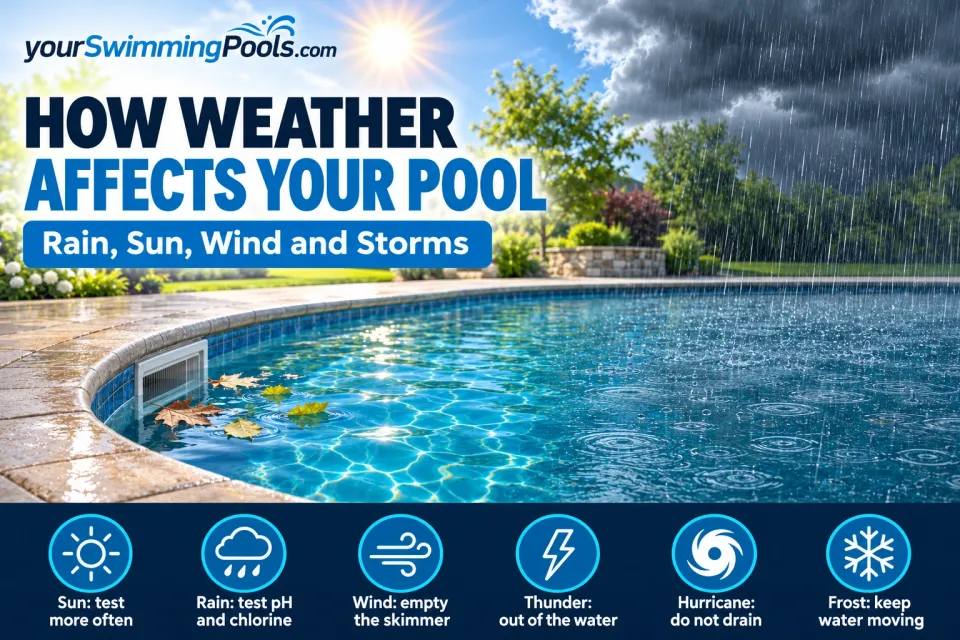
Your pool lives outside, so the weather does a fair share of your pool care for you, and not always in a helpful way. Sun burns off chlorine, rain waters the chemistry down, wind fills the skimmer, and a storm can do all three in an afternoon. This page goes through each kind of weather: what it does to the water, and what to do about it.
The short version: sunlight is one of the things that uses up chlorine (CDC), so test more on bright, hot days. Rain is slightly acidic (normal rain has a pH of about 5.6, EPA) while pool water should sit at 7.0 to 7.8 (CDC), so test pH and chlorine after a heavy downpour. Warm, dry and windy weather speeds up evaporation and blows in debris. Get out of the water when thunder roars (National Weather Service). And no weather forecast replaces a water test: only testing tells you your chlorine and pH.
Sun and heat: chlorine gets used up faster
The CDC lists sunlight among the things that reduce chlorine levels, along with what swimmers bring in (sweat, dirt and worse). Hot, sunny days usually mean both more sun and more swimmers, so chlorine can drop faster than on a cool, cloudy day (our reading). That is why many outdoor pools use cyanuric acid (stabilizer), which helps protect chlorine from the sun (our explanation). The CDC sets a higher chlorine minimum when it is used, and notes that disinfection takes longer in its presence.
The CDC's targets for home pools: pH 7.0 to 7.8 and at least 1 ppm free chlorine, or at least 2 ppm if you use cyanuric acid or stabilized chlorine (dichlor or trichlor). In a heat wave, test more often and run the pump long enough to keep the water circulating (our advice). When to run it: best time to run a pool pump.
Rain: diluted chlorine and a lower pH
Normal rain is slightly acidic: the EPA puts it at a pH of about 5.6, because carbon dioxide dissolves in it. Your pool water should be at 7.0 to 7.8. A light shower barely matters, but a heavy downpour adds a lot of slightly acidic, unchlorinated water to the pool, which can lower the pH and dilute the chlorine (our reading). Rain can also wash soil, leaves, fertilizer and lawn debris in from the deck and garden (our view).
After heavy rain (our advice):
- Empty the skimmer and pump baskets.
- Test free chlorine and pH, and correct them before swimming.
- If the water level rose above the middle of the skimmer opening, lower it again once the ground has drained. Pentair's SuperFlo VS manual asks for the water to be about halfway up the skimmer opening, so the pump does not pull in air.
- Brush and vacuum if dirt washed in, and keep an eye on clarity for a day or two.
How much rain is "a lot"? A rain gauge or weather station tells you how many inches actually fell on your pool, rather than at the nearest airport. How rainfall is measured and how to read a gauge: how rainfall is measured. If the water turns hazy afterward: cloudy pool water.
Wind, dry air and evaporation
Evaporation depends on the air around the water. The U.S. Geological Survey estimates evaporation from open water using air temperature, relative humidity, wind speed and solar radiation. In plain terms (our explanation): warm, sunny, dry and windy weather takes water out of your pool fastest; cool, humid, still weather slows it down.
Wind does a second job: it blows leaves, pollen and dust into the pool, straight into your skimmer. On windy days, empty the skimmer basket more often, because a full basket restricts flow (our advice). A cover cuts evaporation and keeps debris out when the pool is not in use (our view).
Losing more water than you expect? Run the bucket test before you assume a leak: why your pool is losing water. Keep the level halfway up the skimmer opening, so the pump does not pull in air (Pentair): why a pool pump loses prime.
Thunderstorms: get out of the water
The National Weather Service is clear: when thunder roars, go indoors, and stay there for 30 minutes after the last clap of thunder. Its lightning rules list pools among the water to get out of. The CDC adds that during a thunderstorm you should stay away from open spaces such as swimming pools. Pool maintenance can wait until the storm has passed.
Hurricanes and big storms
For major storms, the University of Florida's IFAS Extension gives clear advice for pool owners:
- Do not drain the pool, not even partly. Keep it full until the storm has passed and the surrounding ground has had time to drain.
- You may shock the pool before the storm arrives.
- Never put outdoor furniture or accessories in the pool to keep them from blowing away.
- As long as the power is still on, keep the pump running for as long as possible, and keep an eye on the skimmer basket and bottom drain, emptying them quickly to keep the circulation going. If the pump or its wiring ends up under water or damaged, leave it switched off until a pool professional or electrician has checked it (our advice).
After the storm, IFAS says: only start the clean-up once the area is safe, watch out for unexpected wildlife, remove debris before it can stain the pool finish, bring the water back down to about halfway up the skimmer once the area is fairly dry, never leave a draining pool unattended, and check the chemistry again once everything is clean. The pool will probably need another shock once the debris is out and the power is back on. Shock kills most bacteria, algae and viruses, but IFAS is clear that it never removes fertilizers or other chemicals that floodwater or runoff carried into the pool. So a shock alone does not make storm water safe to swim in.
Cold snaps and freezing nights
Pentair's SuperFlo manual says that in mild climates, when freezing conditions may occur for a short time, you can run the filtering equipment all night to prevent freezing. Water that keeps moving is less likely to freeze in the pump and pipes (our explanation). For a real winter, a pool needs closing properly: how to winterize a pool. If your pump has a freeze protection setting, its manual explains how to use it (our advice).
Which weather measurements actually help?
| Measurement | What it tells a pool owner | What to do |
|---|---|---|
| Rainfall (inches) | How much fresh, slightly acidic water just went in | After heavy rain: test pH and chlorine, check the water level |
| Temperature and sunshine | Days when chlorine is used up faster and more people swim | Test more often; check stabilizer if you use it |
| Wind speed | More evaporation and more debris | Empty baskets more often; use a cover when the pool is not in use |
| Humidity | Dry air speeds up evaporation | Expect to top up more; bucket test if in doubt |
| Freezing forecast | Risk of frozen pipes and pump | Keep water moving, or winterize for a real winter |
| Thunder and lightning | Danger in and around the pool | Out of the water; wait 30 minutes after the last thunder |
The table is our own summary of the sources on this page.
Can a home weather station help with pool care?
A little, and only for the weather side (our view). A backyard station measures what fell and blew on your pool rather than at the nearest airport: rainfall, wind, temperature and humidity. That helps you decide when to test after a downpour, when to expect more evaporation, and when a frost is coming. What it cannot do is measure your water. Chlorine and pH only come from a test: the CDC's advice for home pools is to test chlorine and pH at least twice a day, and more often when many people use the pool. So a weather station is a nice extra for keen owners, not a replacement for a test kit (our view). The weekly routine with the CDC values: weekly pool maintenance checklist.
Weather checklist for pool owners
- Hot, sunny spell: test chlorine and pH more often; keep the pump running long enough.
- Heavy rain: empty baskets, test pH and chlorine, lower the water level if it rose above mid-skimmer.
- Windy day: empty the skimmer basket more often; cover the pool when not in use.
- Dry, warm weeks: top up the water; bucket test if the level drops faster than you expect.
- Thunderstorm: everyone out of the water, wait 30 minutes after the last thunder.
- Hurricane warning: do not drain; nothing goes into the pool; shock beforehand if you want; clean up only when it is safe.
- Freezing night: keep the water moving, or winterize for a real winter.
This checklist is our own advice, built on the sources below. If the water turns green after a storm or a heat wave: green pool water.
Sources
Chlorine and pH targets, sunlight reducing chlorine, testing frequency: CDC: home pool and hot tub water treatment and testing. pH of normal rain: EPA: air, animals and plants. What evaporation estimates use: USGS: estimation of evaporation from open water (2012). Lightning: National Weather Service: lightning rules and CDC: lightning safety. Storms: UF/IFAS Extension: pools and hurricanes. Water level halfway up the skimmer: Pentair SuperFlo VS manual. Freezing nights: Pentair SuperFlo manual. Points marked as ours are our own advice, view or explanation.
Frequently asked questions
Does rain affect pool chlorine?
Normal rain is slightly acidic (pH about 5.6, EPA), and heavy rain adds a lot of unchlorinated water, so it can lower the pH and dilute the chlorine (our reading). Test both after a downpour.
Does sunlight affect pool chlorine?
Yes. The CDC lists sunlight among the things that reduce chlorine levels. Many outdoor pools use cyanuric acid (stabilizer) to help protect chlorine from the sun (our explanation).
Should I drain my pool before a hurricane?
No. UF/IFAS Extension advises not to drain the pool, not even partly, and to keep it full until the storm has passed and the ground has drained.
Can I swim during a thunderstorm?
No. The National Weather Service lists pools among the water to get out of: go indoors when thunder roars and wait 30 minutes after the last thunder.
Why does my pool lose more water in some weather?
The USGS estimates evaporation from air temperature, humidity, wind speed and sunshine; in practice warm, sunny, dry and windy weather takes the most water (our explanation). Use the bucket test to tell evaporation from a leak.
Do I need a weather station for my pool?
No. It can tell you how much rain fell and how windy it got at your house, but it cannot measure chlorine or pH. A test kit does that.
