
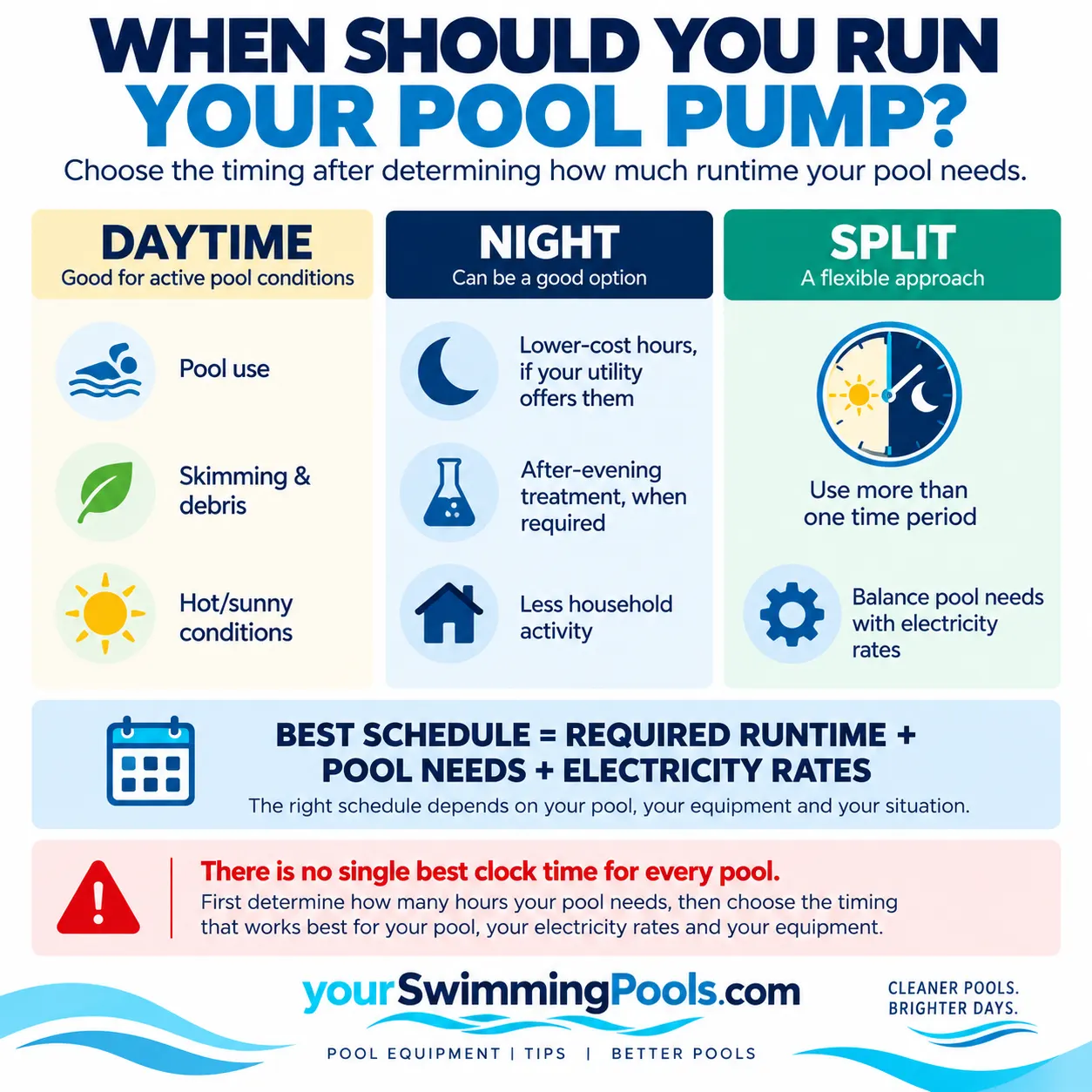
There is no single best clock time for every pool. Before deciding when to run the pump, settle how long it needs to run. Once you know the required daily hours, schedule them around your pool’s actual conditions and your electricity costs.
What is the best time to run a pool pump?
It depends on four things you need to check for your own pool:
- Your electricity tariff. If your utility charges time-of-use rates, running the pump during off-peak hours (often overnight) can reduce your electricity bill without reducing total circulation. If your tariff is flat-rate, timing has no effect on cost.
- When your pool is in use. Running the pump while swimmers are in the water distributes sanitizer and skims debris while the load is heaviest.
- Daytime heat and sunlight. Sunlight degrades chlorine faster. Hot water increases sanitizer demand. Running the pump during the day moves fresh treated water through the pool while these conditions are active.
- When you add chemicals. If a chemical’s label requires circulation after dosing, the pump needs to run after that treatment, regardless of the time of day.
Pool pump day vs night: a direct comparison
| Daytime | Nighttime | Split schedule | |
|---|---|---|---|
| Electricity cost | May be peak-rate hours | May coincide with off-peak rates | Can capture off-peak savings while keeping daytime coverage |
| Circulation during use | Good: pump runs while swimmers are in the pool | Limited: pool often unoccupied at night | Good: some hours during use, rest overnight |
| Skimming | Good: debris enters the pool during the day | Misses peak debris hours | Partial: morning hours catch debris from previous night |
| Sanitizer distribution | Useful: circulates treatment while sunlight is degrading it | Useful after evening chemical dosing | Flexible: can time runs around chemical additions |
| Noise | Some households prefer quieter daytime | Quieter if no one is outside | Adjustable |
| Best fit | Pools with regular daytime use, heavy daytime debris, or flat-rate electricity | Pools where off-peak rates apply and daytime use is low | Most residential pools where some flexibility is available |
Should you run your pool pump during the day?
Daytime operation makes the most practical sense when:
- The pool is actively used during the day and you want circulation and skimming while swimmers are in the water
- Your area has high daytime temperatures that accelerate sanitizer loss and algae growth
- Wind, trees, or other debris sources load the pool during the day and the skimmer needs to be running to capture it
- Your pool has water features, fountains, or a cleaner that operates on a daytime schedule
- Your electricity tariff does not charge more during the day (flat-rate pricing)
If the pool is mainly used during the afternoon and evening, keeping the pump running for at least part of that period means the filtration system is working while the bather load is highest.
Should you run your pool pump at night?
Nighttime operation can make sense when:
- Your electricity utility offers lower time-of-use rates during overnight hours. Check your actual tariff, not a general assumption. Not all utilities use time-of-use pricing and rates vary by provider, region, and plan.
- You add chemicals in the evening and want the pump to circulate them after dosing. Running the pump for several hours after an evening shock or chemical treatment helps distribute it through the pool.
- The pool is not used much during the day and there is no compelling reason for daytime circulation.
- Your household prefers quieter conditions during the day.
A common misunderstanding is that nighttime operation is automatically cheaper or better for the pump. Neither is universally true. Lower rates depend on your specific electricity plan. Pump longevity depends on maintenance and operating conditions, not on what time of day it runs.
What about a split schedule?
A split schedule divides the daily runtime across two or more time periods. This is often the most practical approach for residential pools because it lets you balance competing priorities.
For example, a pool that needs several hours of runtime per day might run for a portion in the morning, covering overnight debris and early swimming activity, and the remainder in the late afternoon or evening when pool use is highest. If the electricity tariff has a cheaper overnight rate, some hours can shift there as well.
Most timer-equipped pumps and pool automation systems can handle split schedules. Variable-speed pumps often have their own programmable schedules built in.
There is no correct split that applies to every pool. Build your schedule around your pool’s actual runtime needs first, then arrange the hours where they provide the most benefit.
What is the best pool pump schedule in summer?
Hot weather, longer sunny days, and heavier pool use all increase circulation demands. Sanitizer breaks down faster in warm water and bright sunlight. More swimmers mean more organic load. The total runtime your pool needs in peak summer is often higher than in spring or autumn.
Before adjusting timing, confirm the total hours are sufficient. If water quality is slipping in summer, the first question is whether the pump is running long enough, not whether it is running at the right time of day. Use the pool pump runtime calculator to check whether your current runtime covers your pool volume and flow rate adequately for the conditions.
Once runtime is confirmed, summer scheduling usually favors keeping at least part of the pump’s hours during the hottest part of the day so the filtration system is working when sanitizer demand is highest.
Should a variable-speed pump run at different times?
Variable-speed pumps can run at different speeds for different tasks, and many have built-in scheduling so you can program when each speed runs. This is separate from simply deciding day versus night.
A typical variable-speed schedule might run at a lower speed for the majority of daily runtime to cover basic circulation, then switch to a higher speed briefly for tasks like running a cleaner, boosting a water feature, or hitting a faster flow rate for a specific period.
The right speed for each period depends on the pump model, your plumbing, the connected equipment, and the flow required. There is no universal RPM schedule that applies to every system. If you have a variable-speed pump, consult its documentation or programming interface for guidance on setting speed schedules. The variable-speed pumps page covers the principles.
When should you run the pump after adding chemicals?
Follow the product label. Chemical manufacturer instructions specify how long to circulate after dosing, and those instructions exist for reasons related to both effectiveness and safety. Do not substitute a general rule for the label directions.
As a general principle, the pump needs to run after adding any chemical that requires distribution through the pool. This means scheduling a run period after an evening shock dose, an algaecide treatment, or any product that needs to be circulated to work correctly. If your treatment schedule is in the evening, that evening run period should be part of your daily pump schedule.
Should a pool pump run 24 hours a day?
Continuous operation is not automatically necessary for most residential pools. A well-designed schedule that covers the required turnover at the appropriate times is usually sufficient.
That said, some situations justify extended or continuous operation: a significant algae problem where continuous circulation is part of the treatment, very hot weather combined with heavy use that pushes up water-care demands, or a variable-speed pump running at very low speed where long runtime is needed to complete adequate circulation at low cost.
Before running the pump continuously as a default, check whether the total daily runtime is actually sufficient. If it is, timing adjustment rather than continuous operation is usually the answer. The how long to run your pool pump article and the runtime calculator help with that.
Choose your pump schedule: a practical decision process
Example schedules
These are illustrative examples only. They are not universal recommendations.
Example A: flat-rate electricity, regular daytime use
Pool used afternoons and evenings. Electricity is flat-rate so timing has no cost effect.
Approach: Run the full required hours during the afternoon and early evening, coinciding with pool use and peak heat. Simple, no splitting needed.
Example B: time-of-use pricing, off-peak overnight
Electricity is cheaper from 11pm to 7am. Pool is lightly used on weekday mornings.
Approach: Run the majority of hours overnight in the off-peak window. Add a short daytime period to cover skimming and active circulation during any weekend use. Check water quality weekly and adjust if needed.
Example C: variable-speed pump
Pump is programmed with low speed for most hours and higher speed for a mid-afternoon circulation boost.
Approach: Program the low-speed run across overnight and early morning hours when rates are lower. Set a higher-speed period in the afternoon during peak pool use. Total energy cost is lower than a single-speed pump even with more total hours.
Example D: heavy summer use
Pool used daily, temperatures consistently high, sanitizer demand elevated.
Approach: Increase total runtime to account for higher demand (confirm with runtime calculator). Run a significant portion during the hottest part of the day. Evening run after chemical dosing. Monitor chemistry closely and adjust runtime if water quality slips.
Schedule helper: what fits your situation?
Answer three questions for a scheduling suggestion
How do you know if your schedule is working?
These signs suggest your schedule is adequate:
- Water stays clear and has no persistent haze or cloudiness
- Water chemistry remains stable between maintenance sessions
- The skimmer surface is pulling debris effectively
- Filter pressure behaves normally and does not spike rapidly between cleanings
- No persistent dead spots or visibly poor circulation in any part of the pool
If water quality is poor, changing the clock time rarely fixes it on its own. Work through this sequence first: confirm total runtime is sufficient, check filter condition, check water chemistry, check pump and system flow. For filter and pump diagnostic guidance, see pool filter maintenance and pool pump problems.
Frequently asked questions
What is the best time of day to run a pool pump? There is no single answer. The best time depends on your electricity tariff, when the pool is in use, daytime temperature and debris, and when you add chemicals. First determine how many hours the pump needs to run, then schedule those hours to match your specific conditions.
Is it better to run a pool pump during the day or at night? Neither is universally better. Daytime is better for covering active pool use, skimming, and circulation during hot, sunny conditions. Nighttime can reduce electricity cost if your utility offers off-peak rates. Many pools benefit from a split schedule that covers both.
Should I run my pool pump at night? Only if it fits your pool’s needs. If your electricity tariff has cheaper overnight rates and the pool is not in heavy use during the day, running at night can save money. If you have no time-of-use pricing advantage and the pool is actively used during the day, daytime or a split schedule is usually more practical.
Can I split my pool pump runtime into two periods? Yes, and for many pools this is the most effective approach. A split schedule lets you capture off-peak electricity rates while still providing daytime circulation during pool use or peak heat. Most timers and pool automation systems support multiple run periods.
Should I run my pool pump during peak electricity hours? If you have time-of-use pricing, running during peak hours costs more per kWh. If you can shift some runtime to off-peak hours without sacrificing water quality, that saves money. But do not reduce total runtime below what your pool actually needs just to avoid peak hours. Water quality comes first.
Should a pool pump run 24 hours a day? Not automatically. Most residential pools do not need continuous operation. Extended or continuous runtime may be justified for specific situations such as an algae outbreak, very high summer demand, or a variable-speed pump running at a very low speed. Calculate your actual required runtime first.
Should I run my pool pump after adding chemicals? Follow the product label instructions. Chemical treatments require circulation to distribute them through the pool. If a product’s instructions specify a run period after dosing, schedule that run period regardless of what time of day it falls.
Do I need to run my pool pump longer in summer? Often yes. Higher temperatures, more intense sunlight, and heavier bather loads increase water-care demands. If water quality is harder to maintain in summer, check whether total runtime is sufficient before adjusting timing. The runtime calculator helps with this.
How do I calculate how long my pool pump should run? Divide your pool volume by your actual system flow rate in GPM, then multiply by your target turnovers per day. Use the pool pump runtime calculator for a quick estimate, or see how long to run your pool pump for the full explanation.
