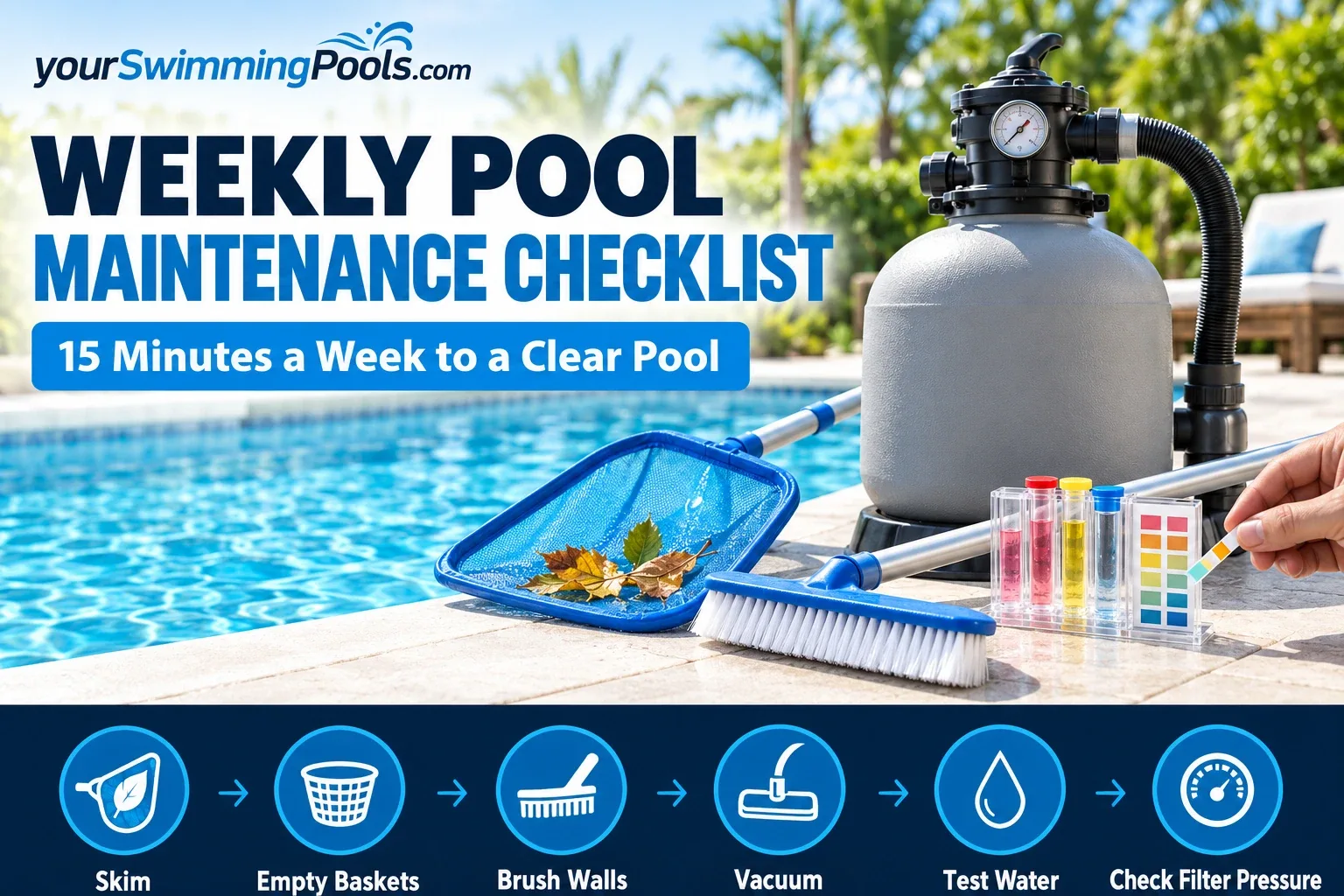
A clear pool is mostly the result of a short routine done every week, not of big rescues. This checklist puts that routine in the order that works best, says which tasks are weekly and which are not, and gives the water values from the CDC so you know what you are testing for.
The short version: once a week, skim the surface, empty the skimmer and pump baskets, brush the walls, vacuum the floor, check the water level and the filter pressure, and test the water. Chlorine and pH are the exception: the CDC recommends testing those at least twice a day, not once a week. Aim for at least 1 ppm free chlorine (2 ppm if you use stabilizer) and a pH of 7.0 to 7.8.
The weekly checklist
Do the tasks in this order (our routine). Cleaning first stirs up debris and lets the filter catch it; testing after the cleaning gives you a reading of the water as it really is after the work.
| Step | Task | Why it matters |
|---|---|---|
| 1 | Skim the surface | Leaves and bugs sink and stain if you leave them. Skimming more often than weekly is fine. |
| 2 | Empty the skimmer baskets | A full basket cuts the flow to the pump and the filter. |
| 3 | Empty the pump strainer basket | Turn the pump off first. A clogged strainer is one of the things to check when a pump loses prime (our advice). |
| 4 | Brush walls, steps and the waterline | Brushing loosens the film that algae starts from, in corners and behind ladders where the cleaner does not reach. |
| 5 | Vacuum the floor | Removes what brushing knocked down. A robotic or suction cleaner can do this part. |
| 6 | Check the water level | Too low and the skimmer pulls air; too high and it stops skimming (our advice). Your skimmer's instructions give the right level. |
| 7 | Test and adjust the water | Free chlorine and pH first, then the other values (see below). Adjust one thing at a time and follow the product label. |
| 8 | Check the filter pressure | Compare it with your clean starting pressure. Pentair's training material: clean a sand filter when the gauge is usually 5 to 10 psi above that starting pressure, a cartridge filter at about 10 psi. |
How long this takes depends on your pool and your trees. For a small backyard pool with few leaves it is about 15 minutes a week (our estimate); a larger pool, leaf season or a storm can double that.
Chlorine and pH are not weekly tasks
This is the part most weekly checklists get wrong. The CDC's guidance for home pools says to test chlorine and pH at least twice per day, and more often when a lot of people are using the pool. Chlorine gets used up by sunlight, swimmers and debris, so a level that was fine on Saturday can be gone by Tuesday (our explanation, not from the CDC).
What the CDC recommends for home pools:
| Value | CDC recommendation |
|---|---|
| Free chlorine | At least 1 ppm |
| Free chlorine, with stabilizer | At least 2 ppm (when you use cyanuric acid, or dichlor or trichlor products) |
| pH | 7.0 to 7.8 |
Two testing tips from the same CDC page: a DPD test kit gives the most accurate results, test strips are less accurate; and if the chlorine is above 10 ppm, the test can bleach out and show a false low or zero reading. Always follow the directions of your test kit.
Need a test kit? A DPD kit is the type the CDC calls the most accurate. As an Amazon Associate we earn from qualifying purchases: see DPD pool test kits on Amazon.
The other water values: total alkalinity, calcium and stabilizer
Total alkalinity, calcium hardness and cyanuric acid (stabilizer) usually change more slowly than chlorine, so we test them at the weekly session (our routine; your test kit may advise otherwise). We do not give one set of target numbers here on purpose: the published ranges differ between test kit makers, pool builders and pool surfaces (plaster, vinyl, fiberglass). Use the target ranges printed in your test kit's instructions or in your pool's manual, and stick with one source so your readings stay comparable.
Run the pump long enough
Cleaning only works if the water passes through the filter. Pool professionals talk about turnover: the time it takes to move the whole pool volume through the filter once. Pentair's training material explains it this way: a pool that is turned over three times in 24 hours has an 8-hour turnover. How many hours that takes for your pool depends on its size and your pump's actual flow; the pump runtime calculator works it out, and how long to run a pool pump explains the trade-offs.
Filter care: on pressure, not on a calendar
The weekly pressure check tells you when the filter needs attention. Write down the pressure right after a cleaning (your clean starting pressure). Pentair's training material puts the cleaning point at usually 5 to 10 psi above that starting pressure for a sand filter, and at about 10 psi for a cartridge filter. Cleaning much earlier is not needed: the same material explains that a filter catches finer dirt as it gets dirtier, and every backwash also uses water.
- Sand filter: how to backwash a pool sand filter.
- Cartridge filter: when to replace a pool filter cartridge.
- Pressure high right after cleaning? See what high pool filter pressure means.
Beyond weekly: monthly and seasonal tasks
| How often | Task |
|---|---|
| At least twice a day (CDC) | Test free chlorine and pH |
| Weekly | The eight steps above |
| When the pressure says so | Backwash the sand filter or clean the cartridge |
| Monthly (our routine) | Look over the pump lid O-ring and other seals for cracks or flattening; see pool O-rings and gaskets |
| After heavy use or a storm | Extra skimming and brushing, and test the water again |
| Once a season | Opening and closing the pool (see how to winterize a pool), and checking the filter media (sand or cartridge) |
Common mistakes
- Testing chlorine only once a week. The CDC says at least twice a day.
- Testing right after adding chemicals. Let the water circulate first and follow the product label for the waiting time.
- Opening the pump basket with the pump running. Always switch the pump off first.
- Backwashing every week out of habit. Let the pressure gauge decide.
- Skipping the brush because there is a robot cleaner. Many cleaners focus on the floor; steps, corners and the waterline still need a brush (our advice).
- Chasing several values at once. Adjust one value, let the water circulate, then test again.
Sources
Chlorine and pH values, testing frequency, DPD versus test strips and the bleach-out warning: CDC, Home Pool and Hot Tub Water Treatment and Testing. Turnover and the 10 psi cleaning point: Pentair and Sta-Rite pool training material. The order of the weekly tasks, the time estimate, the monthly seal check and the practical tips marked as ours are our own routine and advice, not from these sources; where your equipment manual says something different, follow the manual.
Frequently asked questions
How often should I clean my pool?
Skim, empty the baskets, brush and vacuum once a week, and more often after storms or heavy use. Test chlorine and pH at least twice a day, as the CDC recommends for home pools.
What should my chlorine and pH be?
The CDC recommends at least 1 ppm free chlorine (at least 2 ppm if you use stabilizer or dichlor/trichlor products) and a pH of 7.0 to 7.8 for home pools.
How long does weekly pool maintenance take?
For a small backyard pool with few leaves, about 15 minutes a week by our estimate, plus the short daily water tests. A larger pool, many trees or a storm can double that.
Do I still need to brush if I have a robotic cleaner?
Yes, a quick brush of the steps, corners and waterline once a week (our advice). Many cleaners focus on the floor and can miss those spots.
When should I clean the filter?
When the pressure gauge rises above your clean starting pressure: usually 5 to 10 psi for a sand filter and about 10 psi for a cartridge filter, according to Pentair's training material. Not on a fixed weekly schedule.
