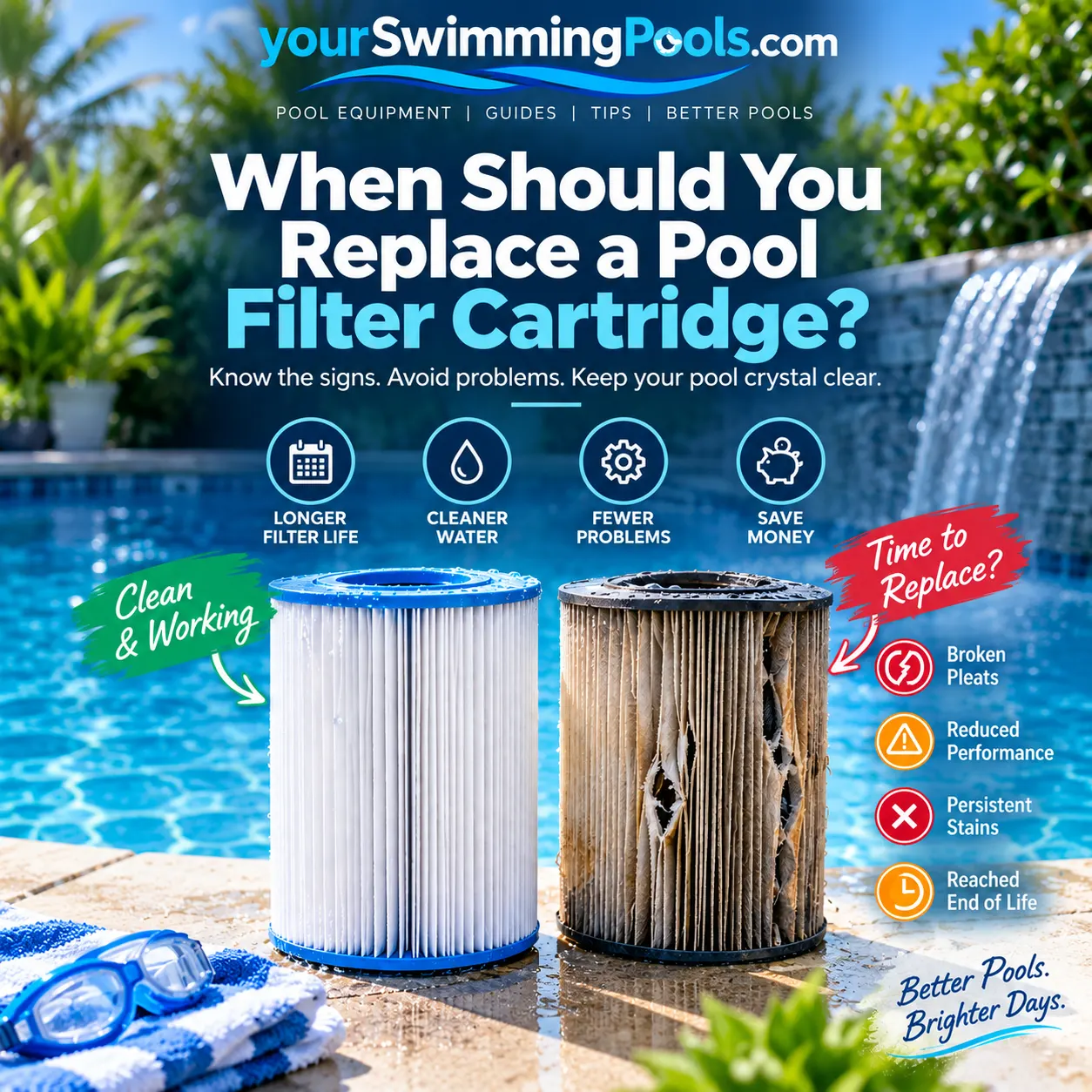
A pool filter cartridge does not come with a fixed expiry date. Whether yours needs replacing this season or next depends on how much work it has done, how it has been treated, and what it looks like now. This page helps you make that call correctly.
The core distinction is straightforward. Clean the cartridge when cleaning restores normal performance. Replace it when cleaning no longer restores performance, or when physical damage makes further use pointless.
Everything else flows from that principle.
How long does a pool filter cartridge last?
Typical residential cartridge life is one to three years, but that range is wide enough to be nearly useless on its own. A cartridge in a lightly loaded, well-maintained pool with correct water chemistry and the right filter sizing can last considerably longer. One in an undersized filter running a large, heavily used pool may need replacing far sooner.
The variables that actually determine lifespan include pool volume and bather load, the amount of debris the pool collects, how many hours per day the filter runs, water chemistry (persistent chemistry issues can affect cartridge condition and filtration performance), how frequently and how thoroughly the cartridge is cleaned, cartridge quality and construction, ambient conditions such as sun exposure and heat, and whether the filter is correctly sized for the pool’s flow requirements.
If your filter is undersized for your pool, the cartridge works harder and fails sooner regardless of how carefully you maintain it. The pool filter sizing page covers how to check whether your filter is matched correctly to your pool.
The practical takeaway: treat lifespan as a range to monitor rather than a fixed schedule. A cartridge that was cleaned two months ago and is already causing pressure problems needs investigating. One that is two years old but cleaning easily and performing well is not automatically due for replacement.
Signs your cartridge needs replacing
These are the signals that replacement is the right answer rather than another cleaning cycle.
Pressure rises quickly after cleaning. A freshly cleaned cartridge that returns to high pressure within a few days, or faster than before, is a strong signal that the media is compromised. The pleats may have lost their ability to shed debris effectively, or the material may be so saturated with oils and fine particles that rinsing can no longer clear it. If a thorough cleaning including a chemical soak does not extend the cleaning interval, the cartridge is past its useful life.
Cleaning no longer restores performance. This is the clearest sign. After a proper clean, filter pressure should return close to your clean baseline and water clarity should improve. If neither happens, the cartridge is the likely cause. Confirm that the pump, valves, and baskets are not contributing before concluding the cartridge is at fault.
Water stays cloudy despite correct chemistry and normal pressure. A cartridge that can no longer capture fine particles will let them pass back into the pool. If you have confirmed that water chemistry is correct and the filtration system is otherwise working, a worn or blocked cartridge media is a likely culprit.
Physical damage to the pleats. Torn, collapsed, or permanently deformed pleats cannot be repaired and do not respond to cleaning. Even a single significant tear in the filter media lets particles bypass the filtration entirely.
Cracked or damaged end caps. The plastic or composite end caps seal the top and bottom of the cartridge. A crack allows water to pass around the filter media rather than through it. Replace on sight.
The cartridge collapses or is misshapen. A cartridge that can no longer hold its cylindrical shape under operating pressure has structural failure in the core or media. It is not filtering correctly and should be replaced.
Persistent staining that cleaning cannot remove. Some discoloration is normal and harmless. Dark, heavy staining that does not respond to a chemical soak, particularly staining from metals, oils, or algae, can permanently clog the media pores and reduce filtration capacity. If multiple proper cleaning cycles have not removed it, replacement is the more practical choice.
The cartridge gets dirty unusually fast. A cartridge that requires cleaning every few days rather than every few weeks is either in a pool with a filtration problem (chemistry, circulation, debris load) or has degraded to the point where it cannot hold a cleaning cycle. Investigate other causes first, but if the cartridge continues to load rapidly after other causes are addressed, replacement is reasonable.
Should I clean or replace? A decision flow
Use this sequence before ordering a replacement.
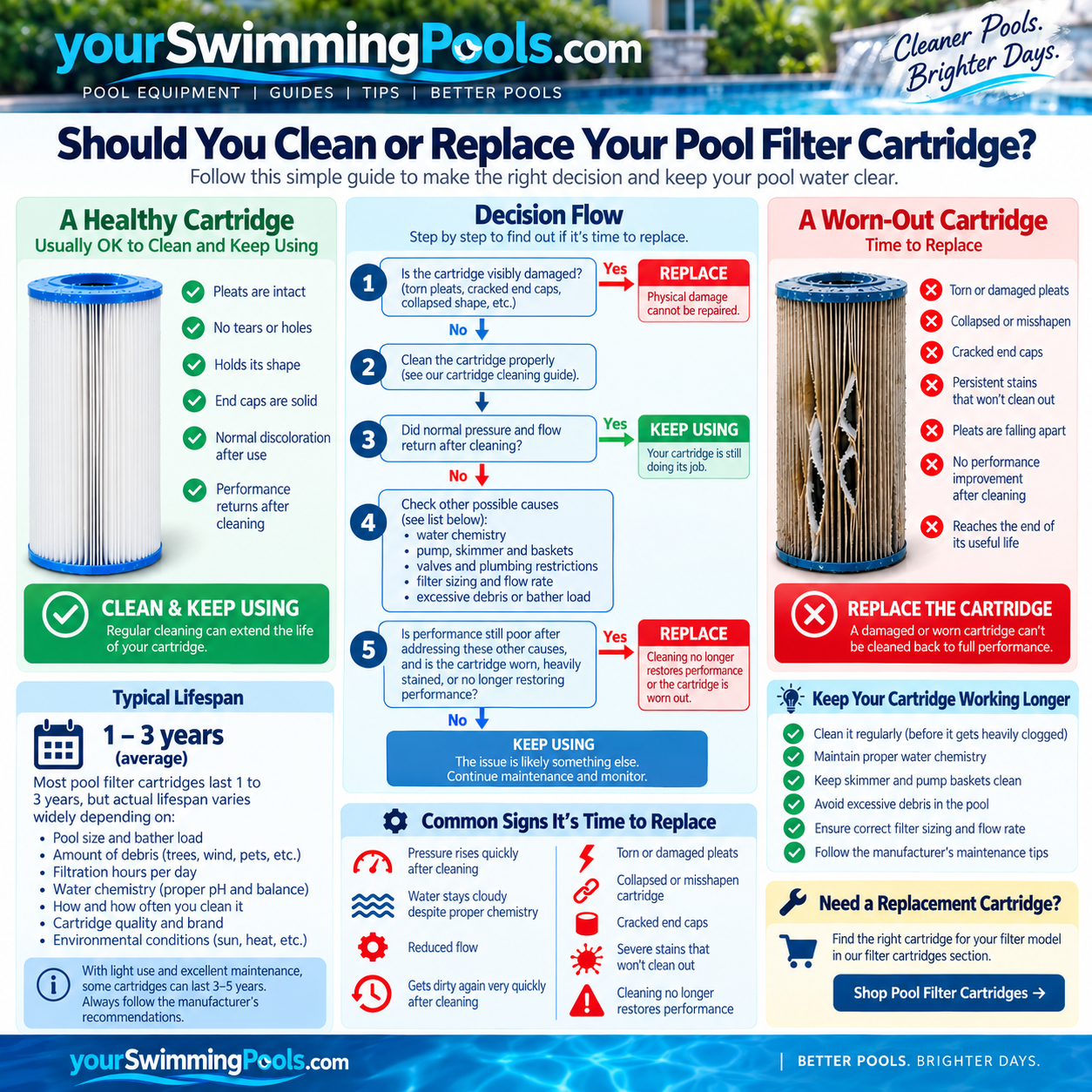
The decision flow works as follows. If the cartridge is visibly damaged (torn pleats, cracked end caps, collapsed shape), replace it. Cleaning does not fix physical damage.
If there is no visible damage, clean the cartridge properly, including a soak if oils or fine buildup are suspected. Then check whether pressure and flow return to near your clean baseline. If they do, the cartridge is still serviceable. Keep using it and monitor.
If performance does not return after a proper clean, check other causes before assuming the cartridge is the problem. Restricted flow, pump issues, partially closed valves, clogged baskets, and water chemistry problems can all cause symptoms that look like cartridge failure. For a full diagnostic sequence, the pool filter maintenance page and high filter pressure page cover these in detail.
If other causes have been addressed and the cartridge still cannot restore performance, and the cartridge is heavily stained or worn, replacement is the right call.
Cleaning versus replacing: a decision table
| Symptom | Try this first | Replace when |
|---|---|---|
| High filter pressure | Clean the cartridge | Pressure returns quickly after a thorough clean |
| Reduced flow | Check pump, baskets, valves, then clean | Cartridge remains restrictive after proper cleaning |
| Cartridge is dirty | Clean | Cannot be restored to near-clean condition |
| Pressure rises quickly after cleaning | Chemical soak, then re-check | Cleaning interval has shortened to days |
| Cloudy water | Check chemistry and circulation first | Cartridge confirmed as the cause after eliminating other issues |
| Damaged pleats | Replace | No cleaning alternative |
| Cracked end caps | Replace | No cleaning alternative |
| Collapsed or misshapen cartridge | Replace | No cleaning alternative |
| Severe staining that won’t clean out | Chemical soak attempt | Soak does not restore the media |
How to inspect a cartridge before deciding
Pull the cartridge and lay it on a clean surface in good light. Work through this list before deciding whether to clean or replace.
Look at the pleats from above and from the side. They should fan evenly and hold their spacing. Crushed, collapsed, or bent pleats that do not spring back indicate structural wear. A single torn pleat is enough reason to replace.
Run a finger along the outer surface of the pleated media. It should feel uniform. Rough patches, thin spots, or areas where the material has separated indicate degradation.
Inspect both end caps where they meet the media. Any crack, chip, or gap between the cap and the media is a bypass path and a replacement trigger.
Hold the cartridge upright and look at its overall shape. It should be a clean cylinder. Any distortion, bulging, or collapse of the core points to structural failure.
Look at the core (the central tube the media wraps around). Cracks in the core allow water to bypass the media entirely.
If you find visible damage anywhere, replace the cartridge. Do not attempt repairs with silicone or adhesive on pool filter media. The repair will not hold under operating pressure and will leave you uncertain about filtration integrity.
If the cartridge passes the inspection, clean it. A good cleaning inspection article is on the way as page #10 in this series.
Cartridge lifespan by usage pattern
Two pools with identical filters can have very different cartridge life because of how they are used.
A cartridge in a pool with low bather load, good water chemistry, minimal debris, and regular cleaning (before it becomes heavily clogged) can last toward the longer end of the typical range. A cartridge in a pool with high bather load, trees dropping debris, water that regularly runs out of balance, or a filter that is undersized for the pool’s volume will wear faster.
The cleaning pattern matters too. Cleaning too infrequently lets the cartridge load so heavily that each cleaning cycle removes less, shortening the overall lifespan. Cleaning too aggressively with high-pressure hosing can damage the pleated media and accelerate physical wear.
There is no universal replacement schedule that accounts for all of these variables. The pressure gauge, the cleaning interval, and the physical condition of the cartridge are better indicators than the calendar. If your cartridge is two years old and still cleaning well, that is a reason to monitor, not replace.
Can you keep using an old cartridge?
Running a cartridge beyond its useful life has real consequences. A worn cartridge that cannot filter effectively lets fine particles circulate continuously. This makes it harder to maintain water clarity, increases chemical demand, and may allow algae to establish. Continued use of a damaged cartridge means water is bypassing the filtration media entirely.
That said, replacing a cartridge that can still be cleaned and restored is an unnecessary cost. If the inspection shows no physical damage and a proper clean restores pressure and flow to near-normal, the cartridge has more life in it.
The false economy runs in both directions. Do not keep a worn cartridge to save money, and do not replace a functioning one on a fixed calendar.
What does a replacement cartridge cost?
Replacement cartridge cost varies considerably by filter model and cartridge size. A small above-ground filter cartridge (such as those used in Intex or Bestway units) typically costs less than a full-size in-ground cartridge. Larger cartridge filter systems may use multiple cartridges.
Match the replacement to your specific filter model rather than buying by size alone. Different manufacturers use different end cap designs and pleat configurations. The filter model number is on the filter housing label. Use that to search for the correct replacement rather than measuring the old cartridge, which may have deformed with use.
Find your replacement cartridge
Search by your filter model number on Amazon to find the correct replacement cartridge for your specific unit.
Find Your Cartridge on Amazon →As an Amazon Associate we earn from qualifying purchases.
How to make your next cartridge last longer
The same practices that extend cartridge life also improve water quality and reduce overall maintenance effort.
Clean before the cartridge is heavily clogged. A cartridge cleaned at a moderate pressure rise (8 to 10 psi above your clean baseline) comes much cleaner than one left until pressure is very high. Heavy loading pushes oils and fine particles deep into the media where rinsing cannot reach them. For pressure-based cleaning guidance, see the filter maintenance page.
Keep water chemistry balanced. Persistent chemistry problems can affect cartridge condition and filtration performance. Maintaining balanced chemistry also reduces the organic load the cartridge has to capture.
Keep skimmer and pump baskets clean. Debris that reaches the cartridge accelerates loading. Clean baskets prevent larger material from reaching the filter and reduce the overall burden.
Do not use a high-pressure hose directly on the pleats. Rinsing with a standard garden hose held at an angle works well. High-pressure washing can flatten and permanently distort the pleats, reducing the effective filter surface area and shortening life.
Confirm your filter is correctly sized. An undersized filter relative to your pool volume and pump flow rate runs harder and loads faster. A correctly sized system filters more effectively and the cartridge lasts longer. The pool filter size calculator can confirm whether your setup is matched correctly.
Use a chemical soak periodically. A commercial filter cleaner soak dissolves the oils and scale that a hose cannot remove. This is particularly important for pools with high bather load or water that tends toward scale. How often depends on use, but once per season is a reasonable baseline for most pools.
Keep a spare cartridge. Having a replacement on hand means you can swap immediately when cleaning is needed and clean the old one without leaving the pool unfiltered. Leaving a pool without filtration during cleaning is more likely to cause a water quality problem that puts additional strain on the cartridge when it goes back in.
What manufacturers say about cleaning pressure
The 8 to 10 psi pressure rise threshold used throughout this page comes from manufacturer documentation, not from a universal industry standard. It is worth knowing where the number comes from and where it varies.
Pentair’s current documentation for its Clean and Clear Plus cartridge filters specifies cleaning when pressure reaches 10 psi above the clean starting pressure. Their Clean and Clear RP documentation uses a range of 8 to 10 psi above starting pressure. Both Pentair documents emphasize that the baseline is your filter’s own clean starting pressure at installation, not a fixed absolute reading.
Pentair also specifically documents soaking cartridges to remove oils such as suntan lotion that a rinse cannot clear, which supports the chemical soak recommendation above.
The consistent point across manufacturer documentation is that the cleaning trigger is relative to your filter’s own starting pressure, not a number you look up in a table. Note your pressure gauge reading when the filter is freshly cleaned and running normally. That is your baseline. A rise of 8 to 10 psi above that baseline is the standard signal.
Your specific filter’s manual takes priority over any general figure. Manufacturer documentation for your model may specify a different threshold.
Frequently asked questions
How often should a pool filter cartridge be replaced? There is no fixed interval that fits every pool. The practical answer is: replace it when cleaning no longer restores normal pressure and flow, or when the cartridge shows physical damage. Many residential cartridges last one to three years under typical conditions, but lighter use and good maintenance can extend that, and heavier use can shorten it.
How do I know if my pool filter cartridge is bad? The clearest signs are pressure that rises quickly after a proper clean, a cartridge that cannot be restored to near-clean condition, and visible physical damage such as torn pleats, cracked end caps, or a collapsed shape. Any of these is a replacement trigger.
Can a pool filter cartridge be cleaned instead of replaced? Yes, until it cannot. Cleaning restores cartridge performance as long as the media and structure are intact. When cleaning no longer restores performance, or when the cartridge has physical damage, replacement is necessary.
Why does my pool filter pressure rise so quickly? Rapid pressure rise after cleaning usually means the cartridge can no longer shed debris effectively, the pool has a high debris or organic load, the filter is undersized for the pool, or there is a water chemistry problem contributing to media clogging. Check cartridge condition, filter sizing, water chemistry, and pool debris load before concluding the cartridge is the only cause.
Can a damaged cartridge be repaired? No practical repair exists for a pool filter cartridge. Torn pleats, cracked end caps, and collapsed cores cannot be reliably fixed. A cartridge with physical damage should be replaced.
What happens if I keep using an old cartridge? A worn or damaged cartridge that cannot filter effectively lets particles circulate continuously, makes water clarity harder to maintain, increases chemical demand, and can allow algae to take hold. A physically damaged cartridge allows water to bypass the filter media entirely.
How much does a pool filter cartridge replacement cost? Replacement cost varies widely by filter model and cartridge size. Small above-ground cartridges cost significantly less than large in-ground cartridges. Some in-ground systems use multiple cartridges. Match by your filter model number for the correct part, not by size or appearance.
For cartridge filter comparisons and recommendations, see the cartridge filters page. For finding replacement filter cartridges by model, see the filter cartridges page.
