Pool pumps
Pool Pump Runtime Calculator
Enter your pool volume, your actual system flow rate, and how many turnovers you want per day. The calculator gives you an estimated daily runtime, turnover time, and optional electricity cost estimate.
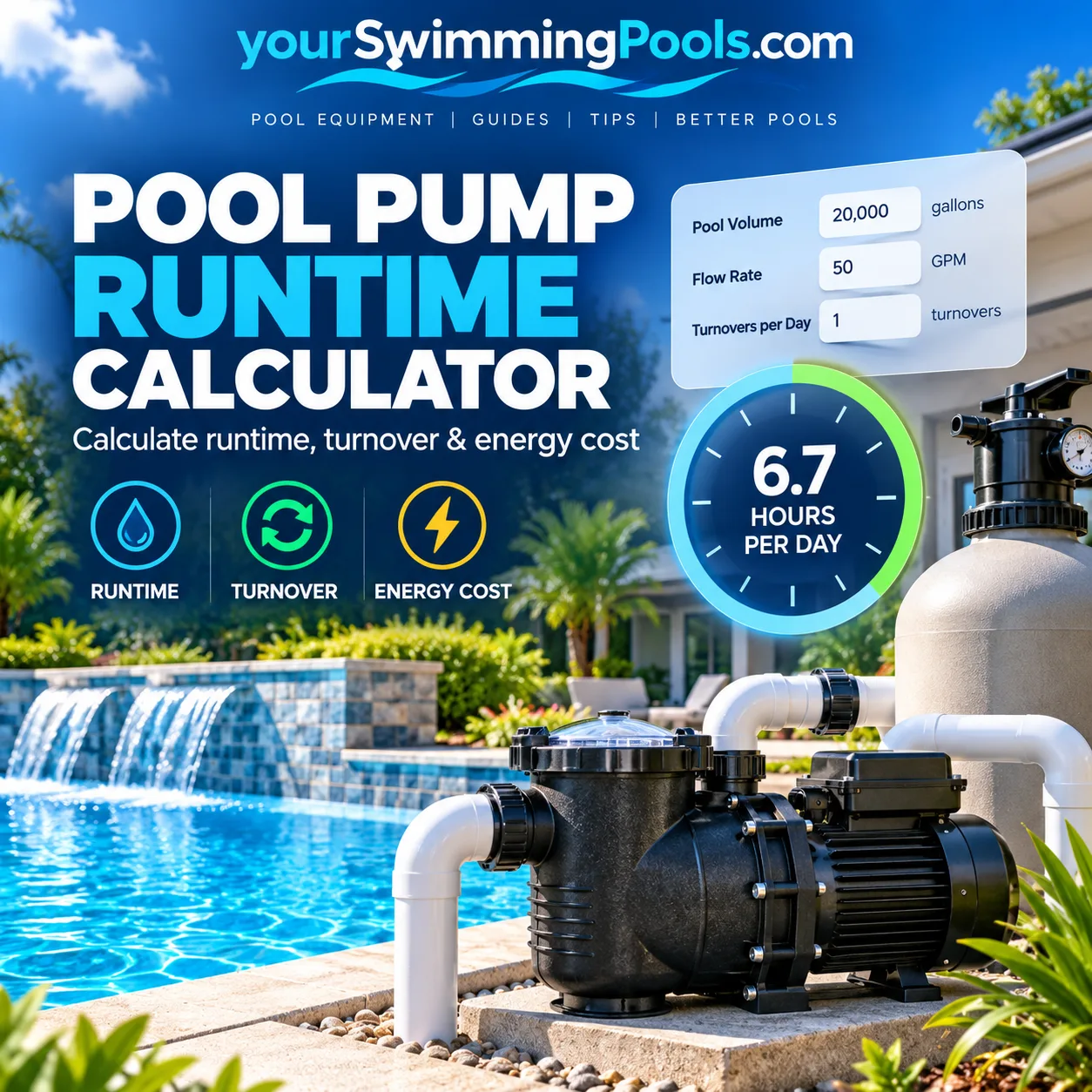
Your pool details
Don't know your pool volume? Calculate it
Length (ft) × Width (ft) × Avg Depth (ft) × 7.48 = gallons
Estimate for a rectangular pool. For round or irregular pools use your manufacturer's volume or a shape-specific formula.
Calculate required flow
This is a planning flow rate, not a final pump recommendation. Actual system flow depends on plumbing, fittings, filter, valves, heater, and system resistance. Check the pump curve at your estimated head pressure before selecting a pump.
For pump sizing guidance, see pool pump sizing.
Electricity cost estimate
This is an estimate. Actual cost depends on your pump's real power draw at operating speed, local rates, and actual runtime. Variable-speed pumps draw significantly less at lower speeds.
All results are mathematical estimates from your inputs, not measurements or operating recommendations. Actual runtime needs depend on your pool, equipment, water conditions, bather load, and applicable requirements.
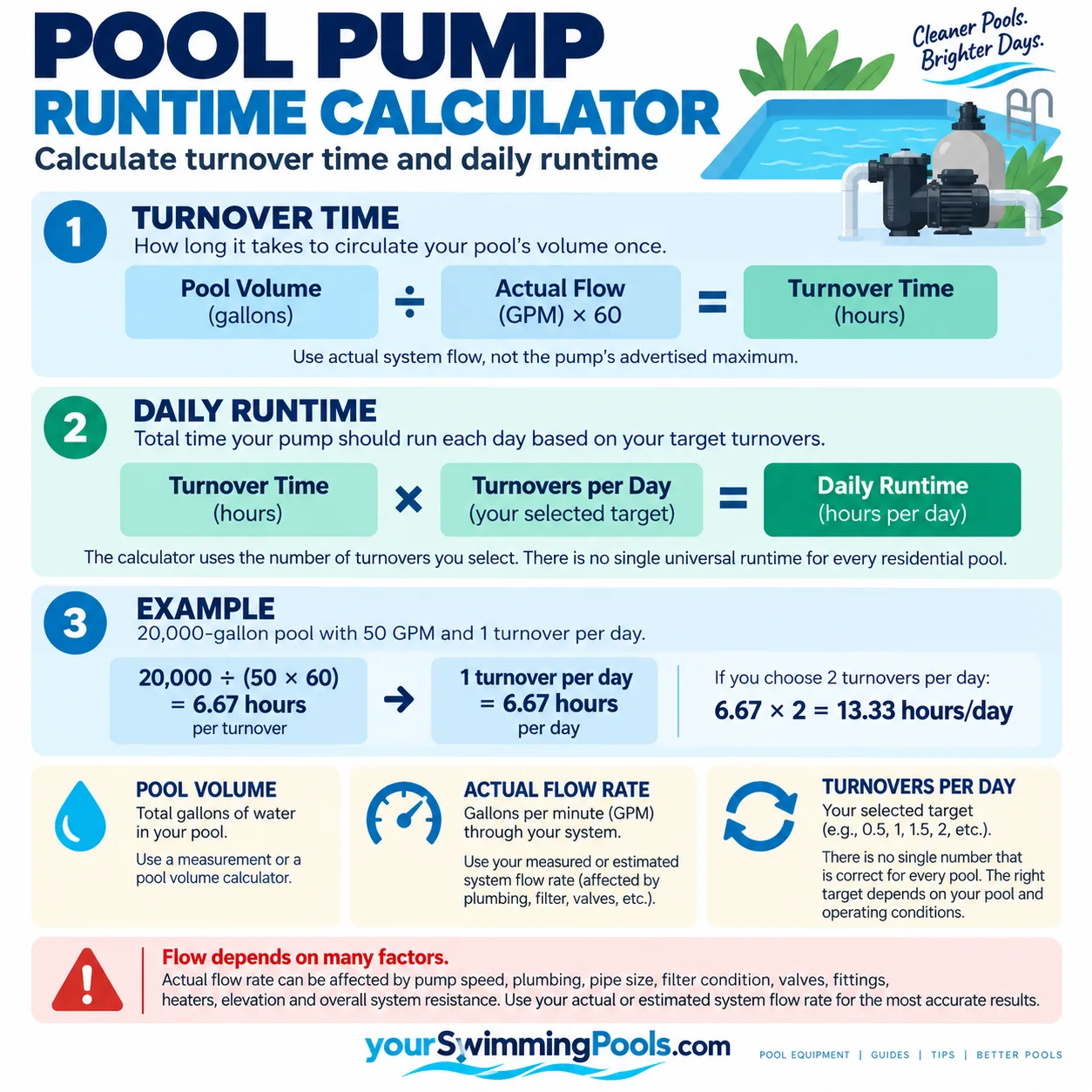
How the pool pump runtime calculator works
The calculator uses two standard pool industry formulas. First, it divides your pool volume by your actual flow rate to find one turnover time. Then it multiplies that by your target turnovers per day to give daily runtime.
Pool pump runtime formula
Example: 20,000-gallon pool
What flow rate should I enter?
Use your actual or estimated system flow rate, not the pump's advertised maximum. A pump's published peak GPM is measured at low resistance. Your installed system adds resistance through pipe runs, fittings, the filter, valves, and any other equipment in the loop. All of that reduces actual delivered flow below the rated figure.
If you don't have a measured flow rate, use your best estimate based on pump specifications and system complexity. A pool service professional can measure actual flow with a flow meter if you need a precise figure. For a detailed explanation of why actual flow and rated flow differ, see How Long Should You Run Your Pool Pump.
How many turnovers should a pool have per day?
There is no single universal answer. Appropriate turnover targets vary by pool type, usage, equipment, water conditions, and applicable local requirements. Pentair's technical documentation demonstrates that different pool types and applications use different turnover targets. A heavily used commercial pool has different needs from a lightly used residential pool.
Many residential pool owners use one turnover per day as a starting point and adjust based on water quality, bather load, and seasonal conditions. Some pools with high bather load or particular sanitation requirements target higher turnover. The calculator lets you try different values to see how they affect required runtime.
Does pool pump runtime change with a variable-speed pump?
Yes, because speed and flow are connected. A variable-speed pump running at lower speed delivers lower flow. Lower flow means a longer time to complete one turnover. The trade-off is that a pump running at lower speed draws significantly less electrical power, so even though it runs longer, the total energy cost can be lower.
To use this calculator with a variable-speed pump, enter the flow rate the pump delivers at the speed you plan to run it, not the maximum speed rating. For more, see variable-speed pool pumps.
How much does it cost to run a pool pump?
Use the Energy Cost tab above for a personalised estimate. The formula is:
Check your pump's nameplate for its power draw. Variable-speed pumps may list power at different speeds. Use the wattage at your operating speed, not the maximum.
Pool pump runtime vs pool pump size
This calculator tells you how long to run the pump you have. It does not tell you whether you have the right pump for your pool. Those are different questions. Runtime is about how many hours per day. Sizing is about whether the pump delivers enough flow through your specific plumbing. For pump sizing, see pool pump sizing.
Reference runtimes (at 50 GPM, 1 turnover/day)
| Pool volume | One turnover | 2 turnovers/day |
|---|---|---|
| 10,000 gal | 3.3 hrs | 6.7 hrs |
| 15,000 gal | 5.0 hrs | 10.0 hrs |
| 20,000 gal | 6.7 hrs | 13.3 hrs |
| 30,000 gal | 10.0 hrs | 20.0 hrs |
| 40,000 gal | 13.3 hrs | 24.0 hrs (limit) |
These are examples at 50 GPM. A different flow rate changes every figure. Use the calculator above with your actual values.
Pool pump runtime FAQ
How long should a pool pump run for a 10,000 gallon pool?
At 50 GPM actual flow and 1 turnover per day: 10,000 ÷ (50 × 60) = 3.3 hours. At 30 GPM: 10,000 ÷ 1,800 = 5.6 hours. Enter your values in the calculator above for your specific estimate.
How long should a pool pump run for a 20,000 gallon pool?
At 50 GPM actual flow and 1 turnover per day: 20,000 ÷ (50 × 60) = 6.7 hours. At 40 GPM: 20,000 ÷ 2,400 = 8.3 hours. The flow rate you actually deliver has a large effect on required runtime.
How many hours should a pool pump run?
It depends on your pool volume and actual flow rate. Divide your pool volume by (GPM × 60) to get hours per turnover, then multiply by your target turnovers per day. Many residential pools run between 6 and 12 hours per day, but your pool may need more or less.
Can I run my pool pump too long?
Running longer than needed increases electricity cost and equipment wear without improving water quality. If your water is consistently clear at a shorter runtime, there is no reason to run longer. The right runtime is the one that keeps your water clear at the lowest practical cost.
Does a variable-speed pump change how long I need to run it?
Yes. Lower speed means lower flow, which means a longer time per turnover. But the energy cost at low speed is much less, so total cost can still be lower even with longer runtime. Enter the flow rate at your actual operating speed, not the maximum, to get an accurate estimate.
How much electricity does a pool pump use per month?
Use the Energy Cost tab. The formula is kW × hours × electricity rate. A 1.0 kW pump running 8 hours at $0.15/kWh costs $1.20/day or about $36/month. A variable-speed pump at low speed may draw 0.2 to 0.4 kW, reducing monthly cost significantly even with more hours.
Related topics
- How Long Should You Run Your Pool Pump?Calculate daily runtime from pool volume and actual flow rate, with guidance on single-speed vs variable-speed, summer, cost, and when to adjust.
- Pump SizingMatch pump flow to your pool and filter without oversizing.
- Variable-Speed PumpsWhere the higher upfront price pays itself back.
- Single-Speed PumpsWhen the simple, cheaper pump still makes sense.
- Pool Filter Flow Rate Explained: GPM, GPH and TurnoverGPM, GPH and turnover, plus why required, rated, actual and filter-spec flow are different numbers.
- Filter SizingMatch filter and pump to your pool volume and flow.
- Why Your Pool Pump Loses PrimeA pump that keeps losing prime is almost always pulling air somewhere on the suction side. A diagnostic sequence, the O-rings to check first, drain-back explained, and when the pump itself is actually the problem.
- Pool Pump ProblemsWhere to start when a pump will not prime, start, or flow.