Pool pumps
How long should you run your pool pump?
There is no single number that fits every pool. Runtime depends on your pool volume, the flow your system actually delivers, pump type, water conditions, and what water quality you need. This page explains how to work it out for your pool.
The short answer
Most residential pools need several hours of pump operation each day, but the right number comes from your pool volume and the flow your system actually delivers, not a fixed universal figure. A useful starting point: divide your pool volume (gallons) by your actual system flow rate (GPM) to get the minutes needed for one circulation cycle. That gives you a baseline to adjust from, not a rule to follow blindly.
How many hours a day should a pool pump run?
The answer varies because pools vary. A 10,000 gallon above-ground pool with a small pump has very different circulation needs from a 35,000 gallon in-ground pool with a variable-speed pump running at a low speed all day. The figure that connects them is turnover time: how long it takes the pump to move a volume equal to the pool through the filter.
Many residential pools are operated somewhere between 6 and 12 hours per day during the swimming season, but that range reflects typical practice, not a requirement. Some pools running variable-speed pumps at low speeds run longer. Some smaller pools with efficient systems run less. The right runtime for your pool depends on your actual flow rate, pool volume, and water conditions.
How to calculate pool pump runtime
Start with turnover. One turnover means the pump has moved a total volume of water equal to your pool's volume through the filter. The formula is:
Divide by 60 to convert to hours.
Example A
20,000 gallon pool, 50 GPM actual flow
20,000 ÷ 50 = 400 minutes ÷ 60 = 6.7 hours
Example B
15,000 gallon pool, 40 GPM actual flow
15,000 ÷ 40 = 375 minutes ÷ 60 = 6.25 hours
Example C
30,000 gallon pool, 60 GPM actual flow
30,000 ÷ 60 = 500 minutes ÷ 60 = 8.3 hours
For help calculating required flow from your pool volume, see the pool filter size calculator. For understanding how pump-rated flow, actual system flow, GPM and GPH relate to each other, the pool filter flow rate explained page covers those distinctions in detail.
Enter your pool volume and flow rate in our Pool Pump Runtime Calculator.
Use the Pool Pump Runtime Calculator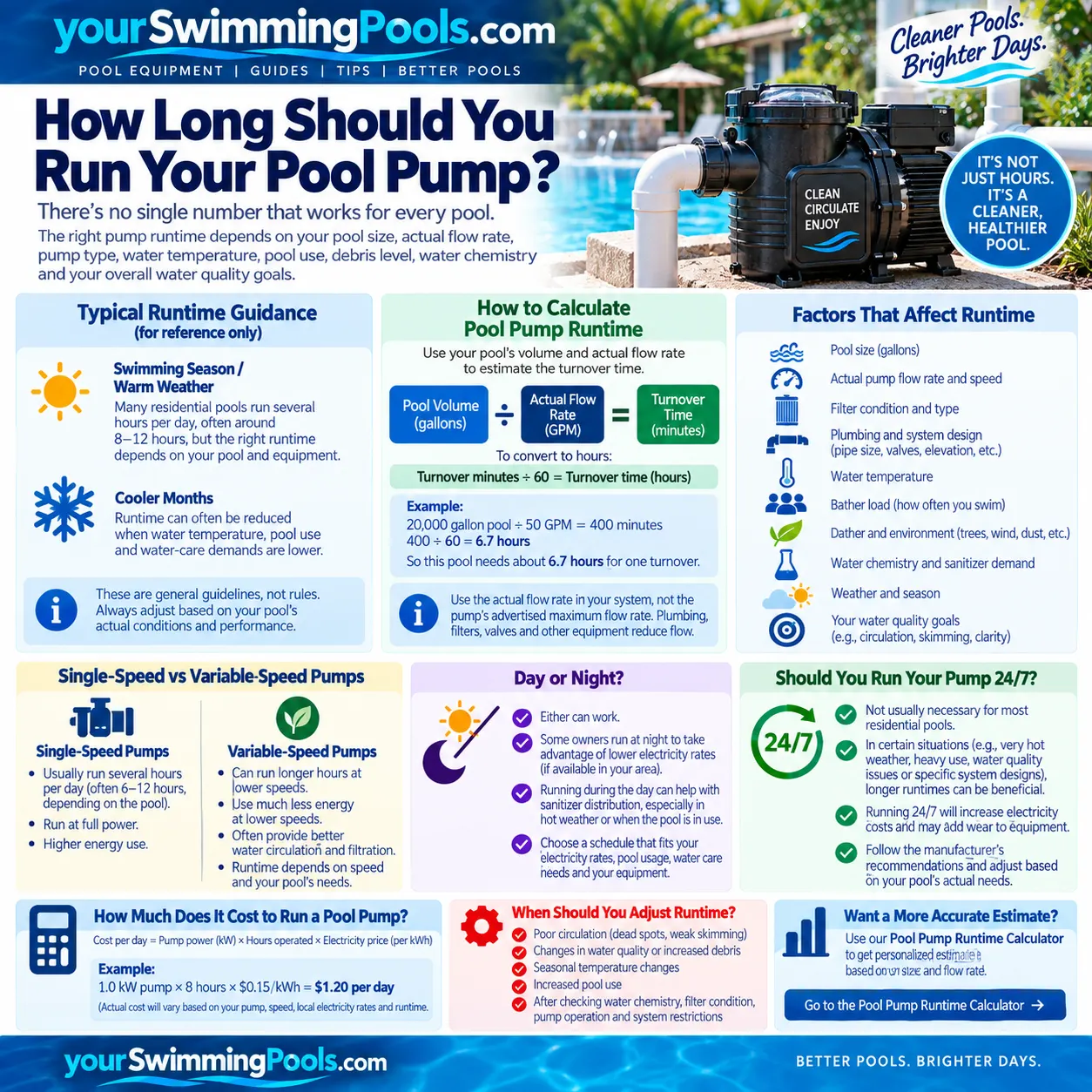
What affects pool pump runtime?
Turnover time is a starting point, not a complete answer. These are the factors that determine whether a given runtime is adequate for your pool.
| Factor | How it affects required runtime |
|---|---|
| Pool volume | Larger pools need more circulation time at the same flow rate |
| Actual system flow rate | Lower flow means longer runtime for the same turnover |
| Filter condition | A dirty or restricted filter reduces actual flow |
| Plumbing and pipe size | Long runs and narrow fittings add resistance and reduce delivered flow |
| Pump type and speed | Variable-speed pumps running slowly may need more hours to move the same volume |
| Water temperature | Warmer water generally increases sanitizer demand and may warrant more circulation |
| Bather load | More swimmers means more organic load and usually more circulation needed |
| Debris and environment | Trees, wind, and heavy debris add to filtration demand |
| Water chemistry | Persistent chemistry issues may call for more circulation, not just more chemicals |
| Weather and season | Hot weather increases evaporation and can increase sanitizer consumption |
| Your water quality goals | Higher clarity or stricter sanitation standards may require more runtime |
Single-speed vs variable-speed pool pumps
Pump type changes how you think about runtime because it changes the relationship between speed, flow, and energy consumption.
Single-speed pumps
A single-speed pump runs at one flow rate whenever it is on. You size runtime around how many hours the pump needs to run at that fixed flow to turn the pool over adequately. Fewer hours at full speed, with no ability to run longer at a quieter, lower-power setting.
For more on single-speed pump trade-offs, see the single-speed pumps page.
Variable-speed pumps
Variable-speed pumps can run at different speeds. A lower speed means lower flow and significantly lower energy consumption, because power draw falls steeply as speed drops. The practical result: many variable-speed pump installations run the pump for more hours per day at a lower speed, moving the same or more water at less cost.
If your pump delivers 25 GPM at a low speed, a 20,000 gallon pool needs 20,000 ÷ 25 = 800 minutes (13.3 hours) for one turnover at that speed. That is more hours than at a higher speed, but if the energy cost at low speed is substantially lower, the total operating cost can still be less. See variable-speed pumps for how this works in practice.
Neither pump type has a single correct runtime. The right setting depends on the speed, your pool's volume, and your water quality needs.
Should you run your pool pump 24/7?
Continuous operation is not automatically necessary for most residential pools. A pump that runs all day and all night uses significantly more electricity and adds wear on the equipment compared to a well-timed runtime.
That said, certain situations make longer operation reasonable: very hot weather combined with heavy use, a pool with specific sanitizer or circulation demands, or a variable-speed pump running at a very low speed that needs more hours to complete adequate circulation. Some pool owners also run their pumps continuously for short periods when dealing with an algae outbreak or when bringing water quality back after a problem.
The question is not whether 24/7 is allowed but whether it is necessary. If your water quality is consistently good at a shorter runtime, there is no reason to run continuously. If water quality falls off without longer operation, investigate whether a different runtime schedule, better pool chemistry management, or equipment maintenance is the right answer before defaulting to all-day running.
Should you run your pool pump during the day or at night?
Both can work. The right timing depends on what you are trying to achieve.
- Electricity rates. If your electricity supplier charges time-of-use rates, running some or all pump hours during off-peak periods (often overnight) can reduce your electricity bill without reducing circulation.
- Sanitizer distribution. Running the pump during the day, when the pool is in use and when sunlight is degrading chlorine, helps distribute sanitizer and process the organic load from swimmers. Many pool professionals recommend at least some daytime circulation for this reason.
- After chemical dosing. When you add chemicals, running the pump immediately afterward distributes them through the water. The timing of that run matters more than whether it is day or night.
- Debris. Running the pump during the hours when wind and trees drop the most debris helps the skimmer collect it before it sinks.
A practical approach for many pools: run enough hours during the day to handle active use, sanitizer distribution, and skimming, and schedule remaining hours at the cheapest electricity rate. Most timers and automation systems can split a daily schedule across two or more periods.
How long should you run your pool pump in summer?
Hot weather and heavy use both increase circulation demands. Warmer water holds less dissolved oxygen, bacteria multiply faster, and chlorine breaks down more quickly in sunlight and heat. More swimmers means more organic load entering the water. Together these factors mean that the same runtime that keeps water clear in mild conditions may not be enough at peak summer.
There is no universal summer runtime. The right response is to watch your water quality and adjust. If clarity drops or chemistry becomes harder to maintain during a heat wave or a stretch of heavy use, increasing circulation is a reasonable first step alongside checking chemistry. If water quality stays good, there is no need to run longer than necessary.
A variable-speed pump can reduce energy costs significantly while giving you flexible runtime control.
Shop Pool Pumps on AmazonAs an Amazon Associate we earn from qualifying purchases.
Does running the pump longer keep the pool cleaner?
More circulation helps, but it is not a substitute for correct water chemistry or a clean filter. A pool with poor chemistry will not clear up from pump runtime alone. A clogged filter provides less filtration regardless of how long the pump runs. And a pump that is delivering very low flow because of plumbing restrictions or equipment problems does not improve much from more hours of operation.
When water quality is persistently poor, the diagnostic sequence is: check chemistry first, then filter condition, then whether the pump and plumbing are delivering adequate flow, then runtime. Runtime is often the last variable to adjust, not the first. For filter condition and pressure, see the pool filter maintenance page.
How much does it cost to run a pool pump?
The calculation is straightforward:
Example: single-speed pump
1.0 kW pump, 8 hours/day, $0.15/kWh
1.0 × 8 × $0.15 = $1.20/day (~$36/month)
Example: variable-speed pump
0.3 kW at low speed, 12 hours/day, $0.15/kWh
0.3 × 12 × $0.15 = $0.54/day (~$16/month)
Your actual power draw depends on your pump model, speed setting, and local electricity rate. Check your pump's documentation for the power draw at the speed you operate it. Many variable-speed pumps show wattage at different speeds in their specifications.
Signs you may need more pump runtime
These observations may point to insufficient circulation, but each can also have other causes. Investigate the full system before concluding runtime is the only issue.
| What you observe | Possible circulation cause |
|---|---|
| Water looks dull or slightly hazy despite correct chemistry | Insufficient circulation for load or conditions |
| Dead spots or warm patches in parts of the pool | Circulation is not reaching those areas consistently |
| Skimmer barely draws surface debris | Flow may be too low or runtime too short for debris load |
| Pressure rises quickly after backwashing or cleaning | High debris load may require more filtration time |
| Algae developing despite correct sanitizer levels | Poor distribution from insufficient circulation |
| Water quality drops quickly on days of heavy use | Runtime may be insufficient for the bather load |
Before increasing runtime, check filter pressure, clean the filter if needed, inspect pump and skimmer baskets, and confirm all valves are in the correct position. Poor circulation can be a plumbing or equipment problem rather than a runtime problem. See pool pump problems for a diagnostic approach.
When should you reduce pump runtime?
Reducing runtime purely to save electricity makes sense only if your water quality remains consistently good at the shorter schedule. A pool that needs 8 hours to stay clear does not benefit from switching to 5 hours to cut the electricity bill.
Reasonable situations for reduced runtime include: cooler months when water temperature is lower and the pool is less used; periods when bather load drops significantly; or when a variable-speed upgrade allows adequate circulation at a lower speed and longer schedule that costs less overall. Always monitor water quality for a week or two after changing the runtime before deciding the new schedule is adequate.
Enter your pool volume and actual flow rate in the Pool Pump Runtime Calculator to see the approximate runtime needed for one turnover, and adjust from there.
Open the Pool Pump Runtime CalculatorPool pump runtime: frequently asked questions
How many hours a day does a pool pump need to run?
It depends on your pool volume and the flow your system actually delivers. Divide pool volume by actual GPM to get the minutes for one circulation cycle, then convert to hours. Many residential pools run between 6 and 12 hours per day during the swimming season, but that range is a typical observation, not a requirement. Your pool may need more or less depending on conditions.
Can you run a pool pump too long?
Running a pump longer than necessary increases electricity cost and adds wear. For most pools, consistently good water quality at a shorter runtime is the goal. Running very long hours because chemistry or equipment problems are not being addressed is not a good long-term approach.
Should you leave your pool pump running 24/7?
Not automatically. Most residential pools do not need continuous operation. Certain situations, such as heavy use during a heat wave, a very low-speed variable-speed pump that needs more hours, or recovering from a water quality problem, may justify longer or continuous operation temporarily. Evaluate based on your pool's actual needs.
Is it better to run a pool pump at night or during the day?
Neither is universally better. Running during the day helps with sanitizer distribution and skimming while the pool is in use. Running overnight can reduce electricity cost if time-of-use rates apply in your area. Many pool owners split the daily runtime across morning and evening periods to get benefits of both.
How long should a pool pump run in summer?
Hot weather typically increases circulation demands because warmer water degrades chlorine faster, and heavy use adds more organic load. There is no universal summer figure. Monitor your water quality during warm periods and increase runtime if clarity or chemistry becomes harder to maintain. If water stays clear and balanced, there is no need to run longer than usual.
How much does it cost to run a pool pump per day?
Multiply pump power in kW by hours operated by your electricity rate per kWh. A 1.0 kW pump running 8 hours at $0.15/kWh costs $1.20 per day. A variable-speed pump drawing 0.3 kW at low speed for 12 hours costs $0.54 per day at the same rate. Actual cost depends on your pump model, speed setting, and local rates.
What is the cheapest time of day to run a pool pump?
If your electricity supplier charges time-of-use rates, off-peak periods are usually overnight or early morning. Check your electricity tariff for your specific off-peak windows. Not all tariffs use time-of-use pricing, so check before assuming overnight operation saves money.
Why does my pool pump need to run at all?
The pump circulates water through the filter, which removes particles and distributes sanitizer throughout the pool. Still water allows bacteria to multiply faster, debris to accumulate, and chemical imbalances to concentrate in spots rather than distributing evenly. Regular circulation is what keeps filtration and sanitation working across the whole pool.