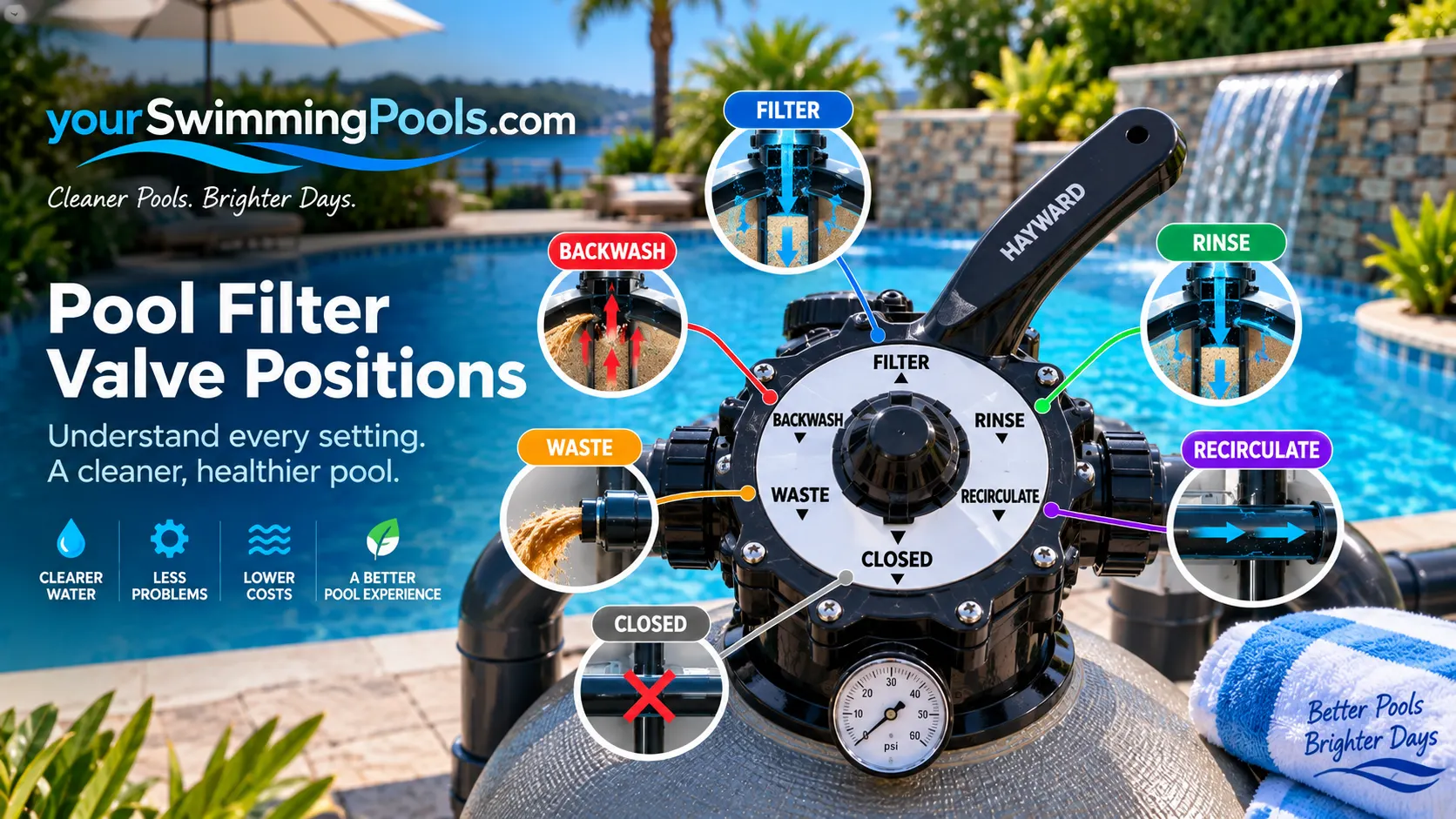
A multiport valve controls where water flows through your sand filter system. Turn the handle and you change the entire flow path: normal filtration, reverse-cleaning the sand, bypassing the filter, or draining water straight to waste. Most homeowners only ever use the FILTER position, then get stuck when something goes wrong. This page explains every position, what actually happens to the water, and where the standard advice comes from.
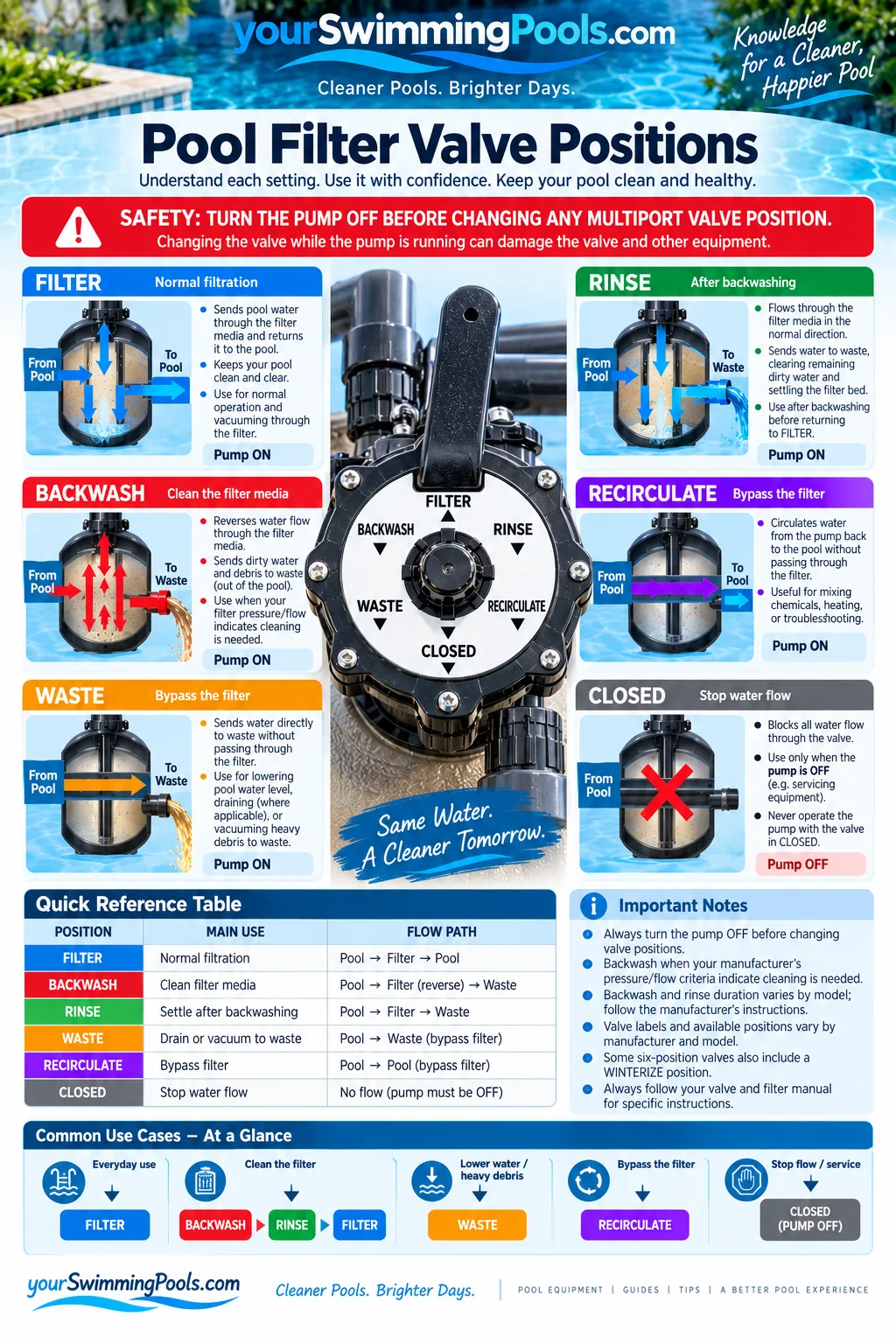
Always turn the pump off before moving the valve handle. Manufacturer instructions for both Pentair and Hayward specify that the pump must be off before changing any multiport valve position. The sequence is always: pump off, move the valve, pump on.
Pool filter valve positions at a glance
| Position | What it does | Flow path | Pump |
|---|---|---|---|
| FILTER | Normal filtration | Pool → Sand → Pool | On |
| BACKWASH | Cleans the sand bed | Pool → Sand (reversed) → Waste | On |
| RINSE | Settles sand after backwash | Pool → Sand → Waste | On |
| WASTE | Bypasses filter to drain | Pool → Waste (no sand) | On |
| RECIRCULATE | Circulates without filtering | Pool → Pump → Pool (no sand) | On |
| CLOSED | Blocks all flow | No flow | Off |
Not every multiport valve has all six positions. Above-ground combination units often have four or five. Some in-ground valves add a WINTERIZE position. Check the label on your specific valve before assuming.
What a multiport valve is
A multiport valve is a single housing with a rotating internal disc that selects between several flow paths. Rather than needing separate valves for each maintenance task, you turn one handle and the entire flow path changes.
The valve body connects to four points: the pump inlet, the filter tank ports, the return to the pool, and the waste line. The rotating disc inside aligns different internal channels depending on which position the handle points to. The sand never moves. The valve redirects the water around or through it.
Residential sand filters use either a top-mounted valve (handle sits above the tank) or a side-mounted valve (handle sits at the side). Full-size in-ground systems typically use valves from Hayward, Pentair, or Jandy. Above-ground combo units often use smaller, simpler valves with fewer positions and sometimes different label wording.
Water flow paths: what actually happens at each position
Understanding the flow path is more useful than memorizing a label. Here is what happens to the water at every position.
FILTER: normal pool filtration
FILTER is the default position for every normal pump cycle. Water from the pool enters the top of the valve, flows down through the sand bed, passes through the lateral tubes at the bottom of the tank, and returns to the pool through the return lines.
When to use it: Any time the pump runs for normal circulation.
What to expect: Stable pressure near your clean baseline. Visible flow at the returns.
Common mistake: Restarting the pump without checking the position after any maintenance step. The valve handle should point to FILTER before every normal start.
BACKWASH: clean the sand filter
BACKWASH reverses the direction of water flow through the sand bed. Instead of flowing down through the sand, water flows up from the bottom through the laterals, lifts and agitates the trapped debris, and carries it out through the waste line.
When to use it: When your filter pressure has risen noticeably above its clean starting pressure. Hayward’s documentation for high-rate sand filters specifies backwashing when the pressure rises approximately 8 to 10 psi above the clean baseline. Use your own filter’s manual for the threshold specific to your model, and note that the actual clean pressure varies with your pump and plumbing.
What to expect: Dirty water exits through the sight glass or waste line. The discharge clears as the backwash progresses. Stop when the discharge runs clear, or per your manufacturer’s stopping condition.
For the complete backwash and rinse procedure, see the full backwash article. This page explains the valve position. That page explains the full sequence.
RINSE: settle the filter after backwashing
RINSE runs water in the normal downward direction through the sand but sends it to waste instead of back to the pool. Its purpose is to flush loosened debris out of the plumbing path and let the sand resettle before normal filtration resumes.
When to use it: Immediately after BACKWASH, before returning to FILTER. Always. Skipping RINSE is the most common reason pool water turns cloudy after a backwash.
How long to run it: This varies by manufacturer and model. Pentair’s Hi-Flow valve documentation describes a brief rinse before returning to the filter position. Hayward documentation for their ProSeries filters describes a similar short rinse cycle. Follow the time stated in your filter’s manual. A common residential range is 15 to 30 seconds, but that is not a universal rule.
Why it exists: After backwashing, the sand is disturbed and the pipe path between the valve and the pool returns holds loosened debris. Going directly from BACKWASH to FILTER sends that debris into the pool through the returns. RINSE flushes it to waste first.
WASTE: remove water without filtering
WASTE bypasses the sand bed entirely and sends pool water straight to the waste line. The water never contacts the sand.
When to use it:
- Vacuuming algae or heavy debris directly to waste, so it does not pass through the filter and risk being pushed back into the pool
- Lowering the water level after heavy rainfall
- Any time you want to remove water from the pool without filtering it
What to expect: The pool water level drops while the pump runs. Watch the skimmer level. If it drops below the skimmer intake, the pump can lose prime. The pump losing prime page covers what to do if that happens.
Note: WASTE discharges pool water, which has a cost in water usage and possibly in chemical waste. Check local regulations for your area about where discharge water can go.
RECIRCULATE: bypass the filter
RECIRCULATE sends water from the pump directly back to the pool returns without touching the sand. The pump runs, the pool circulates, but nothing is being filtered.
When to use it:
- When a chemical treatment requires circulating through the pool before the filter processes it. Some treatments specify this approach. Follow the chemical product’s instructions for whether RECIRCULATE is appropriate for that product.
- When the filter requires service and you need to keep the pump running temporarily
- In some winterization procedures, to distribute chemicals through the system
What to expect: Normal pump operation and circulation. No filtration. Do not leave the valve in RECIRCULATE as a substitute for FILTER.
CLOSED: stop flow through the valve
CLOSED blocks all flow through the valve body. It is used during equipment service, not during normal operation.
When to use it: When you need to isolate the valve while working on the equipment pad, replacing valve components, or performing tasks that require no water movement through the valve.
Critical: Never run the pump with the valve in CLOSED. Running the pump against a blocked valve builds pressure with nowhere to go and can damage the pump, valve body, or plumbing. The pump must be off before setting the valve to CLOSED, and must remain off until the valve is moved to an operating position.
What the manufacturers actually specify
This is the part most valve-position articles skip. The standard advice comes from manufacturer documentation, and it is worth knowing what each manufacturer actually says and where the procedures can differ.
On turning the pump off before changing positions: Both Pentair and Hayward documentation specify that the pump must be off before the valve handle is moved. Pentair’s Hi-Flow six-way valve manual states this requirement explicitly. This is not an informal rule. It is a documented manufacturer requirement for valve protection.
On backwash timing: Neither Pentair nor Hayward specifies a fixed backwash duration. Pentair’s documentation describes running the backwash until the water in the sight glass runs clear. Hayward’s ProSeries manual describes a similar sight-glass observation method. Running to a fixed timer rather than observing the water is not what the manufacturers instruct.
On rinse timing: This is where manufacturer instructions vary. Pentair’s Hi-Flow valve documentation describes a short rinse before returning to filter. Hayward’s instructions for their ProSeries describe a similar brief rinse. The actual duration specified can differ between models. The consistent point across both manufacturers is that a rinse step is required between BACKWASH and FILTER.
On RECIRCULATE and chemical treatments: Neither Pentair nor Hayward specifies which chemical products require RECIRCULATE. That decision follows the chemical product’s instructions, not the filter manufacturer’s.
| Setting | Pentair documents | Hayward documents | Where they differ |
|---|---|---|---|
| Pump off before moving | Yes, required | Yes, required | None - both require it |
| Backwash trigger | When sight glass clears | ~8 to 10 psi rise above clean baseline | Observation method vs pressure threshold |
| Backwash duration | Until water clears | Until water clears | Consistent |
| Rinse required | Yes | Yes | Duration is model-specific |
| CLOSED with pump running | Not permitted | Not permitted | None |
This table reflects general documentation patterns. Your specific valve and filter model’s manual takes priority over any general comparison.
How valve positions differ by valve type
Most discussions of multiport valves assume a standard six-position valve. That covers most in-ground residential systems, but it is not the full picture.
Standard six-position valves (Hayward SP0714T, Pentair 261055, Jandy valves): Filter, Backwash, Rinse, Waste, Recirculate, Closed. This is the common configuration for full-size in-ground sand filters.
Seven-position valves: Some models add a WINTERIZE position, which allows air to pass through the system during blowout without building pressure. Pentair’s TA series documents this position. Not every climate or installation needs it.
Above-ground combination units (Intex SX2800, Bestway Flowclear, similar): These often have a six-position selector but the valve body is smaller and integrated with the pump. The position labels may say the same words but the flow rates and internal construction differ from a standalone in-ground valve. Some smaller Intex cartridge units have no multiport valve at all, since cartridge filters do not backwash.
DE (diatomite) filter multiport valves: The position labels are the same as sand filter valves but the flow paths and cleaning procedures differ significantly. This page covers sand filters. DE filter procedures follow their own manufacturer documentation.
What position should my pool valve be in?
| Situation | Valve position | Notes |
|---|---|---|
| Normal everyday circulation | FILTER | Default for all pump cycles |
| Backwashing the filter | BACKWASH | Run until discharge clears |
| After backwashing | RINSE | Per your manual, then switch to FILTER |
| Vacuuming normal debris | FILTER | Debris is trapped in sand |
| Vacuuming algae or heavy debris | WASTE | Debris exits to waste line |
| Lowering the water level | WASTE | Watch skimmer level |
| Circulating chemicals (if product requires) | RECIRCULATE | Follow chemical product instructions |
| Filter needs service, pump still needed | RECIRCULATE | Short-term only |
| Servicing equipment | CLOSED | Pump must be off |
Common pool valve mistakes
Moving the valve while the pump is running. This is the one that causes real damage. Manufacturer documentation from both Pentair and Hayward requires the pump to be off before moving the handle. The consequence is internal seal damage and potentially debris pushed into the pool.
Skipping RINSE after BACKWASH. The sand is disturbed after backwashing and the plumbing holds loosened debris. Going straight to FILTER sends that debris into the pool. Always run RINSE first.
Forgetting to return from WASTE. The pump keeps running and draining water while the valve stays in WASTE. A pool owner who vacuums to waste and then restarts the pump without checking the valve can lose significant water before noticing.
Running the pump with the valve in CLOSED. There is nowhere for the pressure to go. This can damage the pump, valve, or plumbing. CLOSED is only for use with the pump off.
Treating RECIRCULATE as normal operation. Everything looks fine because the pump runs and water circulates. But nothing is being filtered. Water clarity deteriorates quietly.
Multiport valve maintenance: the spider gasket
A common multiport valve failure is a worn or damaged spider gasket. This is a flat gasket inside the valve with a web pattern that seals the flow channels between positions. When it wears, water leaks between positions. Signs include water flowing toward the waste line while the valve is in FILTER, or the handle no longer clicking cleanly into position.
Replacement spider gaskets are sold by valve model. The model number is typically stamped on the valve body. If you notice leakage between positions, the valve gasket is the first component to inspect.
Moving the valve handle while the pump is running accelerates spider gasket wear, which is one of the practical reasons the pump-off requirement matters beyond just the immediate risk.
The filter parts page covers valve components including where to find replacements for common Hayward and Pentair models.
Frequently asked questions
What is the difference between WASTE and BACKWASH? BACKWASH reverses flow through the sand to clean it, with the dirty water exiting to waste. WASTE bypasses the filter entirely and sends water to drain without touching the sand at all. Use BACKWASH to clean the filter media. Use WASTE to remove water from the pool or to vacuum heavy debris directly to drain.
Do I need RINSE after every backwash? Yes. RINSE flushes loosened debris from the plumbing path and resettles the sand before you return to FILTER. Pentair and Hayward both document a rinse step as part of the proper backwash sequence. Skipping it risks sending disturbed sand and debris back into the pool.
My valve does not have a RECIRCULATE position. Is something wrong? No. Some valves, particularly those on smaller above-ground systems, do not include RECIRCULATE. Check the label on your valve for the positions it actually has. A valve with four or five positions is not defective.
