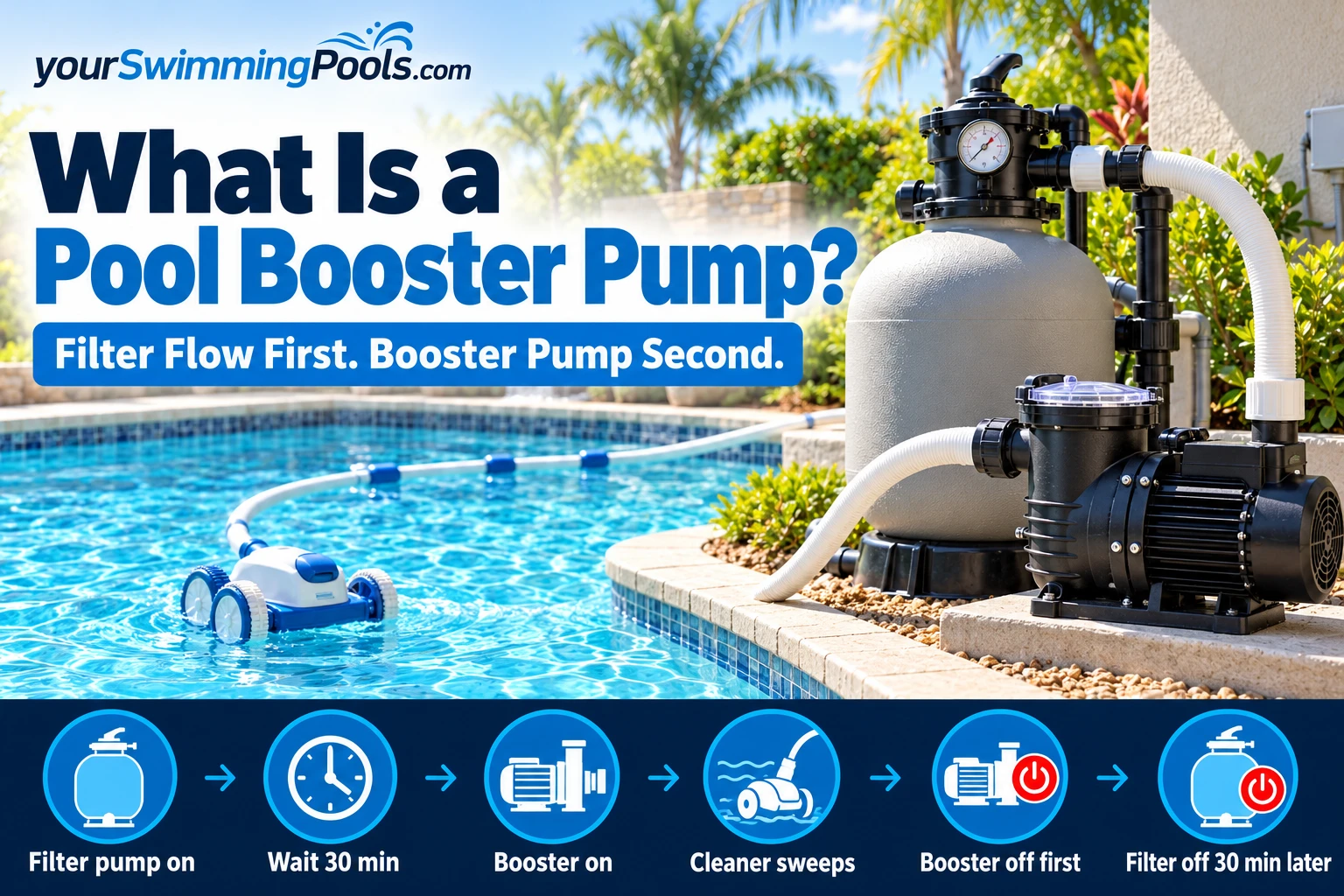
A pool booster pump is a small second pump that gives a pressure-side pool cleaner the extra water pressure it needs to drive around and sweep the pool. It does not filter anything and it cannot run on its own. Think of it as the cleaner's personal espresso shot: useless without the main pump, very effective with it.
The short version: you only need a booster pump if your pressure-side cleaner is a booster-pump model. Polaris, for example, lists the Vac-Sweep 280, 380 and 3900 Sport as requiring a booster pump, while the Polaris 360 runs on your filter pump's return flow alone and should not be used with a booster. Robotic and suction cleaners do not use one (our note). A booster pump must only run while the filter pump runs: Polaris warns that running it without the filtration pump damages the booster pump.
What a booster pump does
Your filter pump pushes water through the filter and back into the pool. A pressure-side cleaner connects to a return line and uses that flow to move. Some cleaners are designed to need more pressure than the filter pump delivers on its own. The booster pump takes clean water after the filter and raises its pressure for the cleaner. Polaris describes its PB4-60 booster pump like this: it "supplies high pressure water to the Polaris pool cleaner to optimize cleaner efficiency."
Do you need one?
| Your cleaner | Booster pump? |
|---|---|
| Robotic cleaner (for example the Dolphin Nautilus CC Plus) | No. It runs on its own power supply |
| Suction-side cleaner | No. It uses the suction of your filter pump |
| Pressure-side, booster-pump model (Polaris 280, 380, 3900 Sport) | Yes, Polaris lists these as requiring a booster pump |
| Pressure-side, booster-less model (Polaris 360) | No, and Polaris says it should not be used with one |
Not sure which you have? The cleaner's manual or its product page says whether it needs a booster pump. More on which cleaners need one: which pool cleaners need a booster pump.
How a booster pump is installed
From the Polaris PB4-60 installation manual:
- A dedicated return line. The booster pump needs its own line to the cleaner, plumbed so that it always receives flow from the filtration pump.
- Upstream of all air-inducing equipment, and as far away as possible from a chlorinator.
- Not self-priming. It depends on the filter pump to feed it water.
- A dedicated electrical circuit, with GFCI protection: Polaris points out that the National Electrical Code requires GFCI protection for all pool pump circuits.
- Bonding: within 5 feet of the pool, the motor frame must be bonded to the pool's metal parts, as the manual describes.
The manual says installation should follow the National Electrical Code and local codes. It also says all electrical work must be performed by a licensed electrician.
Timer settings: the half-hour rule
If you use a time clock, Polaris's manual says to turn the booster pump on at least half an hour after the filtration pump starts, and off at least half an hour before the filtration pump stops. Check the two timers now and then to make sure they stay in sync. With a variable-speed filter pump, make sure it runs fast enough to feed the booster while the booster is on (our advice; your pump's and cleaner's manuals give the details).
Electrical at a glance (Polaris PB4-60)
| Item | From the PB4-60 manual |
|---|---|
| Motor | 1.13 THP, 3,450 RPM |
| Voltage | Factory wired for 230 V, can be rewired for 115 V |
| Amps | 6.4 A at 230 V, 12.8 A at 115 V |
| Breaker on 115 V | 20 A recommended: the starting current may exceed 15 A |
Why the amps halve at 230 V: pool pump voltage, 115V vs 230V. The full product write-up: Polaris PB4-60 booster pump review.
Common mistakes
- Running the booster without the filter pump. Polaris warns this damages the booster pump.
- Timers out of sync, so the booster starts before the filter pump or keeps running after it stops.
- Adding a booster to a booster-less cleaner such as the Polaris 360.
- Sharing the circuit with lights or outlets. The manual asks for a dedicated circuit.
Sources
Purpose, installation, electrical data and timer rule: Polaris PB4-60 Pressure Cleaner Booster Pump Installation and Operation Manual (Zodiac, H0399500 Rev F). Which Polaris cleaners use a booster pump: Polaris product pages for the Vac-Sweep 280, Vac-Sweep 380, 3900 Sport and Vac-Sweep 360 and Polaris: booster pump compatible with the Vac-Sweep 360. Points marked as ours are our own advice.
Frequently asked questions
What is a booster pump for a pool?
A second, small pump that raises the water pressure for a pressure-side pool cleaner. Polaris describes its PB4-60 as supplying "high pressure water to the Polaris pool cleaner".
Can a booster pump run without the filter pump?
No. The PB4-60 is not self-priming, and Polaris warns that running it without the filtration pump damages it.
Does the Polaris 360 need a booster pump?
No. Polaris sells the 360 as a booster-less cleaner that runs on the return flow of your filter pump, and says it should not be used with a booster pump.
Do robotic cleaners need a booster pump?
No. A robotic cleaner runs on its own power supply and filters into its own basket (our note).
When should the booster pump turn on?
Polaris's manual: at least half an hour after the filtration pump starts, and off at least half an hour before the filtration pump stops.
