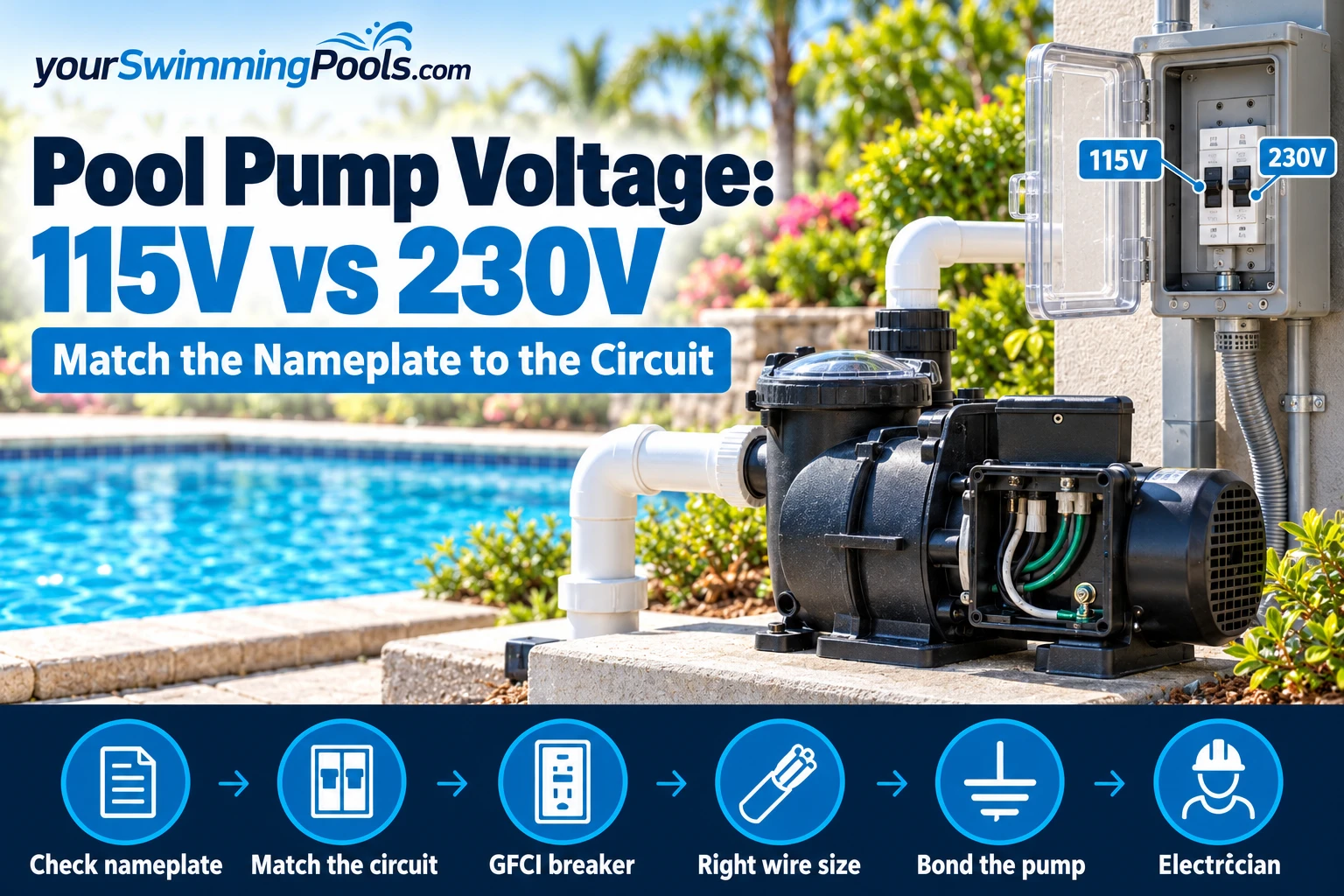
Many pool pumps are sold as "115V/230V" or "dual voltage". That does not mean they work on whatever you plug them into. It means the pump can be set up for either voltage, and the setting has to match the circuit it is wired to. Get it wrong and the pump is the one paying for it. This page explains the difference, and why the amps halve at 230 volts.
The short version: a fixed-speed motor delivering the same power draws about half the current at 230 V that it draws at 115 V. Polaris's PB4-60 booster pump is a clear example: 12.8 amps at 115 V, 6.4 amps at 230 V. The pump must be wired for the voltage of its circuit, as its manual describes, and pool pump circuits need GFCI protection under the National Electrical Code. Wiring is a job for an electrician.
Why the amps halve at 230 volts
Electrical power is voltage times current. A motor that needs a certain power gets it either from a lower voltage with more current, or a higher voltage with less current. Double the voltage and the current halves. That is our plain-language explanation, and the manufacturers' own numbers show it:
| Pump | At 115 V | At 230 V | Source |
|---|---|---|---|
| Polaris PB4-60 booster pump (1.13 THP) | 12.8 A | 6.4 A | Polaris installation manual |
Why lower current matters: the wires carry less current, so the same wire size can reach further with less voltage loss. You can see this in Polaris's wiring table for the PB4-60, where, for runs up to 100 feet, the 115 V column needs thicker wire than the 230 V column at the same distance.
What "dual voltage" means on a pump
- Changeable wiring: some motors are factory wired for one voltage and can be rewired for the other. The PB4-60 is factory wired for 230 V and can be rewired for 115 V, following the diagram on the motor's name plate.
- Wide input range: some variable-speed pumps accept a range. Pentair's SuperFlo VS, VST and SuperMax VS manual says these pumps operate within 115 to 230 Vrms, with no wiring change for 115 V. On the lower voltage the drive limits the speed to keep the current below 13.2 A, so on 115 V it may not reach the same top output.
Either way, the pump's own manual tells you how it must be connected. Check the label and the manual before anyone connects it (our advice).
115 V or 230 V: which is better for a pool pump?
Neither is "better" in itself; it depends on what you have at the equipment pad (our view). Some practical differences:
- 230 V means less current for the same pump, so less voltage loss over long wire runs.
- 115 V is often what is available near an above-ground pool (our view), but the current is higher. For the PB4-60, Polaris notes that the starting current may exceed 15 amps on 115 V and recommends a 20 amp breaker.
- A dedicated circuit: the PB4-60 manual says no other equipment, lights, appliances or outlets may be on the pump circuit, apart from devices that must run with the pump, such as a chlorinator or heater.
Safety: the parts that are not optional
- GFCI protection. Polaris's manual notes that the National Electrical Code requires all pool pump circuits to be protected with a ground fault circuit interrupter.
- Grounding and bonding. The manual requires the motor to be grounded, and, within 5 feet of the pool, bonded to the pool's metal parts.
- A qualified installer. Pool electrics combine water and mains voltage. Polaris's PB4-60 manual says all electrical work must be performed by a licensed electrician; Pentair's manual says its pump must be installed by a licensed or certified electrician or a qualified service professional.
Sources
Amps per voltage, rewiring, breaker, dedicated circuit, GFCI, grounding and bonding, wire table: Polaris PB4-60 Pressure Cleaner Booster Pump Installation and Operation Manual (Zodiac, H0399500 Rev F). Voltage range of variable-speed pumps: Pentair SuperFlo VST, SuperFlo VS and SuperMax VS Installation and User's Guide. The explanation of power, voltage and current and the "which is better" points are ours. Licensed electrician: both manuals.
Frequently asked questions
Can I run a 230V pool pump on 115V?
Only if the pump is made for both and is set up for 115 V as its manual describes. A dual-voltage pump has to be wired for the voltage of its circuit; it does not switch by itself unless its manual says it accepts a voltage range.
Does a 230V pump use less electricity?
Not by itself: a fixed-speed motor needs roughly the same power at either voltage, it just draws about half the current at 230 V (our explanation). Real energy savings come from running slower, as with a variable-speed pump.
Does a pool pump need a GFCI?
Yes. Polaris's manual notes that the National Electrical Code requires all pool pump circuits to be protected with a GFCI.
What breaker does a pool pump need?
The pump's manual says. For the Polaris PB4-60 on 115 V, Polaris recommends a 20 amp breaker, because the starting current may exceed 15 amps.
