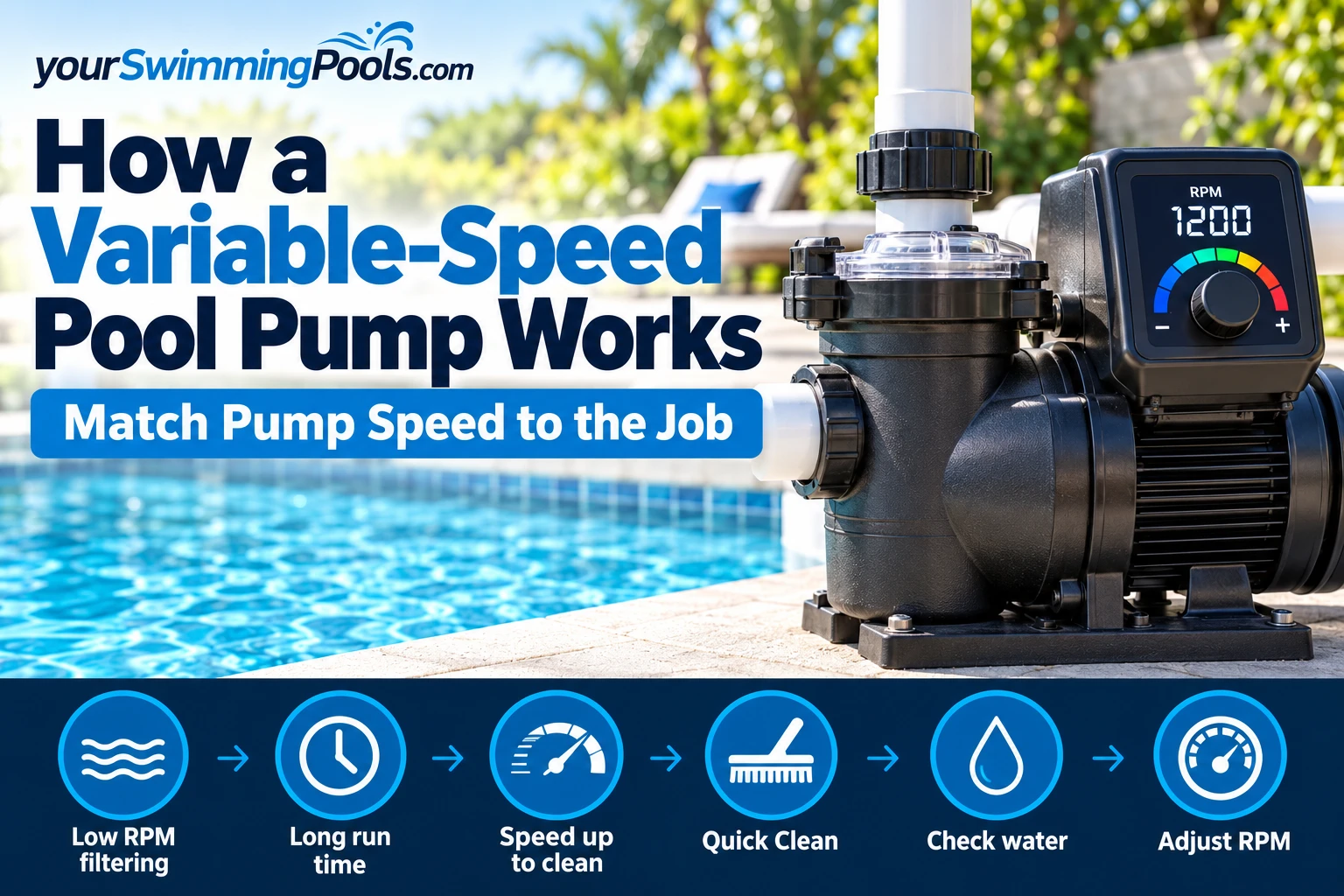
A variable-speed pool pump does the same job as a single-speed pump, but it can slow its motor down. That sounds like a small trick. It is not: because of a bit of pump physics, a pump running at half speed uses only about an eighth of the power. This page explains how that works, and how to pick the right speed (RPM) for your pool.
The short version: flow goes down in step with the speed, but power goes down much faster. The U.S. Department of Energy's example: from 3,450 to 2,400 RPM, a 30% slower pump, the power drops from 2,000 to 593 watts. Pentair's advice for its variable-speed pumps: in most cases the lowest necessary speed for the longest duration minimizes energy use. Run faster only for the jobs that need it, like vacuuming, a cleaner, a heater or water features.
The physics in one table
The DOE calls it the pump affinity law: when you cut the motor speed in half, the flow is also cut in half, but the power drops to one-eighth of the original draw. The Department of Energy's measure guideline (2012) shows it for a typical 1.5 horsepower pool pump:
| Speed (RPM) | Flow (GPM) | Power (watts) |
|---|---|---|
| 3,450 | 66 | 2,000 |
| 3,000 | 55 | 1,157 |
| 2,400 | 44 | 593 |
| 1,800 | 33 | 250 |
| 1,200 | 22 | 74 |
These table figures follow the affinity law (our reading: they are calculated, not measured). In the same guideline, a variable-speed pump in the field drew 116 watts at 22 GPM, against 74 watts in the table: more than the calculation, but still a small fraction of the single-speed pump. A single-speed pump cannot use any of this: it always runs at its full speed, typically 3,450 RPM.
Why a single-speed pump wastes energy
The DOE guideline makes a simple point: occasional jobs such as spa jets, backwashing, a chlorinator, a pool cleaner, a heater, solar panels or water features need more flow, and they take roughly 10% of a pump's running time. A single-speed pump has to be sized for the most demanding job, so for the other 90% of the time it moves more water than the filtration needs. A variable-speed pump can run slowly for filtering and speed up only for those jobs.
What RPM should I run my variable-speed pump at?
There is no single right number: it depends on your pool size, plumbing, filter and what is connected. The way to find yours (our method):
- Work out the flow you need for the turnover you want: pool volume divided by the turnover time in minutes. The pump runtime calculator does the sum.
- Start low and step up. Run the pump at a low speed and raise it until the skimmers pull the surface in properly and the water circulates; on Pentair's SuperFlo VS you change the speed with the + and - buttons.
- Run the low speed for longer. A slower speed moves less water per hour, so it needs more hours to turn the pool over. That is fine: it is still the low-energy way, as the table above shows.
- Add short faster periods for vacuuming, a cleaner, a heater or skimming after a storm.
- Check the water. If it stays clear and the chlorine holds, your low speed is enough. If not, raise it a little.
Two floors to respect: DOE's minimum filtration flow is your pool volume divided by 1,440 (one turnover a day), and if your filter or heater manual gives a minimum flow, stay above it (our advice).
A real example: Pentair's default schedule
For a starting point, here is the factory default schedule from Pentair's manual for the SuperFlo VS, SuperFlo VST and SuperMax VS pumps. Pentair says it is designed to provide sufficient daily turnover for a typical pool:
| Step | Speed | Duration |
|---|---|---|
| Speed 1 (starts 8:00 am) | 3,000 RPM | 2 hours |
| Speed 2 | 1,400 RPM | 10 hours |
| Speed 3 | 2,200 RPM | 2 hours |
| Pause | Off | 10 hours |
Notice the pattern: a short fast start, a long slow middle, a medium finish. These pumps can run anywhere between 450 and 3,450 RPM. Your own pool may need a different schedule; the default is a starting point, not a prescription.
Priming: why it starts fast
Many variable-speed pumps run fast for a short time at start-up to prime: to pull the air out and fill the pump with water (our note). Pentair ships its SuperFlo VS with priming mode enabled, so the pump ramps to its priming speed when it starts. Pentair's manual also warns never to run the pump dry, and to keep the pool water halfway up the skimmer opening so the pump does not pull in air and lose its prime. If yours keeps losing prime: why a pool pump loses prime.
How this compares to two-speed and single-speed pumps
A single-speed pump has one speed, usually 3,450 RPM. A two-speed pump, the DOE guideline explains, is basically two motors in one: full speed at 3,450 RPM and half speed at 1,725 RPM, which saves energy but is much harder to fine-tune than a variable-speed pump. More in dual-speed pool pumps explained and variable-speed vs single-speed pool pumps. What it means for your electricity use: how much electricity a variable-speed pool pump uses.
Sources
Affinity law, power table, minimum filtration flow, the 10% / 90% point and two-speed pumps: U.S. Department of Energy, Building America Measure Guideline: Replacing Single-Speed Pool Pumps with Variable Speed Pumps for Energy Savings (May 2012). Default schedule, speed range, speed buttons, priming, water level and the lowest-speed advice: Pentair SuperFlo VST, SuperFlo VS and SuperMax VS Installation and User's Guide. The step-by-step method for finding your RPM is our own advice.
Frequently asked questions
How does a variable-speed pool pump save energy?
By running slower. Flow drops in step with speed, but power drops much faster: in the DOE example, 30% less speed (3,450 to 2,400 RPM) cut the power from 2,000 to 593 watts.
What RPM should I run my pool pump at?
The lowest speed that still turns the pool over and keeps the water clear, with short faster periods for cleaning jobs. Pentair's default schedule for its SuperFlo VS runs 3,000 RPM for 2 hours, 1,400 RPM for 10 hours and 2,200 RPM for 2 hours.
Is it better to run a pool pump slow and long?
For energy, yes: Pentair says that in most cases the lowest necessary speed for the longest duration minimizes energy consumption.
Why does my variable-speed pump run fast at start-up?
Usually that is priming: it runs fast briefly to fill the pump with water. Pentair, for example, ships its SuperFlo VS with priming mode enabled, so it ramps to the priming speed at start-up.
