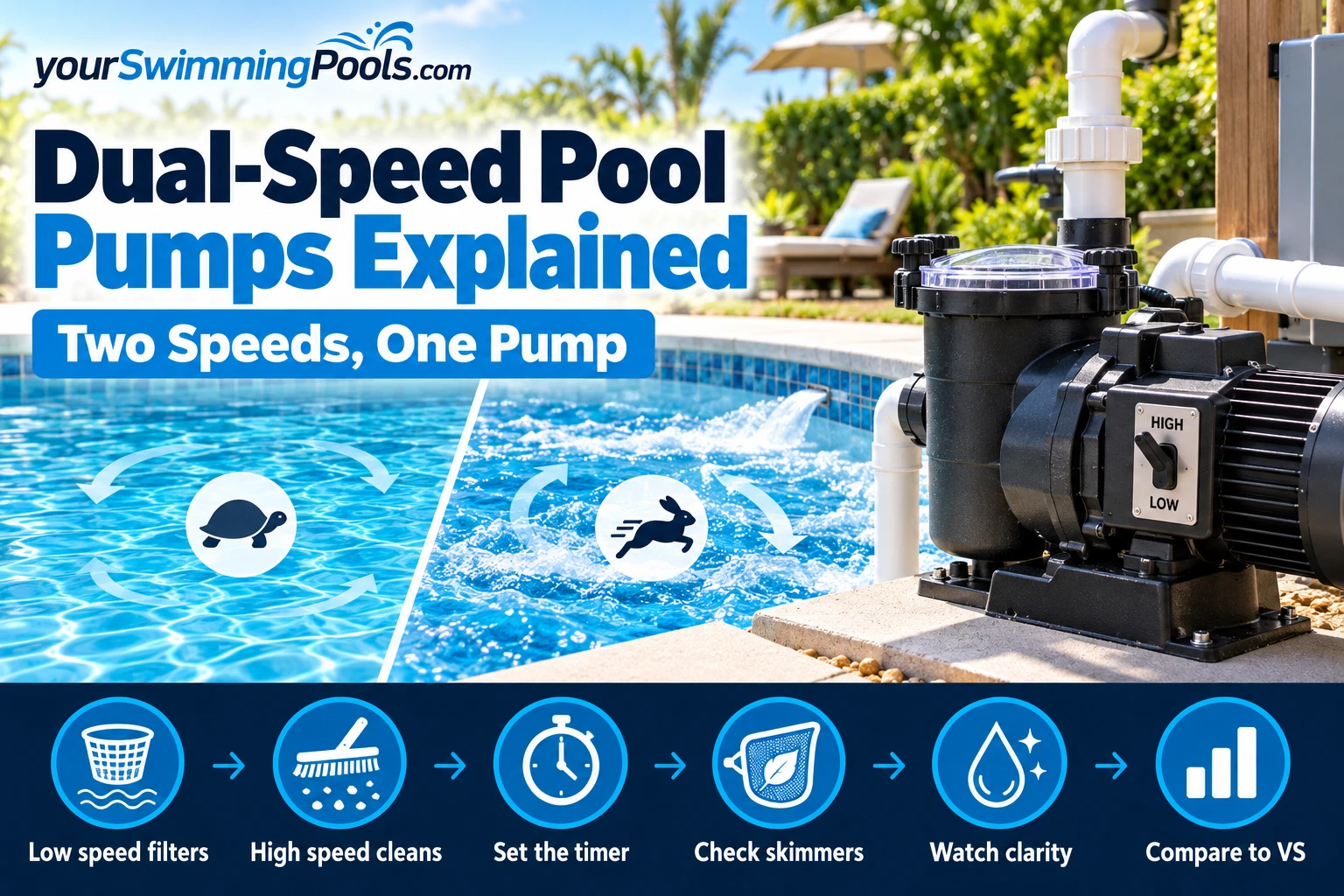
A dual-speed (two-speed) pool pump sits between a single-speed and a variable-speed pump: it has a fast speed for the heavy jobs and a slow speed for everyday filtering. It is a sensible idea with one catch: two speeds are rarely exactly the two you need. Here is how they work, how they compare, and why new rules in the US are moving pool pump motors toward variable speed.
The short version: a two-speed pump is, in the U.S. Department of Energy's words, basically two motors in one: full speed (3,450 RPM) and half speed (1,725 RPM). It saves energy compared to a single-speed pump when the low speed does the filtering, but it is much harder to fine-tune than a variable-speed pump, which DOE says can save more. Under DOE's 2023 rule, new pool pump motors from 0.5 to 5 total horsepower must have variable-speed control (compliance dates in 2025 and 2027).
How a two-speed pump works
DOE's measure guideline (2012) describes the two-speed pump as an induction motor that is "basically two motors in one", with a standard 3,450 RPM full speed and a 1,725 RPM half speed. DOE's 2023 rule explains the idea: the pump can be sized so that high-flow jobs like pool cleaning run at full speed, and low-flow jobs like filtration run at low speed.
Because power drops much faster than speed (the pump affinity law), the half speed uses far less power than full speed. How much less, and why: how a variable-speed pool pump works.
Single, dual or variable speed: side by side
| Single-speed | Two-speed | Variable-speed | |
|---|---|---|---|
| Speeds | One (typically 3,450 RPM) | Two (3,450 and 1,725 RPM) | A range you set (Pentair's SuperFlo VS: 450 to 3,450 RPM) |
| Filtering at low speed | No | Yes, at half speed | Yes, at the speed you choose |
| Fine-tuning | None | DOE: much more difficult with only two speeds | Full: program your own speeds and times |
| Energy savings | Baseline | Can be significant if the low speed does the job (DOE) | DOE: can save more than two-speed |
| Noise and wear | Full flow all the time | Lower at half speed (our reading) | DOE: reduced system wear and noise from lower flow |
The catch: when the low speed is not enough
DOE's guideline puts it plainly: if the half-speed motor cannot complete the required water circulation, the full-speed motor will run instead, and then most of the savings are gone. A variable-speed pump can pick a speed in between; a two-speed pump cannot. Signs that your low speed is too low (our advice): the skimmers barely pull in the surface, the cleaner stalls, or the water stops staying clear.
Is a two-speed pump worth it?
Compared to a single-speed pump: yes, if the low speed handles your filtering, because that is where the pump spends most of its hours (our view; DOE's guideline estimates that the high-flow jobs take roughly 10% of the running time). Compared to a variable-speed pump: DOE says variable-speed motors can save more, because you can set the speed exactly.
And there is the rule question. Under DOE's 2023 rule for pool pump motors, motors from 1.15 to 5 total horsepower must have variable-speed control from September 29, 2025, and motors from 0.5 to under 1.15 total horsepower from September 28, 2027. A two-speed motor is not a variable-speed motor. What that means if you have one, or are about to buy one: are single-speed pool pumps being phased out?
"My two-speed pump only runs on low"
Our advice: a two-speed pump is switched between its speeds by a timer, controller or switch, so if it never goes to high speed, check that control first: the timer settings, the speed switch, and whether the controller is set to call for high speed. If the control is right and the motor still will not run on high, the motor itself needs checking by someone qualified; see replace the motor or the whole pump?
Sources
Two motors in one, 3,450 and 1,725 RPM, fine-tuning and the 10% point: U.S. Department of Energy, Building America Measure Guideline: Replacing Single-Speed Pool Pumps with Variable Speed Pumps (May 2012). How two-speed and variable-speed motors are used, their savings, wear and noise, and the compliance dates: DOE final rule, Energy Conservation Standards for Dedicated-Purpose Pool Pump Motors (2023) and DOE: Dedicated-Purpose Pool Pump Motors. Speed range: Pentair SuperFlo VS Installation and User's Guide. Points marked as ours are our own advice.
Frequently asked questions
What is a dual-speed pool pump?
A pump with two fixed speeds, typically 3,450 RPM (full) and 1,725 RPM (half). DOE describes it as basically two motors in one.
Is a two-speed pump better than a single-speed pump?
For energy, it can be, when the low speed does the everyday filtering. If the low speed cannot circulate the pool well enough, the pump ends up running on high and the savings disappear.
Two-speed or variable-speed?
DOE says variable-speed motors can save more energy than two-speed motors, because you can set the exact speed you need. They can also reduce system wear and noise.
Are two-speed pool pumps still allowed?
Under DOE's 2023 rule, new pool pump motors from 1.15 to 5 total horsepower must have variable-speed control from September 29, 2025, and from 0.5 to under 1.15 total horsepower from September 28, 2027. Details in are single-speed pool pumps being phased out?
