A pool pump is one of the bigger electricity users in a home with a pool. The U.S. Department of Energy says pool pumps can use 3,000 to over 5,000 kWh a year. A variable-speed pump can cut that a lot, and you can work out your own number in two minutes. No bill shock required, just a multiplication.
The short version: electricity use is watts times hours. In DOE's example for a 25,000-gallon pool, a single-speed pump at 2,000 watts needs 6.3 hours for one turnover: 12.6 kWh a day. A variable-speed pump at 22 GPM drew 116 watts and needed 19 hours: 2.2 kWh a day. DOE says a variable-speed pump can reduce pool pump energy use by 50% to 75%. Your own figure depends on your speeds and hours; some variable-speed pumps, such as Pentair's SuperFlo VS, show the watts on their display.
The formula: watts times hours
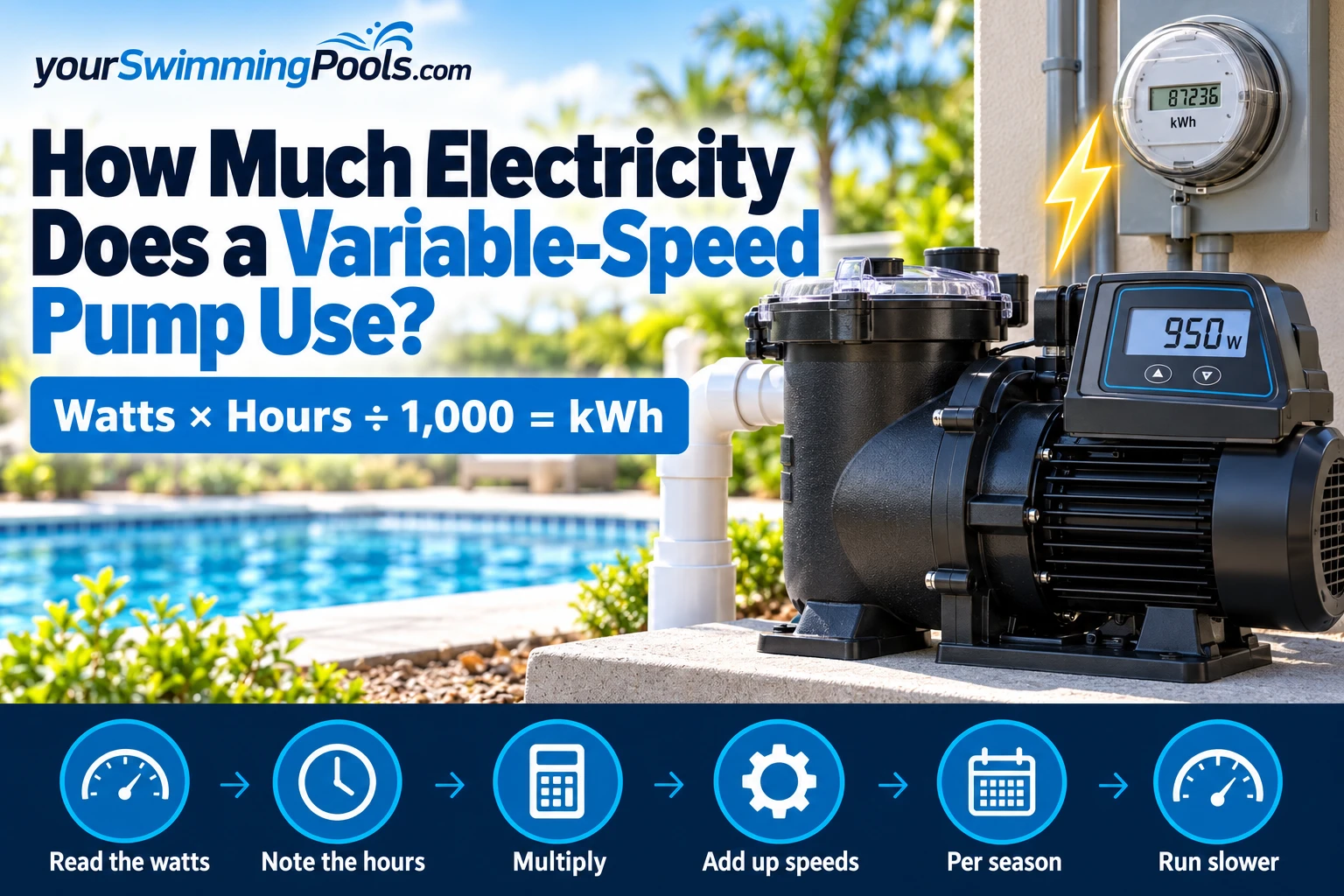
kWh per day = watts / 1,000 × hours per day. That is all. The tricky part is that watts change a lot with speed: halve the speed and the pump uses about one-eighth of the power, as both ENERGY STAR and DOE explain. Why that happens: how a variable-speed pool pump works.
DOE's example: one pool, two pumps
| Single-speed | Variable-speed (low speed) | |
|---|---|---|
| Flow | 66 GPM | 22 GPM |
| Power | 2,000 watts | 116 watts (measured) |
| Time for one turnover (25,000 gallons) | 6.3 hours | 19 hours |
| Electricity per day | 12.6 kWh | 2.2 kWh |
| Per 100 days of pool season (our calculation) | 1,260 kWh | 220 kWh |
Yes, the variable-speed pump runs three times as long and still uses less than a fifth of the electricity. That is the whole trick. Real pools also need faster periods for a cleaner, vacuuming or a heater, so your daily figure will be higher than 2.2 kWh (our note).
Work out your own number
- Find the watts at each speed. Some variable-speed pumps show it: Pentair's SuperFlo VS display can show the watts currently being consumed. Otherwise use the pump's data label or manual (our advice).
- Write down the hours at each speed from your pump's schedule.
- Multiply and add up. Example with Pentair's default schedule (our calculation, with watt readings you would take from your own display): 2 hours at 3,000 RPM + 10 hours at 1,400 RPM + 2 hours at 2,200 RPM. If your display showed 1,200, 150 and 450 watts, that is 2.4 + 1.5 + 0.9 = 4.8 kWh a day. These watt figures are an example, not Pentair's numbers.
- Multiply by your season length for a yearly figure.
Want to know how many hours you need in the first place? The pump runtime calculator works it out from your pool volume and flow.
What ENERGY STAR adds
- ENERGY STAR certifies in-ground pool pumps, above-ground pool pumps and pressure cleaner booster pumps.
- Its page says certified in-ground pool pumps use 20% less energy than standard pool pumps, and certified above-ground pumps 11% less. ENERGY STAR does not define "standard" there; it is probably a pump that just meets the federal minimum, so this is likely a different comparison from DOE's single-speed example above (our reading).
- Filtration only needs about half the flow of running a pool cleaner, ENERGY STAR says, which is exactly why a slow filtering speed saves so much.
- Hours matter too: ENERGY STAR's example is that running the filter 6 hours a day instead of 24 cuts its energy use by 75%. Run long enough to keep the water clean, but not longer (our advice).
Pumps are rated with a Weighted Energy Factor (WEF): ENERGY STAR's criteria set a minimum WEF per pump type and size. WEF is measured in thousand gallons pumped per kWh, so higher means more water per unit of electricity (our explanation).
How to use less without dirtier water
- Filter at low speed, for longer. Pentair's manual: in most cases the lowest necessary speed for the longest duration minimizes energy use.
- Speed up only for jobs that need it, like a cleaner or vacuuming.
- Keep the filter and baskets clean. A clogged filter or basket restricts flow, as Hayward's troubleshooting points out, and then the pump works harder for the same result (our note).
- Check your water, not just the meter: if it stays clear and the chlorine holds, your schedule works. The weekly pool maintenance checklist covers the checks.
Sources
Yearly use, 50% to 75% savings and the 25,000-gallon example: U.S. Department of Energy, Building America Measure Guideline: Replacing Single-Speed Pool Pumps with Variable Speed Pumps (May 2012). Savings percentages, one-eighth rule, certified types, filtration flow and hours: ENERGY STAR: Pool Pumps and ENERGY STAR Pool Pumps Key Product Criteria. Watts on the display and the lowest-speed advice: Pentair SuperFlo VS Installation and User's Guide. Restricted flow: Hayward TriStar owner's manual. Season totals and the example schedule are our own calculations.
Frequently asked questions
How many kWh does a variable-speed pool pump use?
It depends on the speeds and hours. In DOE's example, a variable-speed pump at low speed turned over a 25,000-gallon pool on 2.2 kWh a day, against 12.6 kWh for a single-speed pump.
How many watts does a variable-speed pool pump use?
Anywhere from very little at low speed to full power at top speed. DOE measured 116 watts at 22 GPM; at full speed a typical 1.5 horsepower pump draws about 2,000 watts. Some pumps, such as Pentair's SuperFlo VS, show the current watts on their display.
Does a variable-speed pump save electricity if it runs longer?
Yes, when it runs slower. Power drops much faster than speed, so 19 hours at low speed can use far less than 6.3 hours at full speed, as in DOE's example.
How much energy does an ENERGY STAR pool pump save?
ENERGY STAR says certified in-ground pool pumps use 20% less energy than standard pool pumps, and certified above-ground pumps 11% less.
