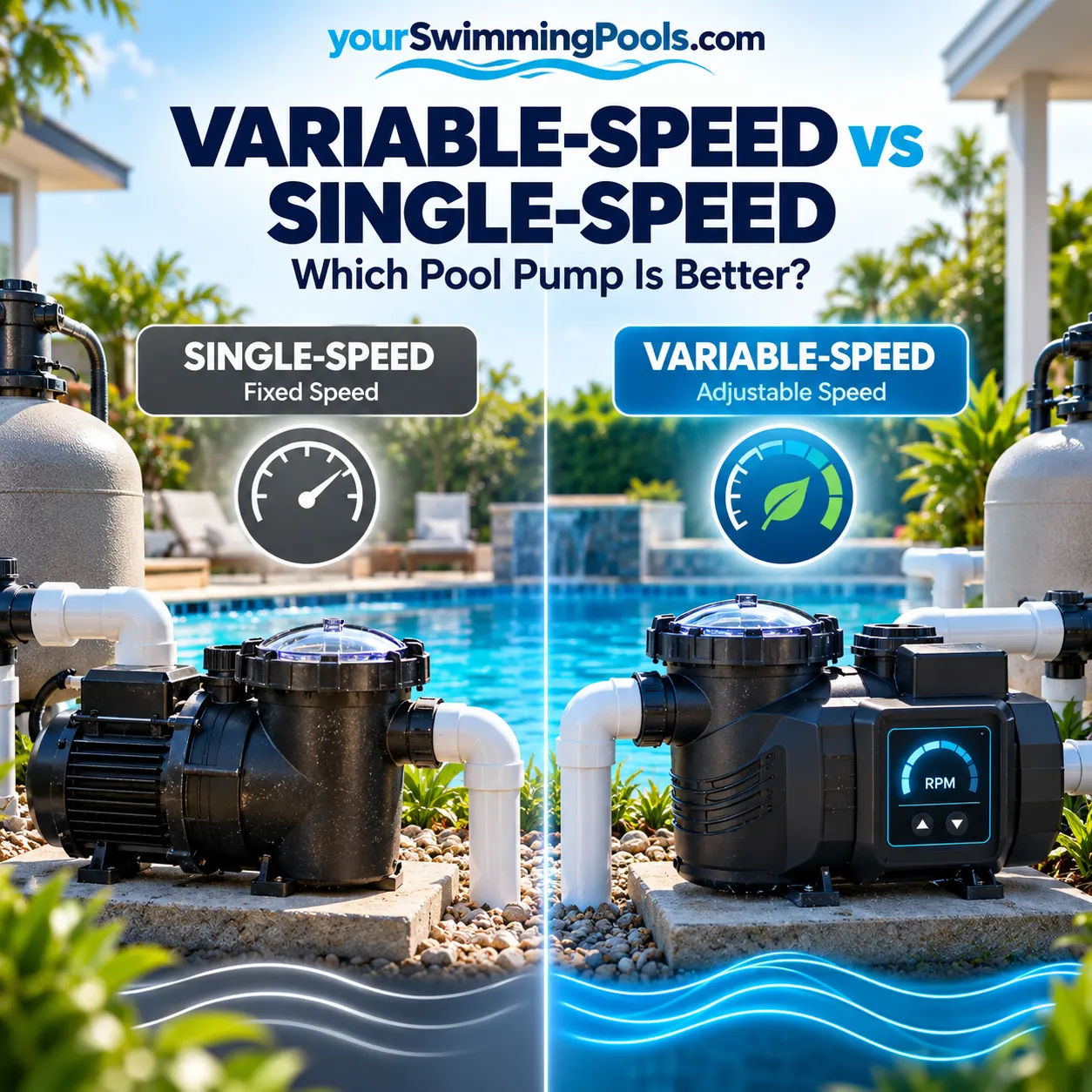
Variable-speed pumps offer more control and can use substantially less energy when operated at lower speeds for routine circulation. Whether one is the right choice for your pool depends on your equipment, electricity rate, existing pump condition, and replacement cost. Neither type is automatically the correct choice for every situation.
Variable-speed vs single-speed: the full comparison
| Feature | Single-speed | Variable-speed |
|---|---|---|
| Motor speed | Fixed - runs at one speed | Adjustable - multiple speed settings |
| Flow control | On or off | Different speeds for different tasks |
| Typical operation | Full speed whenever running | Lower speed for routine circulation; higher speed when needed |
| Energy at low speeds | N/A - always full speed | Can be dramatically lower than single-speed |
| Noise | Louder - runs at full speed | Often quieter, especially at lower speeds |
| Programming | Simple timer (on/off) | Programmable speed schedules |
| Purchase price | Generally lower | Generally higher |
| Operating cost | Higher if running full speed for long periods | Lower when correctly configured at appropriate speeds |
| Water feature support | Fixed flow | Speed can match feature requirements |
| Heating flow control | Fixed operating speed | Adjustable speed to meet heater flow requirements when heating is running |
| Salt system compatibility | Fixed flow | Speed can be set to meet salt cell’s minimum flow |
| Automation integration | Basic timer control | Often supports more advanced automation, depending on pump model and controller compatibility |
| Typical replacement consideration | Often replaced when failed | Worth considering when replacing any pump |
How single-speed pool pumps work
A single-speed pump runs at one fixed speed. When the timer turns it on, it operates at its rated speed. When the timer turns it off, it stops. There is no middle setting.
This simplicity is both its advantage and its limitation. Operation is straightforward and requires minimal setup. But the pump delivers the same flow rate whether the pool needs maximum circulation for an algae treatment or just routine quiet filtration. Every operating hour consumes the same amount of electrical energy.
Single-speed pumps typically cost less to purchase. For a small pool, a short season, or a situation where the pump runs only a few hours per day, the lower upfront cost can be attractive. The trade-off is that the operating energy is higher per hour of operation than a variable-speed pump running at a reduced speed.
How variable-speed pool pumps work
A variable-speed pump uses a different type of motor that can run at different speeds. The operator or automation system sets a speed for each task. Routine circulation might run at a lower speed; running a pressure cleaner, heating, or boosting a water feature might use a higher speed.
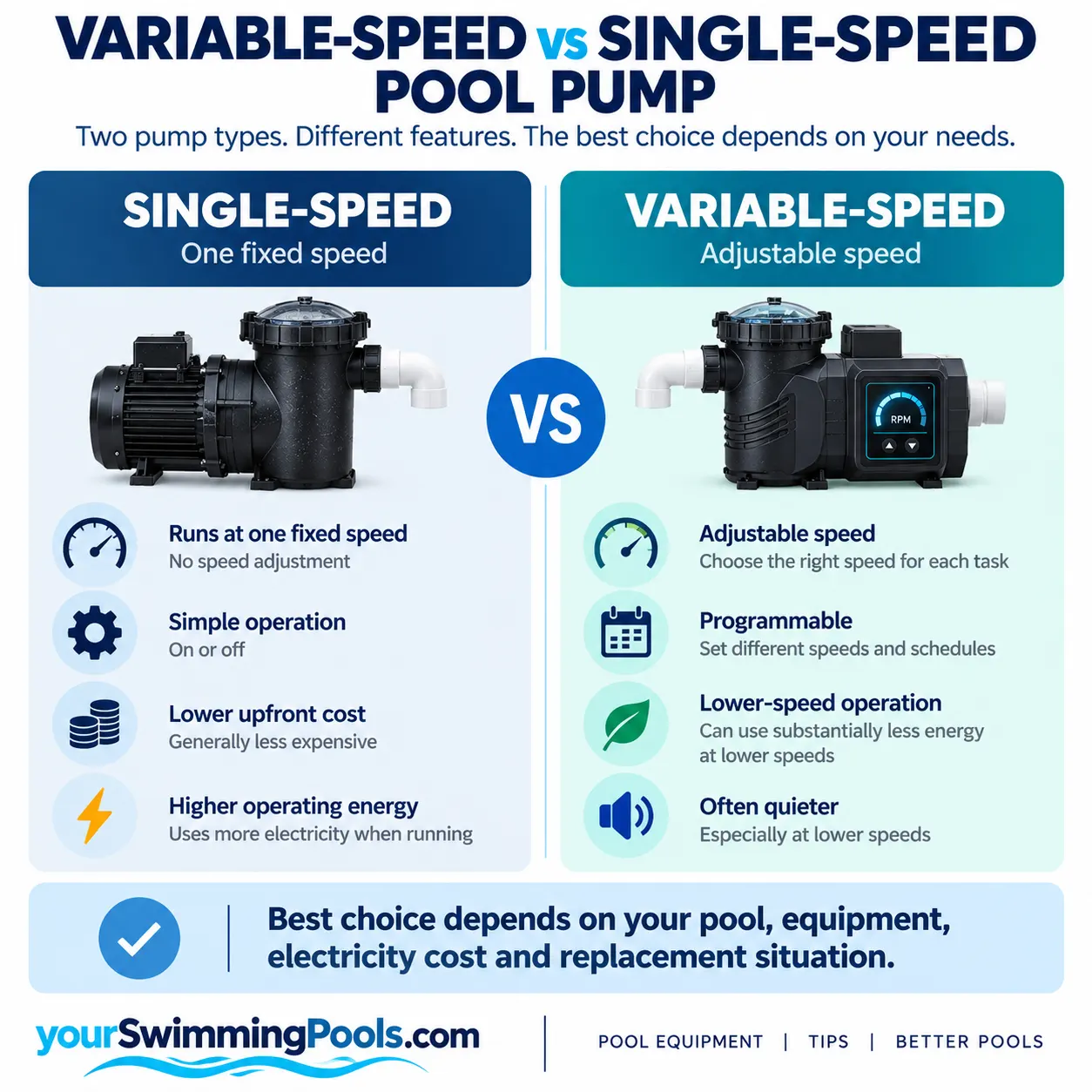
The energy benefit comes from a physical principle: reducing pump speed reduces power demand, and the reduction in power can be much greater than the reduction in speed. This is why variable-speed pumps can offer significant energy savings when operated at lower speeds for the majority of their daily runtime. The U.S. Department of Energy has cited estimates that variable-speed pool pumps can reduce pool-pump energy use substantially compared with single-speed operation, while ENERGY STAR focuses on the efficiency criteria each model must meet. Actual savings vary widely by pump model, system design, operating speeds, runtime, electricity rate, and the flow requirements of connected equipment. A manufacturer’s advertised savings figure is a best-case comparison under specific conditions, not a guaranteed result for every installation.
Energy use: why the difference can be large
The reason variable-speed pumps can be so efficient at lower speeds is that pump power does not fall in a simple one-to-one relationship with speed. When speed drops, power demand can fall much faster. This means running a pump at a lower speed for more hours can move the same volume of water while consuming substantially less total electricity than a single-speed pump running at full speed for fewer hours.
In practical terms: if a single-speed pump draws 1,500 watts and runs for 8 hours, that is 12 kWh. A variable-speed pump running at a speed that draws 400 watts for 10 hours uses 4 kWh to circulate a comparable or greater volume. The numbers in your pool will differ based on pump model, system resistance, and required flow, but the principle explains why the energy difference between the two types can be substantial.
This is only realised when the variable-speed pump is actually configured to run at lower speeds for most of its operation. A variable-speed pump running at maximum speed all day will not save much energy compared with a similar single-speed pump. The savings come from the lower-speed programming.
Noise comparison
Single-speed pumps run at one speed whenever they are on, which is typically their louder mode. Variable-speed pumps running at lower speeds are often noticeably quieter. If the equipment pad is near a living space or outdoor seating area, the quieter low-speed operation of a variable-speed pump can be a meaningful quality-of-life improvement. At higher speeds, variable-speed pumps are louder, similar to single-speed operation.
Initial cost versus long-term operating cost
Single-speed pumps generally cost less to purchase. Variable-speed pumps typically carry a higher upfront price.
Whether the variable-speed pump’s higher purchase price is recovered through lower operating costs depends on several factors specific to each installation:
- The actual electricity rate ($/kWh)
- The daily runtime at the lower speed
- The actual power draw of each pump at its operating conditions
- The price difference between the two options
- How long the pump will be in service
A simplified example: if a variable-speed pump costs $600 more to purchase and reduces annual electricity consumption by $300 in actual measured savings, the simple payback period is about 2 years. If the electricity rate is lower or the runtime is shorter, payback takes longer. If electricity is more expensive, payback is faster. This is only an example and not a prediction for any specific installation.
To make this more concrete with transparent assumptions: suppose a single-speed pump draws 1,500 watts (1.5 kW) and runs 8 hours per day. A comparable variable-speed pump running at a lower speed draws 400 watts (0.4 kW) for 10 hours to move a similar volume of water. At an electricity rate of $0.15 per kWh:
- Single-speed: 1.5 kW x 8 hrs x $0.15 = $1.80/day (~$657/year)
- Variable-speed at low speed: 0.4 kW x 10 hrs x $0.15 = $0.60/day (~$219/year)
- Estimated annual difference: ~$438/year at these assumed values
The actual figures for your pool will differ based on pump model, operating speed, runtime, system resistance, and your local electricity rate. Use the pool pump runtime calculator with the energy cost tab to estimate your own numbers.
There is no universal payback period for variable-speed pumps. Calculate your own based on your actual electricity rate and the specific pumps you are comparing.
Should you replace a working single-speed pump?
This is the question most homeowners are actually asking, and the answer is not automatic.
Replacement makes sense when:
- The existing pump is near the end of its service life or has failed
- The pump needs replacing anyway and variable-speed is available at a reasonable premium
- Electricity costs are high and the pool runs many hours daily
- Connected equipment such as a heater, salt system, or water feature would benefit from adjustable flow
- Better scheduling and automation are priorities
- Local requirements affect what can be installed (see the DOE section below)
Replacement may not be justified when:
- The existing pump is relatively new and functioning correctly
- The pool runs only a few hours per day and energy savings would be modest
- The upfront cost premium does not produce a reasonable payback at your electricity rate
- The system has simple requirements with no equipment that needs variable flow
Replacing a functioning pump purely for energy savings requires an honest payback calculation with your actual electricity rate, actual runtime, and the actual power consumption of the pumps you are comparing. Use the pool pump runtime calculator and the energy cost tab to estimate current operating cost.
What to know about variable-speed pump programming
A variable-speed pump’s efficiency advantage only materialises when it is programmed correctly. An incorrectly configured variable-speed pump can result in insufficient flow for filtration, heating, sanitizer systems, or water features.
When programming a variable-speed pump:
- Identify the minimum flow required by each piece of connected equipment and set speeds that meet those requirements
- Follow the manufacturer’s specifications for the pump, heater, salt system, and any other equipment in the loop
- Do not simply run at the lowest possible speed without confirming flow requirements are met
- For heaters and salt systems, consult the equipment manufacturer’s minimum flow specifications
There is no universal RPM that fits every system. The correct speed for routine filtration in one pool may not provide enough flow in another. Work from the actual flow requirements of your system rather than from a generic setting.
Variable-speed pumps and connected equipment
Heaters: Pool heaters commonly specify minimum and maximum flow requirements. A variable-speed pump must be set to a speed that meets the heater’s flow requirement when heating is running. This is documented in the heater’s installation manual. For example, Pentair’s MasterTemp heaters specify a minimum flow rate in their installation instructions, and Hayward’s H-Series heaters do the same. Check your specific heater model’s manual for the required GPM at the pressure drop your system produces.
Salt chlorine generators: Salt systems also have minimum flow requirements. Running the pump below the minimum flow rate for the salt cell can reduce chlorine production or trigger a low-flow error. Check the salt system’s documentation for the required flow.
Pressure-side cleaners: Some cleaners require a specific flow rate or pressure. Set the pump speed to meet the cleaner’s operating requirements when it is running.
Water features: Waterfalls, fountains, and spa spillovers may need higher flow to operate correctly. Program a higher speed during periods when water features are active.
For more on how flow requirements connect to pump operation, see pool pump flow rate explained.
DOE energy efficiency requirements
Federal efficiency requirements under 10 CFR Part 431 apply to dedicated-purpose pool pumps and pool-pump motors in the United States. These requirements affect which pump models and motors can be manufactured and distributed for covered applications. The exact requirements, compliance dates, and applicability depend on the specific pump or motor type and application category, so check the current DOE requirements and the manufacturer’s documentation when selecting a replacement pump.
The full rule and its applicability criteria are published by the DOE at energy.gov. ENERGY STAR also maintains guidance on qualified pool pump models at energystar.gov/products/pool_pumps.
The applicability of these rules depends on the pump type, horsepower, application, and installation circumstances. Not every single-speed pump is affected equally, and the rules do not make all existing single-speed pumps illegal to operate. However, they do affect what replacement pumps are available for covered applications from manufacturers and distributors.
If you are selecting a replacement pump, confirm that the pump you are considering complies with applicable federal requirements. Check the manufacturer’s documentation and, where there is any uncertainty, consult a qualified pool professional for your specific installation. Do not rely on general statements about what is or is not permitted.
110V vs 220V: does voltage affect energy consumption?
Electrical energy consumption depends on power draw (watts or kilowatts) and operating time, not simply on the supply voltage. A pump operating at 1,200 watts consumes 1.2 kWh per hour whether it is wired for 110V or 220V.
The supply voltage must match the pump’s electrical requirements and local electrical codes. A pump rated for 230V cannot simply be run on 110V. Installation voltage is an electrical compatibility and safety requirement, not a route to lower energy consumption. If you are unsure about the electrical requirements for a pump installation, consult a qualified electrician.
Who should choose which pump?
Variable-speed is worth considering if:
- You run the pump regularly, especially for many hours per day
- Electricity costs are a meaningful factor
- You want flexible flow for different tasks
- You want programmable scheduling
- You want quieter low-speed operation
- You are already replacing a pump that has failed or is near end of life
- Your system includes a heater, salt cell, or water features that benefit from adjustable flow
- Your existing single-speed pump is older and operating cost is noticeably high
Single-speed may still be appropriate when:
- Upfront cost is the primary constraint
- The existing pump is in good condition and not due for replacement
- The pool runs only a few hours per day, limiting potential savings
- The system has simple requirements with no equipment that needs variable flow
- The payback calculation at your actual electricity rate does not justify the premium
Variable-speed pump disadvantages
Variable-speed pumps are often the right choice, but it is worth understanding the trade-offs:
- Higher purchase price than a comparable single-speed pump
- More complex electronics that require programming
- Incorrect speed settings can result in insufficient flow for connected equipment
- Some equipment requires specific minimum flow that must be verified and programmed
- The energy savings depend entirely on correct configuration and appropriate lower-speed operation
- If the pump runs mostly at high speed, savings may be modest compared with single-speed operation
Can a variable-speed pump improve filtration?
A variable-speed pump running at lower speeds for longer periods can circulate the same or more total water volume than a single-speed pump running for fewer hours, potentially improving overall filtration time. However, filtration effectiveness also depends on the filter condition, media type, and flow rate relative to the filter’s design range.
Lower flow through the filter is not automatically better filtration. Very low flow may not maintain adequate turnover. Very high flow may push water through faster than the media can capture fine particles. The right flow rate for filtration depends on the filter’s specifications and the pool’s needs. For more on this, see pool filter flow rate explained.
Frequently asked questions
Is a variable-speed pool pump better than a single-speed pump? For most pools that run regularly, variable-speed pumps offer meaningful advantages in energy use, noise at low speeds, and flow flexibility. Whether they are worth the higher purchase price depends on your electricity rate, runtime, and replacement timing.
Is a variable-speed pool pump worth it? It depends on your electricity rate and runtime. A pool that runs many hours daily at a high electricity rate will see more benefit than one that runs briefly. Calculate your current annual operating cost and compare it against the price difference to estimate payback.
What are the disadvantages of a variable-speed pool pump? Higher purchase price, more complex programming, and the requirement to correctly configure speeds for all connected equipment. Energy savings are not automatic if the pump is not configured to run at lower speeds.
How much electricity can a variable-speed pump save? Actual savings depend on pump model, operating speed, runtime, electricity rate, and system design. The DOE and ENERGY STAR both publish pool-pump efficiency data, and manufacturers cite various savings figures. A realistic personal estimate requires your actual electricity rate and the measured power draw of the specific pumps you are comparing - not a generic percentage.
How long does a variable-speed pool pump last? Variable-speed pumps use permanent magnet motors. Manufacturer warranties vary by model and maker. Actual service life depends on installation quality, operating conditions, and maintenance. Single-speed pumps with induction motors also vary in longevity by model and operating conditions.
Can I replace a single-speed pump with a variable-speed pump? In most cases, yes. The new pump must be compatible with your existing plumbing, electrical supply, and any automation system. Confirm that the variable-speed pump is sized appropriately for your system’s flow requirements, not simply matched to horsepower. For sizing guidance, see pool pump sizing.
Should I run a variable-speed pump 24 hours? Not automatically. Required runtime depends on pool volume, flow rate, and water conditions, not pump type. A variable-speed pump running at low speed may need more hours to complete one turnover than a single-speed pump at full speed, but that does not mean 24-hour operation is necessary. Use the runtime calculator to find your actual requirements.
What RPM should I run a variable-speed pool pump? There is no universal answer. The correct speed depends on your pump model, plumbing, filter, and the flow requirements of each connected piece of equipment. Start from the minimum flow required by your equipment and set speeds accordingly. Consult the pump’s documentation for RPM-to-flow guidance for your specific model.
Are single-speed pool pumps being discontinued? U.S. Department of Energy efficiency standards affect what pumps can be manufactured and sold for covered applications. The specific applicability depends on pump type and installation category. Variable-speed pumps are increasingly the default for new installations and replacements in covered categories. Check current manufacturer offerings and applicable requirements for your specific situation.
Does a variable-speed pump improve filtration? It can, by running longer at lower speeds to circulate more water over the same period. But filtration quality also depends on filter condition, flow rate relative to filter specifications, and media type. More runtime alone does not guarantee better filtration.
Is a variable-speed pump quieter? Yes, at lower speeds. The lower the operating speed, the quieter the pump. At higher speeds, a variable-speed pump is similar in noise to a single-speed pump. Many pool owners notice a significant noise reduction when running at low circulation speeds overnight or during periods when the pool is not in use.
Is 220V better than 110V for a pool pump? Neither is inherently better for energy efficiency. Energy consumption depends on power draw (watts) and operating time, not supply voltage. The voltage must match the pump’s electrical requirements and local electrical codes. Installation decisions should be made based on the pump’s specifications and by a qualified electrician.
