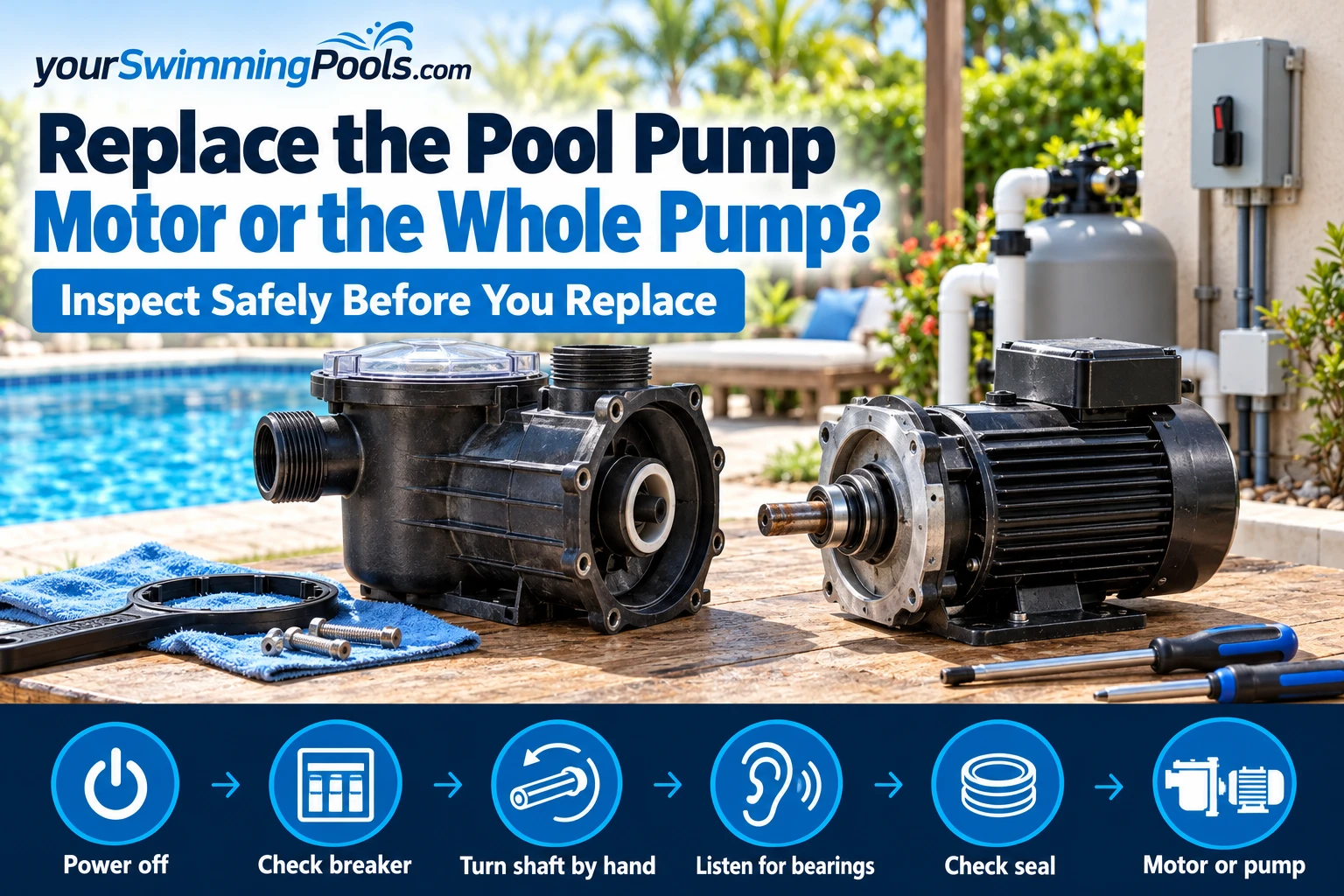
Your pool pump hums, screams, trips the breaker or just sits there. Before you order a new motor, or a whole new pump, it is worth finding out what actually failed. Quite often it is not the motor at all. And if it is, the rules for replacement motors have changed. Here is how to decide, without becoming a motor repair technician overnight.
The short version: first rule out the simple causes Hayward lists: power, breaker, timer, a jammed impeller, low voltage. A screaming or whining motor often means worn bearings, and Hayward notes that a leaking shaft seal lets chlorinated water into the bearings. A motor-only swap keeps your pump housing and plumbing, but under DOE's 2023 rule, new replacement motors from 0.5 to 5 total horsepower must have variable-speed control (from 2025 or 2027, depending on size). An old single-speed pump with a failed motor is often a good moment to switch to a variable-speed pump (our view).
First: is it really the motor?
Hayward's troubleshooting in its TriStar pump manual gives these checks. Switch off the power before touching anything inside the pump.
| What you notice | What Hayward says to check |
|---|---|
| Motor will not start | Wiring connections, open switches or relays, a tripped breaker or blown fuse; whether the shaft turns freely by hand; the timer (bypass it if needed) |
| Motor hums but does not start | An impeller jammed with debris: have a qualified repair professional open the pump |
| Motor shuts off and restarts | Low voltage or power drop, often from undersized wiring or an extension cord. The thermal overload protector switches the motor off before it overheats and keeps cycling until the cause is fixed |
| Noisy pump | Air leaks or a restricted suction line, poor mounting, debris in the housing, or worn motor bearings |
| Low flow | A clogged strainer, a dirty filter, an air leak, or a plugged or damaged impeller |
Hayward also says the voltage at the motor must be within 10% of the name plate voltage, or the motor may overheat and trip. If the problem is priming rather than the motor: why a pool pump loses prime. More symptoms: pool pump not working.
Screaming motor: bearings and the shaft seal
Hayward describes how noisy bearings happen: normal wear, rust, overheating, or chemicals damaging the seal, which lets chlorinated water seep into the bearings and wash out the grease, so the bearings whine. Its advice: replace seal leaks at once. Two practical points:
- A leaking shaft seal is a cheap part with expensive consequences if you ignore it (our view). Hayward says shaft seals occasionally need replacing due to wear or damage.
- Never run the pump dry. Hayward and Pentair both warn that running dry damages the shaft seal.
Hayward says only qualified personnel should replace the rotary seal.
Replace the motor or the whole pump?
| A new motor makes sense when (our view) | A new pump makes sense when (our view) |
|---|---|
| The pump housing, impeller and strainer are in good shape | The housing is cracked, the impeller is worn, or several parts are failing |
| You can get a matching replacement motor for your pump model | Your old single-speed pump is due anyway and you want variable-speed savings |
| Your plumbing fits the old pump and you want to keep it | The pump is too big or too small for your pool and filter |
Motor-only replacement is common: industry and efficiency groups told DOE that the motor on a pool pump often fails before the pump itself. That is exactly why DOE made a rule for replacement motors, so a new efficient pump does not end up with a less efficient replacement motor.
What the rules mean for a replacement motor
Under DOE's 2023 rule for pool pump motors, motors from 1.15 to 5 total horsepower must have variable-speed control from September 29, 2025, and motors from 0.5 to under 1.15 total horsepower from September 28, 2027. The rule applies to motors sold in new pumps and to motors sold on their own as replacements. So a like-for-like single-speed motor may not be available any more for your size (our reading). The details: are single-speed pool pumps being phased out?
If you replace the whole pump
- Size it right, not bigger "to be safe": what size pool pump do I need?
- Check the voltage of your circuit: pool pump voltage, 115V vs 230V.
- Consider variable speed: how much electricity a variable-speed pump uses, and our picks for variable-speed pool pumps, inground pumps and above-ground pumps.
Pumps and motors use mains voltage next to water. Pentair's manual says its pump must be installed by a licensed or certified electrician or a qualified service professional, and Hayward says its pumps should be installed and serviced only by a qualified professional.
Sources
Troubleshooting, voltage tolerance, thermal overload, bearings and shaft seals: Hayward TriStar Pump Series owner's manual (IS3200 Rev. M). Running dry: the same manual and Pentair SuperFlo VS Installation and User's Guide. Motor-only replacements and the motor rule: DOE final rule for dedicated-purpose pool pump motors and DOE: Dedicated-Purpose Pool Pump Motors. The motor-or-pump table is our own view.
Frequently asked questions
Why does my pool pump motor hum but not start?
Hayward's first check is an impeller jammed with debris; have a qualified repair professional open the pump. For a motor that will not start, Hayward also says to check that the shaft turns freely by hand (power off).
Why is my pool pump motor screaming?
Often worn bearings. Hayward says a damaged seal can let chlorinated water into the bearings and wash out the grease, which makes them whine. Fix seal leaks at once.
Can I replace just the motor on my pool pump?
Often, yes, if the rest of the pump is in good shape and a matching motor is available. Under DOE's rule, replacement motors from 0.5 to 5 total horsepower must have variable-speed control from their compliance date.
Why does my pool pump keep shutting off?
Hayward points to low voltage or a power drop, often from undersized wiring or an extension cord. The thermal overload protector switches the motor off and on until the cause is fixed.
