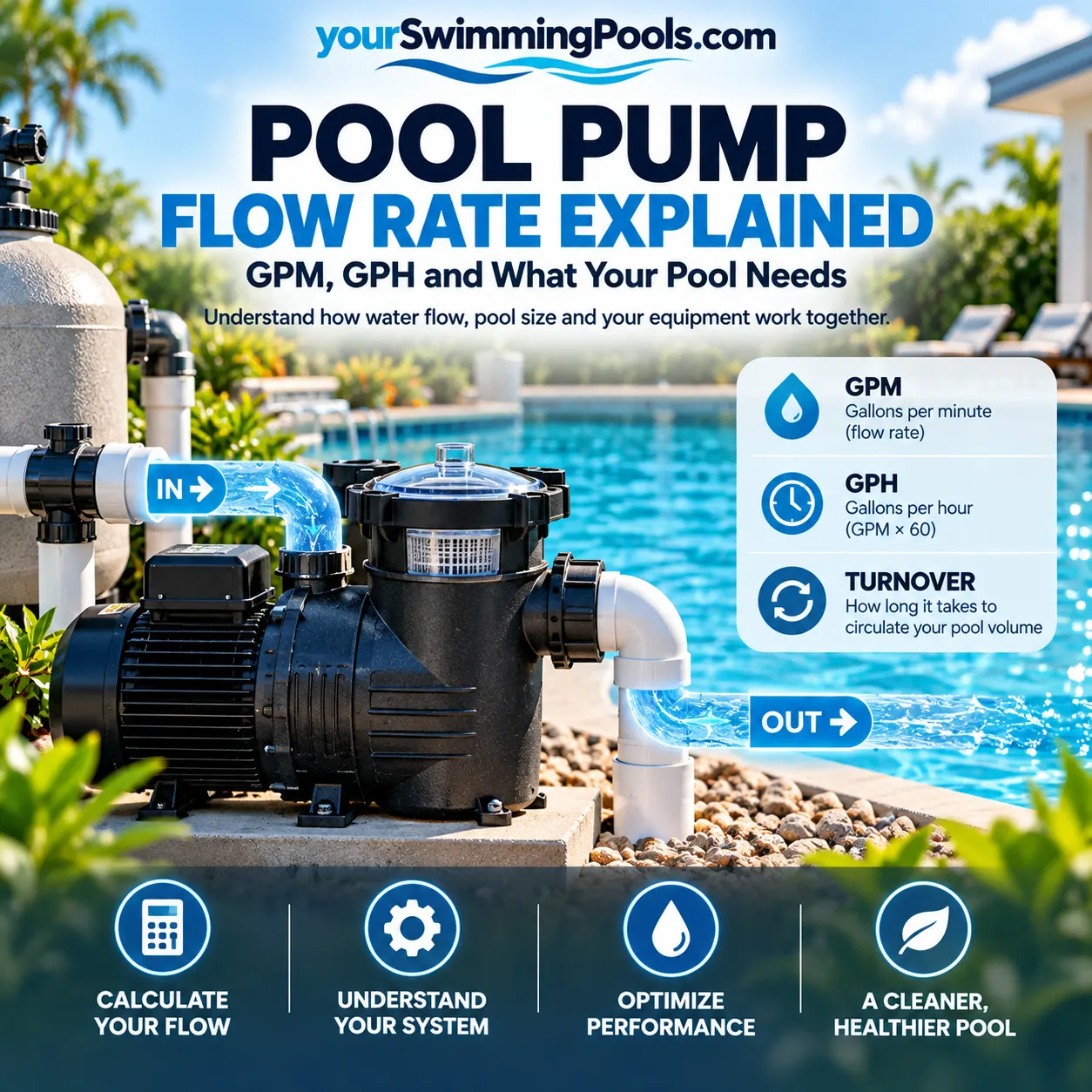
Pool pump flow rate is the volume of water your pump moves through the system in a given time. It is measured in GPM (gallons per minute) or GPH (gallons per hour). Understanding flow rate matters because it connects three things that pool owners need to reason about separately: what the pump can do, what the installed system actually delivers, and what the pool genuinely requires.
What is pool pump flow rate?
Flow rate is the volume of water moving through a point in the system per unit of time. For pool pumps:
- GPM (gallons per minute): How many gallons pass a point in the system each minute
- GPH (gallons per hour): How many gallons pass a point each hour
Flow rate is not the same as pump power or horsepower. A pump rated at 1.5 HP does not automatically deliver a specific GPM. Two 1.5 HP pumps from different manufacturers can deliver very different flow rates in the same installed system, depending on pump design, impeller size, and how the pump performs at the hydraulic resistance the system presents.
GPM vs GPH: the conversion
The relationship is fixed:
| GPM | GPH |
|---|---|
| 20 GPM | 1,200 GPH |
| 30 GPM | 1,800 GPH |
| 40 GPM | 2,400 GPH |
| 50 GPM | 3,000 GPH |
| 60 GPM | 3,600 GPH |
| 80 GPM | 4,800 GPH |
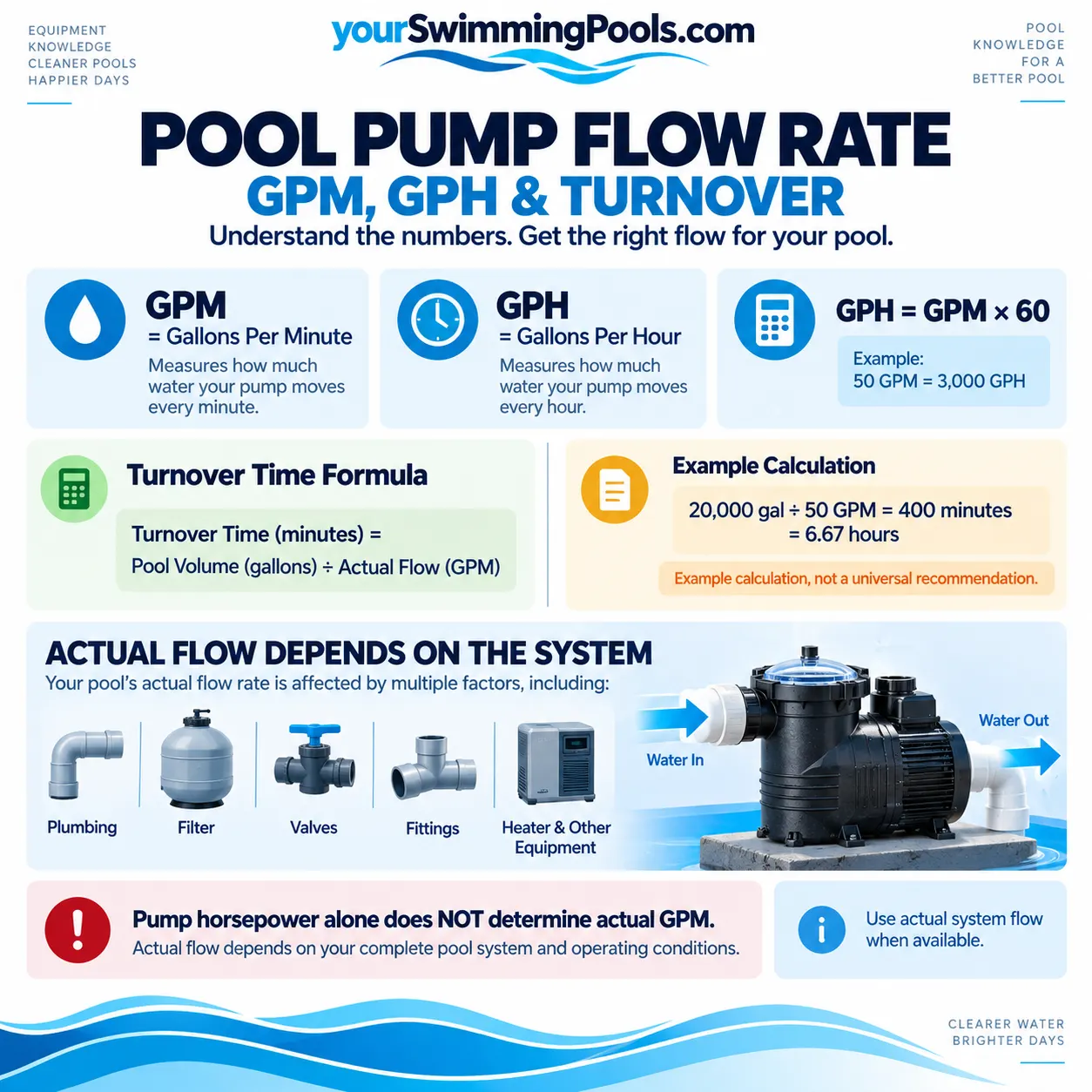
Equipment specifications use both units. Filters are often rated in GPM while some pump specifications list GPH. Convert between them to make meaningful comparisons. The conversion is always multiplication or division by 60.
How pool flow rate connects to turnover
Turnover is the time it takes to move a total volume of water equal to your pool’s volume through the filtration system. The relationship between pool volume, flow rate, and turnover is:
Divide by 60 to convert minutes to hours.
Example (not a universal recommendation):
A 20,000 gallon pool with 50 GPM actual system flow:
- 20,000 ÷ 50 = 400 minutes
- 400 ÷ 60 = 6.67 hours per turnover
This is a mathematical result from these two inputs. It is not a statement that every 20,000 gallon pool should run at 50 GPM, or that 6.67 hours is the correct runtime for every pool. Different pools have different flow rates and different runtime requirements.
How much GPM does a pool need?
There is no single GPM figure that fits every pool. The required flow depends on the chosen turnover target and the pool’s volume. Different turnover targets produce different required flow rates for the same pool.
Formula:
Calculated required GPM by pool volume and turnover target:
| Pool volume | 8-hour turnover | 10-hour turnover | 12-hour turnover |
|---|---|---|---|
| 10,000 gal | 20.8 GPM | 16.7 GPM | 13.9 GPM |
| 15,000 gal | 31.2 GPM | 25.0 GPM | 20.8 GPM |
| 20,000 gal | 41.7 GPM | 33.3 GPM | 27.8 GPM |
| 25,000 gal | 52.1 GPM | 41.7 GPM | 34.7 GPM |
| 30,000 gal | 62.5 GPM | 50.0 GPM | 41.7 GPM |
The calculated required GPM is a starting point. It is the minimum flow the system needs to deliver during pump runtime to achieve the target turnover. It is not a pump size recommendation by itself. The actual pump selection must also account for filter flow limits, plumbing, and system resistance.
Why actual flow can be lower than the pump’s rated flow
A pump’s specification sheet lists a flow rate. That figure is typically measured under controlled laboratory conditions at a specific resistance (head pressure). When the same pump is installed in your pool system, the actual delivered flow will depend on the hydraulic resistance the system presents and may be lower than the specification figure.
The gap between rated flow and actual system flow exists because of hydraulic resistance. Every component the water passes through adds resistance:
- Pipe diameter and length: Narrower or longer pipe adds more resistance
- Elbows and fittings: Each turn and fitting creates turbulence and resistance
- Valves: Even fully open valves add some restriction
- Filter: A dirty or loaded filter adds more resistance than a clean one
- Heater: Adds resistance when in the loop
- Salt chlorine generator: Adds resistance when in the loop
- Pressure-side cleaner booster: Changes flow dynamics
- Water features: Additional flow paths change system behavior
- Elevation changes: Lifting water requires more pump energy
The total of all these resistances is called total dynamic head (TDH). As TDH increases, the pump delivers less flow. This relationship is shown on a pump performance curve, which plots flow rate against head pressure for a specific pump model. The point where the pump’s curve intersects with your system’s resistance curve is the actual operating point.
This is why comparing pumps by horsepower or by peak-rated GPM is unreliable. Two pumps with the same horsepower and similar peak flow can perform very differently in a real installed system, depending on how their pump curves behave at the resistance level your system presents.
For more on how these four flow numbers relate to each other from the filter’s perspective, see pool filter flow rate explained. For pump-sizing using calculated required flow, see pool pump sizing.
Pool pump flow rate and filter compatibility
The filter in your system has its own flow rating. Most manufacturers publish a maximum flow rate for each filter model. The actual system flow should stay within the filter’s designed operating range.
If actual flow exceeds the filter’s rated maximum, water moves through the media faster than the filter is designed to handle, which can compromise filtration and potentially stress the filter. If actual flow is too low, turnover takes longer and may not be adequate for the pool’s needs.
This creates a practical constraint: the pump must deliver enough flow to meet the pool’s turnover needs, but not so much that it exceeds the filter’s rated limits. Pump selection must consider both the pool’s flow floor (minimum required) and the filter’s flow ceiling (maximum permitted).
The pool filter sizing page covers how to match the filter to your system’s flow requirements.
Does horsepower determine GPM?
No. Horsepower describes the motor’s power output, not the volume of water the pump delivers in your installed system.
A pump’s delivered GPM in a real installation depends on:
- The pump’s hydraulic design (impeller, volute, housing geometry)
- The total hydraulic resistance the system presents
- The speed at which the pump is running (for variable-speed pumps)
Two pumps rated at 1.5 HP can deliver very different GPM in the same system if they have different hydraulic designs and pump curves. A 2 HP pump installed in a restrictive system with long pipe runs and many fittings may deliver less flow than a 1.5 HP pump in a well-designed low-resistance system.
This is why sizing by horsepower is unreliable. The meaningful numbers are the actual flow at the operating conditions of your system, and whether that flow meets the pool’s requirements while staying within the filter’s limits. See what size pool pump do I need for the correct sizing approach.
Can a pool pump be too powerful?
Yes, depending on the system.
More pump power does not automatically mean better filtration or cleaner water. Excessive flow can:
- Exceed the filter’s rated maximum flow, potentially reducing filtration effectiveness and stressing the filter
- Create higher velocities in the plumbing that increase energy waste
- Put unnecessary stress on connections and fittings
- Deliver flow that exceeds what connected equipment (heaters, salt systems) can handle
Selecting a pump solely because it has a higher peak GPM than needed can create problems at every component downstream of the pump. The goal is a pump that delivers sufficient flow to meet the pool’s needs while respecting the limits of the filter and plumbing.
Pool pump flow rate and variable-speed pumps
Variable-speed pumps add another dimension: speed. A variable-speed pump operating at lower RPM delivers lower flow and uses substantially less energy than the same pump at higher RPM. This means the actual GPM from a variable-speed pump changes based on the programmed speed.
When calculating turnover or checking system compatibility for a variable-speed pump, use the flow rate at the operating speed you plan to run for routine circulation, not the maximum rated flow. A pump rated at 80 GPM peak may deliver 25 GPM at the low speed used for routine filtration. Those are very different operating conditions.
For more on variable-speed pump operation and its relationship to runtime and flow, see variable-speed vs single-speed pool pump.
GPM and pump runtime
Flow rate and runtime work together. Higher actual flow means a faster turnover for the same pool volume. Lower flow means the pump needs to run longer to achieve the same circulation.
This relationship is why the pool pump runtime calculator asks for actual flow rate, not pump horsepower. The runtime estimate only means something if it is based on the flow your system actually delivers, not a rated peak that your installed system may not reach.
For a full explanation of how to determine required runtime, see how long should you run your pool pump.
How to find your actual pool pump flow rate
Several practical approaches can help you determine what your system actually delivers:
1. Variable-speed pump display. Many modern variable-speed pumps show real-time or estimated flow on the control panel. This is the most convenient source, though it is a calculated estimate from the pump’s operating data rather than a direct measurement.
2. Pump curve from the manufacturer. Find your pump’s published performance curve and note the total head your system presents. The flow at that head point is your approximate operating flow. Manufacturer technical documentation is typically available on the manufacturer’s website. Pentair publishes performance curve data for its pump models in their technical documentation, showing how GPM changes with total dynamic head, which is the relationship this article describes. ENERGY STAR publishes a directory of certified pool pump models at energystar.gov/products/pool_pumps that includes pump efficiency data.
3. Flow meter. A properly installed flow meter provides a direct measurement of actual system flow. Accuracy depends on the meter type, installation position, pipe conditions, and whether the meter has been calibrated.
4. Qualified pool professional. For systems where exact hydraulic performance matters, such as when selecting new equipment or troubleshooting poor circulation, a qualified pool professional can assess the system and measure or calculate actual flow.
What you should not do: assume that the GPM on the pump box or in the manufacturer’s marketing materials is the flow your pool receives. That figure may be measured under a specific test condition and should not be assumed to represent the flow your installed system will deliver.
Sources
- ENERGY STAR: Pool Pumps certified product directory - U.S. government-backed directory of energy-efficient pool pumps with performance data.
- Pentair: Pool pump technical documentation - Manufacturer performance curves showing GPM vs total dynamic head for specific pump models.
FAQ
What is a good flow rate for a pool pump? A useful flow rate is one that provides enough circulation for your pool’s turnover needs without exceeding the filter’s rated maximum flow. There is no single “good” GPM that applies to every pool. The appropriate flow depends on pool volume, the turnover target, and the filter’s specifications.
How many GPM does my pool need? Divide your pool volume by the turnover time in minutes. For an 8-hour turnover target: pool volume ÷ 480 = required GPM. For 10 hours: pool volume ÷ 600. The table above shows these results for common pool sizes. Remember these are the minimum required flow rates, not pump recommendations.
How do I calculate pool pump GPM? The turnover formula is: pool volume (gallons) ÷ actual flow (GPM) = turnover time in minutes. Rearranged to find required GPM: pool volume ÷ turnover time in minutes = required GPM. The runtime calculator handles this calculation interactively.
How many GPM for a 15,000 gallon pool? It depends on the target turnover time. At 8 hours: 15,000 ÷ 480 = 31.2 GPM. At 10 hours: 15,000 ÷ 600 = 25.0 GPM. At 12 hours: 15,000 ÷ 720 = 20.8 GPM. None of these is a universal recommendation; they are the flow rates needed to achieve each turnover time in a 15,000 gallon pool.
How many GPM for a 20,000 gallon pool? At 8 hours: 20,000 ÷ 480 = 41.7 GPM. At 10 hours: 20,000 ÷ 600 = 33.3 GPM. At 12 hours: 20,000 ÷ 720 = 27.8 GPM. These are calculated required flow rates for a 20,000 gallon pool at different turnover targets.
How many GPM for a 30,000 gallon pool? At 8 hours: 30,000 ÷ 480 = 62.5 GPM. At 10 hours: 30,000 ÷ 600 = 50.0 GPM. At 12 hours: 30,000 ÷ 720 = 41.7 GPM.
How many GPH does a pool pump move? GPH = GPM × 60. A pump delivering 40 GPM moves 2,400 GPH. A pump delivering 50 GPM moves 3,000 GPH. The conversion is the same regardless of pump type or pool size.
Can a pool pump be too powerful? Yes. Excessive flow can exceed the filter’s rated maximum, stress plumbing connections, and waste energy without improving water quality. Pump power should be matched to the system’s actual flow requirements, not simply maximised.
Does horsepower determine GPM? No. Horsepower describes motor power, not delivered flow. Two pumps with the same horsepower can deliver different GPM depending on their hydraulic design and the resistance of the installed system. Use actual flow data (from the pump curve or a measurement) rather than horsepower for sizing decisions.
Does pipe size affect pool pump flow? Yes. Narrower pipe creates more resistance and reduces delivered flow. Longer pipe runs also add resistance. The complete plumbing system, including diameter, length, fittings, and valves, affects the total dynamic head that the pump works against, which in turn determines the actual delivered flow.
Does filter size affect flow? Yes, in two ways. First, the filter must be sized to handle the flow the pump delivers without exceeding its rated maximum. Second, as the filter media loads with debris over time, resistance increases and actual flow can decrease. A dirty filter with high pressure typically delivers less flow than the same filter when clean.
