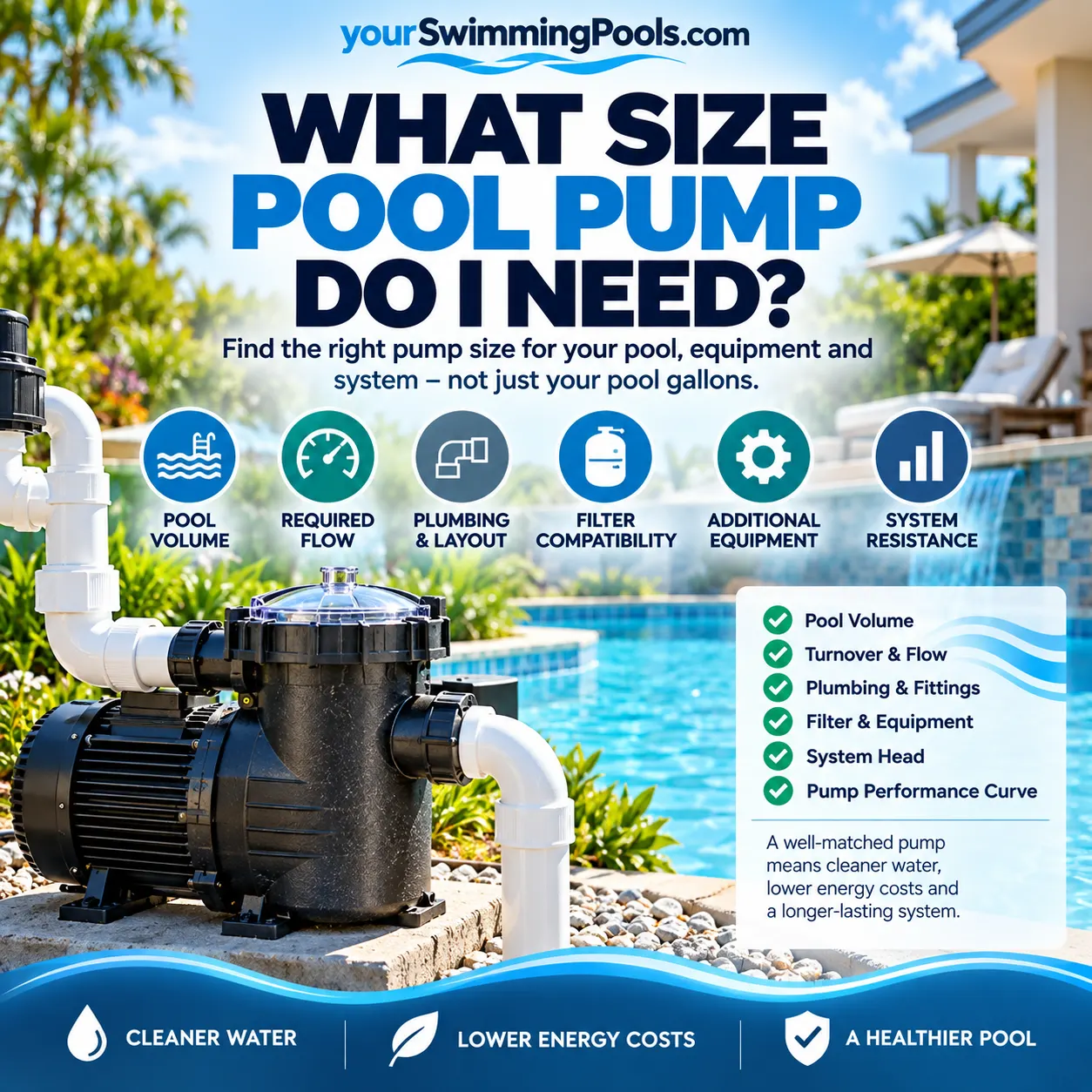
The right pool pump size is not determined by pool gallons alone. Selecting a pump that works well means finding one that delivers the flow your pool and equipment need, at the hydraulic resistance your plumbing and system present, without exceeding your filter’s rated capacity or your equipment’s operating requirements.
What actually determines pool pump size?
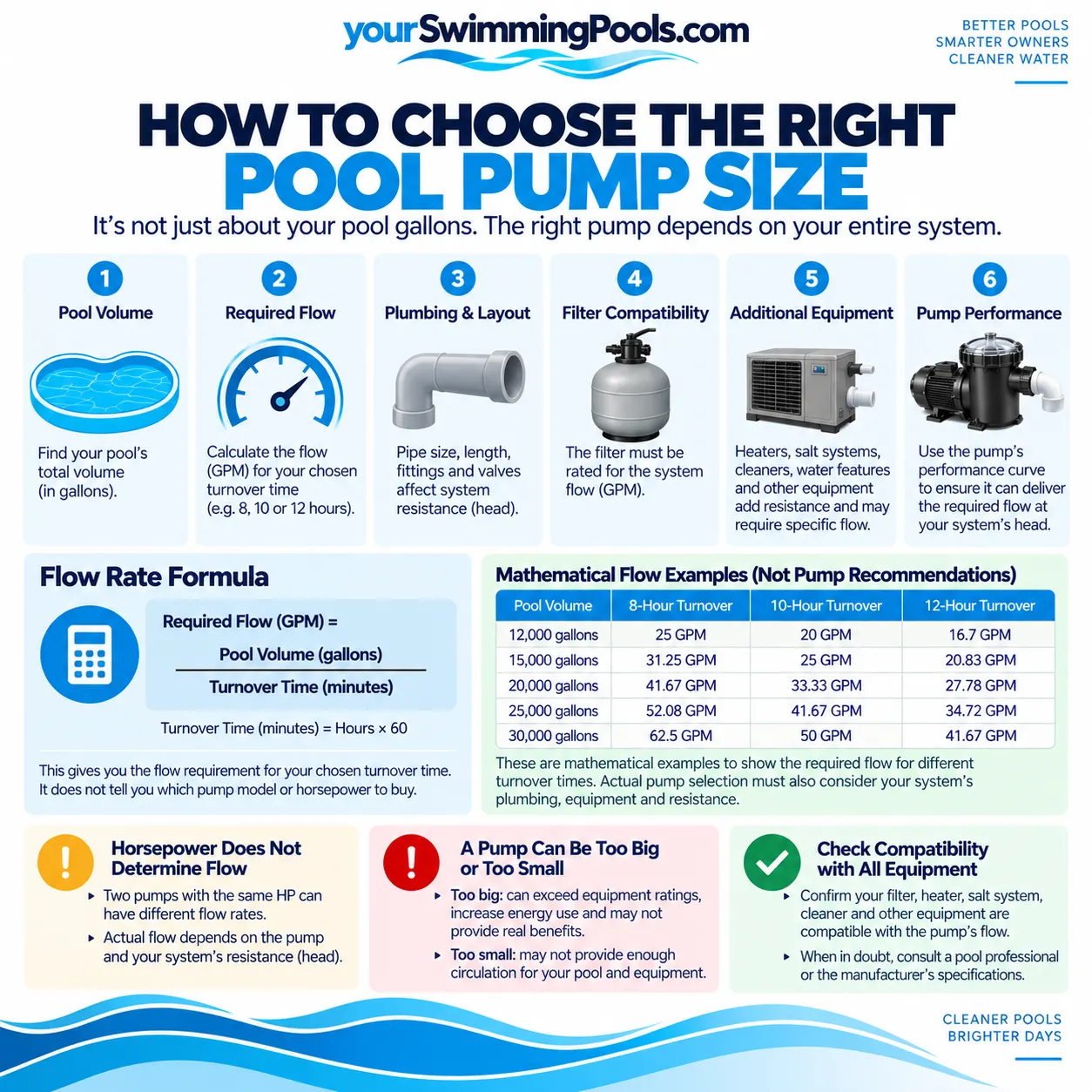
Seven factors together determine whether a pump is sized correctly for a pool system. Pool volume is only the first.
Determines how much water needs to circulate. Larger pool volume requires either more flow or more time to complete one turnover.
The GPM the system must deliver to meet the chosen turnover target. Calculated from pool volume and turnover time, not from horsepower.
Pipe diameter, pipe length, number of fittings, elbows, and valves all add hydraulic resistance. The same pump delivers different flow in different plumbing configurations.
The filter has a rated maximum flow. The pump must deliver enough flow to meet circulation needs without exceeding the filter's design limit.
Heaters, salt chlorine generators, pressure-side cleaners, water features, and other in-line equipment all add resistance and may have minimum flow requirements.
The total hydraulic resistance the pump works against. Determines where the pump operates on its performance curve and what flow it actually delivers.
The relationship between flow and head for the specific pump model. The correct pump delivers the required flow at the system's operating head.
Pentair’s pool pump documentation notes that pump sizing should consider pool size, installed equipment, features, and pipe size, and that every pool is unique. The factors above reflect that system-level thinking.
Calculate your required flow rate
The starting point is a flow requirement, not a horsepower number. The formula is:
Turnover time in minutes = target hours × 60
Worked example (mathematical only, not a universal recommendation):
A 20,000 gallon pool with a target turnover time of 8 hours:
- 8 hours × 60 = 480 minutes
- 20,000 ÷ 480 = 41.67 GPM
This 41.67 GPM is the calculated flow requirement for this turnover target. It is a planning number, not a pump model selection. The next step is finding a pump that can actually deliver that flow in your installed system, not simply buying the pump whose label says 41 GPM.
Use the pool pump runtime calculator to run this calculation for your pool volume and flow rate.
Mathematical flow examples by pool volume
These figures show the calculated flow requirements for different pool volumes and turnover targets. They are mathematical examples only and do not constitute pump recommendations or universal turnover requirements.
| Pool volume | 8-hour turnover | 10-hour turnover | 12-hour turnover |
|---|---|---|---|
| 12,000 gal | 25.0 GPM | 20.0 GPM | 16.7 GPM |
| 15,000 gal | 31.3 GPM | 25.0 GPM | 20.8 GPM |
| 20,000 gal | 41.7 GPM | 33.3 GPM | 27.8 GPM |
| 25,000 gal | 52.1 GPM | 41.7 GPM | 34.7 GPM |
| 30,000 gal | 62.5 GPM | 50.0 GPM | 41.7 GPM |
These numbers are the minimum flow rates needed to achieve the stated turnover time for each pool volume. They do not specify horsepower, pump model, or voltage. Selecting the pump requires the additional steps described below.
The appropriate turnover target depends on your pool’s design, usage, applicable local or regional requirements, and equipment. There is no single turnover target that applies to every residential pool.
Why horsepower does not determine pump size
Horsepower describes motor power, not delivered flow. You cannot reliably select a pool pump based on the HP number alone.
Two pumps with the same HP rating can produce different flow rates in the same system, depending on their hydraulic design (impeller geometry, volute design) and how their performance curves behave at your system’s resistance level.
A 1.5 HP pump from one manufacturer may deliver more or less flow than a 1.5 HP pump from another manufacturer, in the same plumbing system, at the same operating head. The only way to know is to consult the performance curves for each specific model.
For a full explanation of why HP and GPM are not interchangeable, see pool pump flow rate explained.
How pump performance curves determine actual flow
A pump performance curve plots the pump’s flow (GPM) against the system head (resistance). As head increases, flow decreases. As head decreases, flow increases. The point where the pump’s performance curve intersects your system’s resistance curve is the actual operating point, which determines the flow your pool actually receives.
This means:
- A pump that delivers 60 GPM at low head may only deliver 40 GPM at the head your system presents
- Adding a heater, salt system, or longer pipe runs increases head and reduces actual flow
- The same pump in a different pool with different plumbing will operate at a different point on its curve
Pentair’s technical pump documentation publishes performance curves showing GPM at different head pressures for each specific pump model. Selecting a pump requires checking its curve at your estimated system head, not just reading the maximum GPM from the label.
Filter and equipment compatibility
Filter
The filter must handle the flow the pump delivers. Most filter manufacturers publish a maximum flow rating for each model. If the pump delivers more flow than the filter’s rated maximum, you risk exceeding the filter’s design limits, which can compromise filtration and stress the filter.
At the same time, flow needs to be sufficient for the pool’s circulation requirements. Both limits need to be respected. For help finding the right filter-to-flow match, see the pool filter sizing calculator.
Heater
Most pool heaters specify a minimum flow rate for safe operation. Consult the heater’s documentation for the required GPM at your system’s pressure drop. The pump must be able to provide that minimum flow when the heater is in the loop.
Salt chlorine generator
Salt systems have minimum flow requirements. Running below the minimum flow rate can reduce chlorine production or trigger safety shutoffs. Check the salt cell’s documentation for its required flow range.
Pressure-side cleaner
Some cleaners require a dedicated booster pump. Others require specific flow from the main pump. Consult the cleaner’s documentation.
Water features
Waterfalls, fountains, and spa spillovers may require additional flow. Variable-speed pumps can often be set to a higher speed when features are active.
Can a pool pump be too big?
Yes. An oversized pump can deliver more flow than the system is designed for, which creates several problems:
- Exceeding filter capacity: If the pump delivers more flow than the filter’s rated maximum, filtration quality can suffer and system pressure increases unnecessarily
- Unnecessary energy use: A pump delivering significantly more flow than needed runs at higher energy cost without practical benefit
- Exceeding equipment limits: Heaters, salt cells, and other in-line equipment have their own flow limits. Exceeding them can affect performance and longevity
- Increased system stress: Higher velocities in undersized plumbing increase pressure and can accelerate wear on seals and fittings
Bigger is not better in pool pump sizing. The goal is a pump that meets the system’s flow requirements without unnecessary excess.
Can a pool pump be too small?
Yes. Insufficient flow creates its own problems:
- Inadequate circulation: Not enough water turnover to maintain water quality
- Poor skimming and filtration: Reduced flow can leave dead spots and reduce the skimmer’s effectiveness
- Equipment underperformance: Heaters and salt systems that do not receive their minimum required flow may operate inefficiently or trigger safety warnings
- Longer runtime needed: A lower-flow pump must run longer to achieve the same turnover, which may increase total energy use
The right pump delivers adequate flow for the system’s requirements, neither significantly more nor significantly less.
Variable-speed pump sizing
Variable-speed pumps add flexibility because they can run at different speeds. This changes the sizing approach in important ways.
A VS pump can often be used at low speed for routine circulation (lower flow, lower energy) and a higher speed when specific tasks require more flow, such as running a water feature or meeting a heater’s minimum flow requirement.
For sizing purposes, the question is not only “what is the peak rated flow?” but “can this pump deliver the required flow efficiently at each speed the system needs?”
A variable-speed pump with an appropriately sized motor and hydraulic design can often serve a wider range of operating conditions than a single-speed pump. However, a VS label does not automatically make any pump appropriate for any pool. The performance curve still needs to match the system requirements at each operating speed.
For more detail on VS vs single-speed decisions, see variable-speed vs single-speed pool pump.
Replacing an existing pump: can I upgrade HP?
This is one of the most common questions and the answer requires care.
Replacing a 1 HP pump with a 1.5 HP pump is not automatically appropriate.
A higher-horsepower replacement pump may deliver significantly more flow in the same plumbing. That additional flow may exceed:
- The filter’s rated maximum flow
- The plumbing’s practical velocity limits
- The heater’s or salt system’s maximum flow
- The appropriate operating range for the overall system
Before replacing with a higher HP pump, check the performance curve of the proposed replacement at your system’s estimated head and confirm that the resulting flow is within the acceptable range for all equipment in the loop.
Replacing a failed pump with the same model is generally the safest approach. Upgrading should be based on a genuine flow deficiency identified through proper analysis, not simply on the assumption that more HP is better.
Above-ground vs in-ground pool sizing
Pool type affects the equipment configuration but does not create fixed HP rules.
Above-ground pools typically have shorter pipe runs, smaller plumbing, and lower total head than in-ground pools. This generally means they need less pump power to achieve comparable flow. However, the same principle applies: the pump must be matched to the specific system, not simply to the pool type or gallon count.
Do not use rules like “above-ground pools need 3/4 HP” as a substitute for checking the system requirements. Some above-ground pools have more complex installations than simple rules suggest.
Pump sizing checklist
Use this sequence when selecting or evaluating a pool pump.
Frequently asked questions
What size pool pump do I need? The right size depends on your pool volume, required flow, system resistance, filter compatibility, and equipment requirements. Pool gallons alone are not enough to answer this question. Start with the flow calculation, then check whether candidate pumps can deliver that flow at your system’s operating head.
How do I calculate what size pool pump I need? Divide pool volume by the target turnover time in minutes to get required GPM. Then check whether a pump’s performance curve delivers that GPM at your system’s resistance. Pool volume ÷ (hours × 60) = required GPM.
What size pool pump do I need for 12,000 gallons? The mathematical flow requirement depends on the chosen turnover time: 8 hours requires 25.0 GPM; 10 hours requires 20.0 GPM; 12 hours requires 16.7 GPM. These are calculated flow targets, not HP recommendations. The actual pump selection requires checking the performance curve against your system.
What size pool pump do I need for 15,000 gallons? At 8-hour turnover: 31.3 GPM. At 10 hours: 25.0 GPM. At 12 hours: 20.8 GPM. Use these as flow requirements to evaluate pump performance curves, not as horsepower prescriptions.
What size pool pump do I need for 20,000 gallons? At 8-hour turnover: 41.7 GPM. At 10 hours: 33.3 GPM. At 12 hours: 27.8 GPM. The appropriate turnover target depends on your pool’s design and requirements.
What size pool pump do I need for 25,000 gallons? At 8-hour turnover: 52.1 GPM. At 10 hours: 41.7 GPM. At 12 hours: 34.7 GPM.
What size pool pump do I need for 30,000 gallons? At 8-hour turnover: 62.5 GPM. At 10 hours: 50.0 GPM. At 12 hours: 41.7 GPM.
Is a 3/4 HP pool pump enough? It depends entirely on the system. A 3/4 HP pump that delivers adequate flow at your system’s operating head, within the filter’s rated range, and meets all equipment requirements is appropriate. A 3/4 HP pump that cannot deliver sufficient flow is not. HP alone does not answer the question.
Can a pool pump be too big? Yes. An oversized pump can exceed the filter’s rated maximum flow, push more flow than equipment is designed for, and consume more energy than necessary. Bigger is not automatically better.
Can a pool pump be too small? Yes. Insufficient flow leads to inadequate circulation, poor water quality, and potential underperformance of equipment requiring minimum flow rates.
Can I replace a 1 HP pool pump with a 1.5 HP pump? Not automatically. A higher HP replacement may deliver more flow than your filter, heater, or salt system can handle. Check the proposed pump’s performance curve at your system’s head and confirm all equipment compatibility before replacing with a higher HP model.
What size variable-speed pool pump do I need? A VS pump should be selected based on whether it can deliver the required flow across the operating conditions your system needs, at efficient speeds. The key questions are the pump’s performance curve at each intended operating speed and whether those flows meet the system’s requirements. HP alone is not the primary criteria. See variable-speed vs single-speed pool pump.
Does pool size determine pump size? Pool volume is one input into the flow calculation. It does not determine pump size on its own. The complete system, including plumbing, filter, equipment, and system resistance, determines what pump is appropriate.
Does horsepower determine pool pump flow? No. Horsepower describes motor power, not delivered GPM. Two pumps with the same HP can deliver different flows in the same system depending on their hydraulic design and how their performance curves behave at the system’s operating head. For more, see pool pump flow rate explained.
