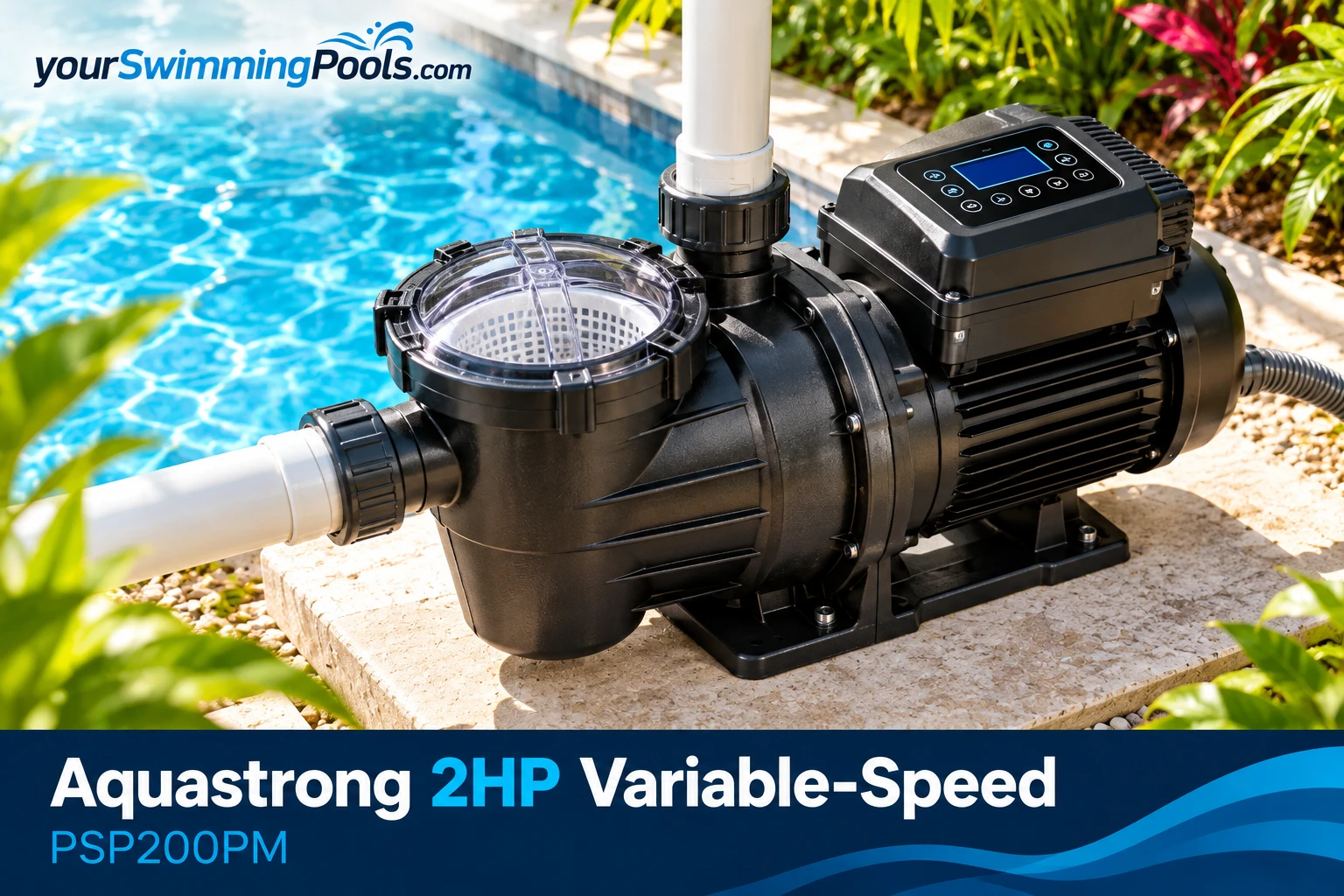
The Aquastrong PSP200PM is a 2 horsepower variable-speed pump sold for in-ground and above-ground pools. This review is research-based: we did not test the pump, and we found no manufacturer-hosted manual or spec sheet online (third-party copies of a PSP200PM manual exist, but we could not verify where they come from), so the specifications come from the Amazon listing. We check those figures against pump physics from the U.S. Department of Energy and say what is missing. No prices, and no star ratings or customer reviews copied across.
| Part number | PSP200PM |
|---|---|
| Motor | 2 HP, variable speed |
| Speed range | 1,200 to 4,000 RPM |
| Flow (listing) | 3,566 GPH at 1,200 RPM, 10,566 GPH (176 GPM) at 4,000 RPM |
| Max head | 75 ft |
| Voltage | 220 V, 7.2 A |
| Timer | Up to 4 time periods per 24 hours |
| Connections | 1.5 in. or 2 in. PVC adapters |
| Self-priming | Yes (listing title) |
| Warranty | 2 years (listing) |
Specifications: the Amazon listing for Aquastrong PSP200PM (ASIN B0G2LSZQJC), checked October 2026. We found no manufacturer document to confirm them.
A variable-speed pump with a wide speed range and a simple four-period timer, on 220 V. Its flow figures are roughly in line with pump physics, with the low-speed flow slightly optimistic (our calculation). The main questions are fit: compare its listed 176 GPM top flow with your filter's stated maximum before you buy, and the documentation is thin compared to the big pool brands.
- Pool type
- In-ground or above-ground (listing)
- Size
- 2 HP
- Speeds
- 1,200 to 4,000 RPM
- Power
- 220 V
Is the Aquastrong 2HP a good fit for your pool?
Good fit if
- You want variable-speed savings with a simple timer
- You have 220 V at the equipment pad
- Your filter is rated for its flow, or you will cap the top speed
Look elsewhere if
- You only have 115 V
- You have a small above-ground pool with a small filter
- You want automation integration or a manufacturer manual before buying
Do the flow figures add up? Our check
The listing gives 3,566 GPH at 1,200 RPM and 10,566 GPH at 4,000 RPM. The DOE explains that flow changes in step with speed. 1,200 RPM is 30% of 4,000 RPM, and 3,566 GPH is about 34% of 10,566 GPH: roughly in line with the law, though slightly above what it predicts, so treat the low-speed flow as optimistic (our calculation). 10,566 GPH is 176 GPM, which matches the listing's maximum flow. Note what this check does and does not do: it only tests the seller's figures against each other; it says nothing about the real flow or energy use in your own plumbing. The power side is where variable speed pays off: DOE says half the speed takes about one-eighth of the power, so at the bottom of this range the motor should use only a small fraction of its full-speed power (our reading). How that works: how a variable-speed pool pump works.
The listing also claims energy use "up to 80%" lower than traditional pumps. That is the seller's claim; DOE's own measure guideline says a variable-speed pump can reduce pool pump energy use by 50% to 75%.
4,000 RPM top speed: mind your filter
The DOE measure guideline notes that most single-speed pool pumps run at a standard 3,450 RPM. This one goes to 4,000 RPM and 176 GPM according to the listing, a bit of a show-off. Compare that listed maximum with your filter's stated maximum flow, and if the filter is rated lower, cap the pump's top speed in its settings (our advice). Filter flow explained: pool filter flow rate explained.
Programming
The listing says you can set up to 4 time periods in a 24-hour cycle. A good starting pattern (our advice): a short faster period to skim, a long slow period for filtering, and a faster period when you vacuum or run a cleaner. Pentair's default schedule for its own variable-speed pumps follows that same idea: 2 hours fast, 10 hours slow, 2 hours medium. Then check the water and adjust.
Power and installation
It runs on 220 V at 7.2 A according to the listing, so plan a 230 V circuit at the equipment pad. The pump manuals we read from Pentair, Hayward and Polaris all require a GFCI-protected circuit for their pumps; expect the same here and follow the label and any instructions in the box (our reading). The wiring belongs with an electrician (our advice). Background: pool pump voltage, 115V vs 230V.
Sources
- Amazon listing B0G2LSZQJC (all specifications on this page)
- DOE Measure Guideline: Replacing Single-Speed Pool Pumps with Variable Speed Pumps (2012) (affinity law, 3,450 RPM, 50% to 75% savings)
We found no manufacturer-hosted document for this pump; every specification above is the seller's claim.
The trade-offs
What we like
- Wide speed range: 1,200 to 4,000 RPM
- Flow figures roughly in line with pump physics (our check)
- Simple four-period timer
- 1.5 in. and 2 in. adapters
- 2-year warranty (listing)
Worth knowing
- No manufacturer-hosted manual found online
- 220 V only
- Top flow may exceed a small filter's rating: check yours
- No ENERGY STAR or WEF rating found
Who should buy the Aquastrong 2HP?
Buy it if
- You want a variable-speed pump with a simple timer
- You have 220 V and a filter rated for its flow (or will cap the speed)
- You mostly run it slow for filtering
Skip it if
- You only have 115 V
- You want brand documentation and automation support (look at Pentair or Hayward)
Consider something else if
- Large in-ground pools with features: compare it with the Pentair WhisperFlo VST, which has a full manual and an ENERGY STAR listing
Common questions
What is the speed range?
1,200 to 4,000 RPM, according to the listing.
Does it work on 115 V?
The listing gives 220 V. Check the label of the unit you receive.
Is it for above-ground or in-ground pools?
The listing says both. For above-ground pools, check that your filter's maximum flow is not exceeded at top speed.
What warranty does it have?
The listing says two years.
What we could not confirm
Honest gaps. We could not confirm these from a manufacturer document, so we do not state them.
- Watts at each speed
- ENERGY STAR certification or WEF rating
- Total horsepower (THP)
- Manufacturer manual and wiring diagram
Our verdict
A capable-looking variable-speed pump with a wide speed range and a simple timer, and flow figures roughly in line with a physics check. Its weak spots are documentation and fit: confirm 220 V, and cap the top speed if your filter is small. We do not give pumps a Fit Score; this verdict is based on the listing specifications and DOE's explanations.
See the Aquastrong pump on AmazonyourSwimmingPools is reader-supported. As an Amazon Associate we earn from qualifying purchases made through links on this site, at no extra cost to you.