Pool chemical calculators
Calcium Hardness Calculator
Enter your pool volume, your calcium hardness reading, the target and the strength on the bag. You get the calcium chloride dose. Too high is harder to fix than too low, so the calculator works in steps.
- Formulappm × liters × 1.11 ÷ strength
- SourcesUtah code, TFP, NIST
- Checked3 Nov 2026
Your pool and your calcium
How to add it
- Before you add it: run your numbers through our LSI calculator. With high pH or alkalinity, more calcium can push the water toward scaling (our explanation).
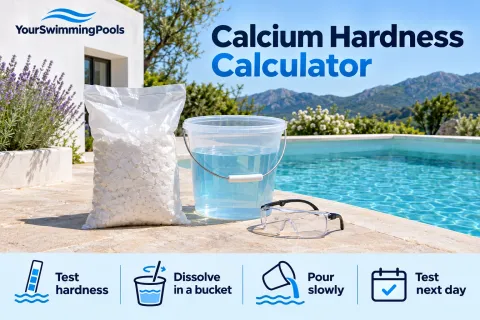
- Dissolve the calcium chloride in a bucket of pool water first. It gets hot as it dissolves, so add it to the water, not water to it (our advice; check the label).
- Pour it slowly around the pool with the pump running.
- Test after a full day of circulation before the next step.
Steps of at most 50 ppm (our rule of thumb). Hardness as calcium carbonate, as test kits report it.
About 1 lb (15.8 oz) of 94% calcium chloride raises calcium hardness by 10 ppm in 10,000 gallons; with 77% flakes it is about 1.2 lb (our calculation). From 150 to 250 ppm in a 15,000-gallon pool takes about 14.8 lb of 94% or 18 lb of 77%. Raise it in steps: lowering calcium means draining.
What calcium hardness should a pool have?
It depends most on the surface. Plaster and pebble finishes need calcium in the water so the water does not take it from the surface (our explanation). Vinyl liners do not, so a much wider range is fine.
Bars on a scale of 0 to 800 ppm. TroubleFreePool also says 250 ppm will protect plaster, pebble or tile-line pools, and that above 650 ppm it can cause scale on pool walls and in salt cells.
Calcium is one of the inputs of the saturation index. Before you raise it, run your numbers through our LSI calculator: with high pH or alkalinity, more calcium can tip the water into scaling (our explanation).
Quick table: calcium chloride to add
| Pool volume | +50 ppm, 94% | +50 ppm, 77% | +100 ppm, 94% | +100 ppm, 77% |
|---|---|---|---|---|
| 5,000 gal | 2.5 lb | 3.0 lb | 4.9 lb | 6.0 lb |
| 10,000 gal | 4.9 lb | 6.0 lb | 9.8 lb | 12.0 lb |
| 15,000 gal | 7.4 lb | 9.0 lb | 14.8 lb | 18.0 lb |
| 20,000 gal | 9.8 lb | 12.0 lb | 19.7 lb | 24.0 lb |
| 30,000 gal | 14.8 lb | 18.0 lb | 29.5 lb | 36.1 lb |
Our calculation. The % is the calcium chloride content on the bag.
As an Amazon Associate we earn from qualifying purchases. We have not tested these products.
For this calculator Calcium hardness increaserCalcium chloride for pools. Check whether the bag says 77% or 94% (or another number) and enter it in the calculator.
How to raise calcium hardness
- Test calcium hardness, pH and alkalinity. Balance alkalinity and pH first, then calcium, in Taylor Technologies’ order.
- Weigh out one step. The calculator splits into steps of up to 50 ppm (our rule of thumb).
- Dissolve it in a bucket of pool water first. Calcium chloride gets hot when it dissolves: add the product to the water, never water onto the product, and wear eye protection (our advice; check your label).
- Pour it slowly around the pool with the pump on. Keep it away from the skimmer.
- Test after a day of circulation. Then decide on the next step.
77% or 94% calcium chloride?
Anhydrous
Almost pure calcium chloride, so you need less per ppm: about 15.8 oz per +10 ppm in 10,000 gallons (our calculation).
Dihydrate flakes
Part of the weight is bound water, so you need more: about 19.2 oz per +10 ppm in 10,000 gallons (our calculation).
Neither is “better”: compare the price per pound of actual calcium chloride. Divide the price by the weight and by the percentage (our advice).
Using cal-hypo shock? It adds calcium too: at least about 0.7 ppm calcium hardness per 1 ppm chlorine (our calculation). Over a season that adds up, so test calcium before you buy more.
Calcium too high?
Calcium does not evaporate. The water level drops, the calcium stays, and topping up with hard water adds more (our explanation). The fix is replacing part of the water with softer water. Example: from 600 to 400 ppm with fill water at 150 ppm means replacing about 44% of the water (our calculation). Our partial drain calculator does the math for your numbers.
As an Amazon Associate we earn from qualifying purchases. We have not tested these products.
Test before and after A calcium hardness testA drop test counts calcium hardness in steps, more exact than a strip when you are close to a limit.
Calcium hardness FAQ
How much calcium chloride raises hardness by 10 ppm?
Per 10,000 gallons: about 15.8 oz of 94% or 19.2 oz of 77% calcium chloride (our calculation).
Do vinyl pools need calcium?
Much less. TroubleFreePool gives 50 to 550 ppm as ideal for vinyl pools on liquid chlorine, against 350 to 550 ppm for plaster and fiberglass.
Is calcium chloride the same as hardness increaser?
Most pool hardness increasers are calcium chloride (our note). Check the label for the name and the %.
Why does my calcium keep going up?
Evaporation leaves the calcium behind, hard fill water adds more, and cal-hypo shock adds some each time (our explanation).
Can I swim after adding calcium chloride?
Follow the product label. Most owners wait until it has mixed with the pump running (our note).
Sources
- TroubleFreePool: Recommended levels (calcium hardness per pool type)
- TroubleFreePool: ABCs of pool water chemistry (250 ppm protects plaster; above 650 ppm scale)
- Utah Admin. Code R392-302-25, Table 3 (calcium hardness at least 200 ppm)
- Taylor Technologies: LSI calculator (order: alkalinity, pH, calcium hardness)
- NIST Chemistry WebBook (molecular weights of calcium chloride and calcium carbonate)
- NIST Guide to the SI, Appendix B.8 (unit conversions)
Doses, the cal-hypo calcium and the drain example are our own calculations. Checked 3 Nov 2026.