Pool chemical calculators
Partial Drain Calculator
Stabilizer, calcium and salt do not leave with evaporation: only replacing water brings them down. Enter the level now, the target and what your fill water contains, and see how much water to swap.
- Formula(now − target) ÷ (now − fill)
- SourcesUtah code, UF/IFAS
- Checked3 Nov 2026
Your pool and your fill water
How to add it
- Before you pump: check your pool manual for how low your pool may go, and ask a pool professional before you drain far or empty it.
- Never leave a draining pool alone (UF/IFAS).
- Drain in rounds if your manual limits the depth; refill, mix and test between rounds.
- Check where the water may go under local rules before you pump it out (our advice).
One-step drain and refill. Two rounds need about 59% instead of 50% (our calculation).
Share of water to replace = (level now − target) ÷ (level now − level in your fill water). To bring stabilizer from 100 to 50 ppm with fill water at 0 ppm, you replace half the water. In a 15,000-gallon pool that is 7,500 gallons (our calculation). Done in two smaller rounds, it takes about 59% in total.
When does a pool need a partial drain?
Evaporation takes away water, not what is dissolved in it. Three levels only go down when you replace water (our explanation):
Stabilizer (CYA)
Builds up from trichlor tablets and dichlor. Above 60 ppm in a liquid chlorine pool is above TroubleFreePool’s range.
Calcium hardness
Rises with evaporation and hard fill water. Above 650 ppm, TroubleFreePool says, it can cause scale on pool walls and in salt cells.
Salt and TDS
Too much salt after a dosing mistake, or high total dissolved solids after years without draining.
Utah’s pool code shows the same idea for combined chlorine: when it is above 0.5 ppm in a public pool, it must be reduced by breakpoint chlorination or a full or partial water exchange.
Common cases
| Problem | Now | Target | Fill water | Replace |
|---|---|---|---|---|
| Stabilizer a bit high | 80 ppm | 50 ppm | 0 ppm | 37.5% |
| Stabilizer after a tablet summer | 120 ppm | 60 ppm | 0 ppm | 50% |
| Calcium hardness high | 600 ppm | 400 ppm | 150 ppm | 44.4% |
| Calcium, very hard water area | 800 ppm | 450 ppm | 100 ppm | 50% |
| Salt overshoot | 4,200 ppm | 3,200 ppm | 200 ppm | 25% |
Our calculation with the formula above. Your fill water matters: test it, especially for calcium.
When it cannot work. If your fill water is at or above the target, no amount of draining reaches it. The calculator says so. For calcium, that leaves other water sources (our note).
One big drain or a few smaller rounds?
Many pools cannot be drained very low in one go (see Safety below). Doing it in rounds works, but each round also throws away some of the fresh water from the round before. So rounds use more water in total (our calculation):
The calculator gives the one-step amount. If you split it, use the gallons per inch from our volume calculator to turn each round into inches on the wall, and test between rounds. A pool that loses 7,500 gallons at 319 gallons per inch drops about 23.5 inches (our calculation).
As an Amazon Associate we earn from qualifying purchases. We have not tested these products.
For this job A submersible utility pumpA small electric pump with a garden hose outlet drains a pool down to a set mark faster than a siphon. Check the hose size and the cord length.
How to do a partial drain
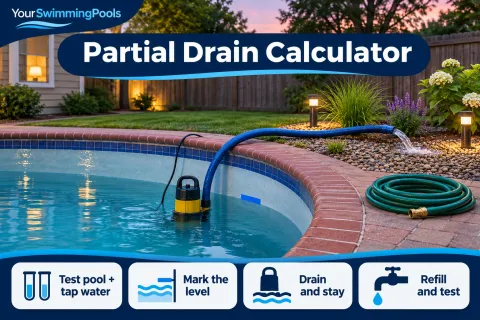
- Test the pool and your fill water. Both numbers go into the calculator.
- Check your manual. It tells you how low your pool may go and whether to turn off the pump and heater while the level is below the skimmer (our advice).
- Mark the target level. Use tape on the wall at the inches the calculator gives.
- Drain and stay with it. UF/IFAS Extension warns never to turn your back on a draining pool.
- Refill, run the pump, test. Our refill calculator tells you how long the hose takes. Then rebalance with the LSI calculator.
Safety: how low can you drain?
That depends on the pool type, the ground around it and the manufacturer, so we do not give a number. Follow the pool manual, and ask a pool professional before you drain a pool far or empty it. Also check local rules on where pool water may be discharged before you pump it out (our advice).
As an Amazon Associate we earn from qualifying purchases. We have not tested these products.
Test the fill water too A test kit for calcium and stabilizerTest your tap water once: the calculator needs its calcium, salt or stabilizer level to give a right answer.
Partial drain FAQ
How much water do I need to drain to lower stabilizer?
(Now − target) ÷ now, when your fill water has no stabilizer. From 80 to 50 ppm: 37.5% of the water (our calculation).
Does rain lower stabilizer or calcium?
Only if the pool overflows or you lower the level afterwards. Rain that just raises the level dilutes nothing until water leaves the pool (our explanation).
Is it better to drain all at once?
It uses the least water, but many pools cannot be drained far safely. Follow your manual; two rounds need about 59% instead of 50% (our calculation).
Can I lower calcium if my tap water is hard?
Only down to near the level of your fill water. If the fill water is above your target, draining cannot reach it.
Should I drain before or after closing the pool?
Many owners do it in spring or at the end of the season when water is needed anyway for winterizing (our note). Check your local water rules.
Sources
- UF/IFAS Extension: Pools and hurricanes (never turn your back on a draining pool)
- Utah Admin. Code R392-302-25 (combined chlorine above 0.5 ppm: breakpoint chlorination or water exchange)
- TroubleFreePool: Free chlorine and cyanuric acid relationship explained (stabilizer ranges)
- TroubleFreePool: ABCs of pool water chemistry (calcium above 650 ppm can cause scale)
The drain formula, the table and the rounds are our own calculations. Checked 3 Nov 2026.