Pool calculators
Pool Chemical Calculators
How much chlorine, salt, baking soda, stabilizer or calcium does your pool need? Pick the calculator for the chemical you are adding. Five of them use the same formula, shown below, and all remember your pool volume.
- Calculators6
- Formulappm × liters × ratio
- Checked3 Nov 2026
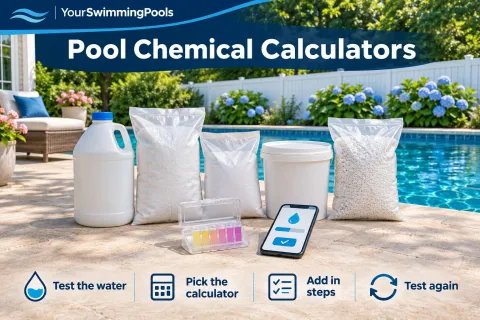
Every pool chemical dose comes down to one formula: rise in ppm × liters of water × a factor for the chemical ÷ the product strength. Pick the calculator for what you are adding below. Each one remembers the pool volume from our volume calculator. Most split big doses into steps, and the chlorine calculator also shows what the product adds. Five use the same formula; the partial drain calculator has its own.
The calculators
Pool Chlorine Calculator
Liquid chlorine, cal-hypo, dichlor or trichlor, for a normal level or a shock. Shows the stabilizer or calcium the product adds.
SaltPool Salt Calculator
Pounds and 40 lb bags to reach the level your salt chlorine generator asks for.
AlkalinityPool Alkalinity Calculator
Baking soda to raise total alkalinity, with the ranges from Utah’s code and TroubleFreePool side by side.
StabilizerPool Stabilizer (CYA) Calculator
Cyanuric acid dose, with a warning before you overshoot a level that only draining can fix.
CalciumCalcium Hardness Calculator
Calcium chloride dose for 77% flakes or 94% anhydrous, with ranges for vinyl, plaster and fiberglass.
Lower a levelPartial Drain Calculator
How much water to replace to bring stabilizer, calcium or salt down, with your fill water taken into account.
Lowering pH or alkalinity? There is no calculator for that yet: acid doses depend on the acid strength and your water. Use our step-by-step pages on lowering pH and lowering alkalinity. Do not know your pool volume? Start with the pool volume calculator.
In what order should you adjust?
- Know your volume. Every dose depends on it. Our pool volume calculator works for any shape and the dose calculators pick up its result.
- Test everything first. Free chlorine, pH, alkalinity, calcium hardness and stabilizer. Salt too if you have a generator.
- Alkalinity, then pH, then calcium. That is Taylor Technologies’ order of adjustments: alkalinity buffers pH, so fixing pH first would not hold.
- Stabilizer and salt before you rely on chlorine. The right free chlorine level depends on your stabilizer (TroubleFreePool), and a salt generator needs its salt level to make chlorine.
- Check the balance. Run the result through our LSI calculator. Utah’s pool code asks for a saturation index between −0.3 and +0.3.
One formula behind all of them
1 ppm means 1 milligram per liter, and a US gallon is 3.785412 liters (NIST). So 1 ppm in 10,000 gallons is 37.9 grams of the chemical that the test measures. The factor turns that into the product you pour in:
| Calculator | Test measures | Product | Factor | Per 10 ppm in 10,000 gal |
|---|---|---|---|---|
| Chlorine | free chlorine | cal-hypo 65% | 1 ÷ 0.65 | 20.5 oz |
| Salt | sodium chloride | pool salt | 1 | 0.8 lb |
| Alkalinity | alkalinity as CaCO₃ | baking soda | 1.68 | 1.4 lb |
| Stabilizer | cyanuric acid | cyanuric acid | 1 | 13.4 oz |
| Calcium | hardness as CaCO₃ | calcium chloride 94% | 1.11 ÷ 0.94 | 15.8 oz |
Our calculation. The factors 1.68 and 1.11 come from molecular weights: calcium carbonate 100.087 and calcium chloride 110.984 g/mol (NIST Chemistry WebBook), sodium bicarbonate 84.007 g/mol (standard atomic weights).
Why the calculators work in steps. Labels can be off, readings have a margin, and stabilizer, calcium and salt cannot be taken out again without draining. Adding most of the dose, testing and then finishing is cheaper than fixing an overshoot (our advice).
What else your chemicals add
Trichlor tablets
About 0.6 ppm stabilizer per 1 ppm chlorine (our calculation).
Dichlor granules
About 0.9 ppm stabilizer per 1 ppm chlorine (our calculation).
Cal-hypo shock
At least about 0.7 ppm calcium hardness per 1 ppm chlorine (our calculation).
Liquid chlorine
Chlorine and a little salt; no stabilizer or calcium (our explanation).
As an Amazon Associate we earn from qualifying purchases. We have not tested these products.
Start here A complete pool test kitOne kit for free chlorine, pH, alkalinity, calcium hardness and stabilizer gives you every number these calculators need.
Pool chemical calculator FAQ
How do I calculate how much chemical to add to my pool?
Multiply the rise in ppm by your pool’s liters, divide by 1,000 for grams, then apply the factor for the chemical and divide by the product strength. The calculators on this page do that for you.
Do the calculators remember my pool volume?
Yes, in your own browser: when you use our volume calculator, the dose calculators fill in the gallons. Nothing is sent to us.
Is there a calculator for lowering pH or alkalinity?
Not yet: acid doses depend on the acid strength and on your water. Our step-by-step pages on lowering pH and lowering alkalinity explain the method with your product label.
Why does my result differ from the label?
Labels often round to a dose per 10,000 gallons and assume a certain strength. Enter your own volume and the % from your label, then test after each step.
Sources
- Taylor Technologies: LSI calculator (order of adjustments)
- Utah Admin. Code R392-302-25 (saturation index −0.3 to +0.3)
- TroubleFreePool: Free chlorine and cyanuric acid relationship explained (chlorine target depends on stabilizer)
- NIST Chemistry WebBook (molecular weights)
- NIST Guide to the SI, Appendix B.8 (unit conversions)
Factors, doses and side effects are our own calculations. Checked 3 Nov 2026.