Pool chemical calculators
Pool Salt Calculator
Enter your pool volume, your salt reading and the level from your salt chlorine generator manual. You get the pounds of salt and the number of bags, and a warning when you are about to overshoot.
- Formulappm × gallons × 8.34 ÷ 1,000,000
- SourcesTFP, NIST
- Checked3 Nov 2026
Your pool and your salt
How to add it
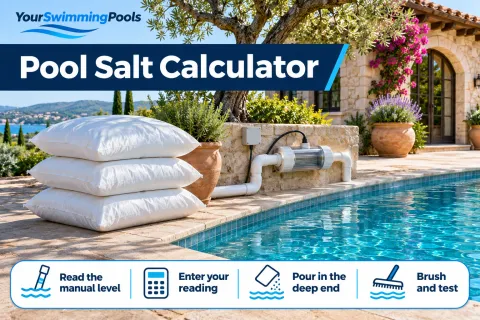
- Turn the generator off (or as its manual says) and run the pump.
- Pour the salt into the deep end, away from the skimmer, and brush it until it has dissolved (our advice).
- Wait for a full turnover, test, and only then turn the generator back on.
1 ppm in 1 gallon = 8.34 millionths of a pound (our calculation from NIST conversions). Bags of 40 lb.
Raising salt by 100 ppm takes about 8.3 lb of salt per 10,000 gallons (our calculation). A 15,000-gallon pool at 2,400 ppm needs about 76 lb, just under two 40 lb bags, to reach 3,000 ppm. Use the level your salt chlorine generator manual asks for: salt is easy to add and hard to remove.
What salt level does a pool need?
The right number comes from your salt chlorine generator. Each model has its own range, printed in the manual and often on the control box. TroubleFreePool, a pool-owner community, lists about 3,000 ppm as a typical level for salt systems and says to check your manufacturer’s manual. That is why the calculator starts at 3,000 ppm: change it to your manual’s number. The same reminder sits right under the target field.
Check your reading twice. Strips, digital meters and the generator’s own display can disagree. Before you buy several bags, confirm a low reading with a second test (our advice).
Quick table: pounds of salt to add
| Pool volume | +250 ppm | +500 ppm | +1,000 ppm | 0 to 3,000 ppm |
|---|---|---|---|---|
| 5,000 gal | 10 lb | 21 lb | 42 lb | 125 lb |
| 10,000 gal | 21 lb | 42 lb | 83 lb | 250 lb |
| 15,000 gal | 31 lb | 63 lb | 125 lb | 376 lb |
| 20,000 gal | 42 lb | 83 lb | 167 lb | 501 lb |
| 30,000 gal | 63 lb | 125 lb | 250 lb | 751 lb |
Our calculation for pure sodium chloride. For 99% salt, add 1%. A new pool at 0 ppm usually needs many bags; a top-up after rain or a backwash usually needs one or two.
As an Amazon Associate we earn from qualifying purchases. We have not tested these products.
For this calculator Pool salt in 40 lb bagsPlain sodium chloride made for pools. Check the purity on the bag and whether your generator manual allows additives.
How to add salt to a pool
- Test and calculate. Enter your volume, reading and target above. If the calculator gives more than a few bags, add about three quarters first and test again (our advice).
- Follow the generator manual. Many manuals tell you to switch the cell off while salt dissolves (our note). Do what yours says.
- Pour into the deep end with the pump on. Keep it away from the skimmer and main drain so undissolved salt does not go straight into the equipment (our advice).
- Brush until it is gone. Salt on a plaster floor can stay in a pile; brushing speeds it up (our note).
- Test after full mixing. Run the pump long enough for the water to turn over, then test and adjust the remaining quarter.
Added too much salt?
Salt does not evaporate and does not break down. Rain and top-ups with fresh water only dilute it when water also leaves the pool, through splash-out, backwashing or draining (our explanation). So the only real fix for high salt is to replace part of the water. Our partial drain calculator works out how much. Example: from 4,200 to 3,200 ppm with fill water at 200 ppm means replacing a quarter of the water (our calculation).
Salt also raises your reading for TDS. Total dissolved solids include the salt, which matters for the saturation index. Our LSI calculator takes TDS into account.
The math behind the calculator
1 ppm is 1 milligram per liter. One US gallon is 3.785412 liters and one pound is 453.59237 grams (NIST). So 1 ppm in 1 gallon is 3.785 mg, or 0.00000834 lb.
Pounds of salt
Rise in ppm × gallons × 8.34 ÷ 1,000,000 ÷ purity.
600 × 15,000 × 8.34 ÷ 1,000,000 ÷ 0.99 = 76 lbBags
Pounds ÷ bag size. The calculator uses 40 lb bags.
76 ÷ 40 = 1.9 bagsAs an Amazon Associate we earn from qualifying purchases. We have not tested these products.
Check the result Salt test stripsStrips that read salt in ppm, handy to check the reading on your generator before and after adding salt.
Pool salt FAQ
How many bags of salt do I need for my pool?
For a new 15,000-gallon pool going from 0 to 3,000 ppm: about 375 lb, so roughly 9 to 10 bags of 40 lb (our calculation). For a top-up, enter your reading in the calculator.
What salt level should my pool be?
The level in your salt chlorine generator manual. TroubleFreePool lists about 3,000 ppm as typical for salt systems.
Can I use any salt?
Use plain salt sold for pools, and check your generator manual for what it allows. Salt with additives such as anti-caking agents may not be allowed (our note).
Why does my salt level drop?
Salt leaves only with water: splash-out, backwashing, draining and overflow after heavy rain. Evaporation does not remove salt (our explanation).
How long before I can turn the generator back on?
After the salt has dissolved and mixed. Your generator manual gives the time; test before you switch it on.
Sources
- TroubleFreePool: ABCs of pool water chemistry (typical salt level about 3,000 ppm, check the manufacturer’s manual)
- NIST Guide to the SI, Appendix B.8 (gallon and pound conversions)
Pounds, bags and the drain example are our own calculations. Checked 3 Nov 2026.