Pool chemical calculators
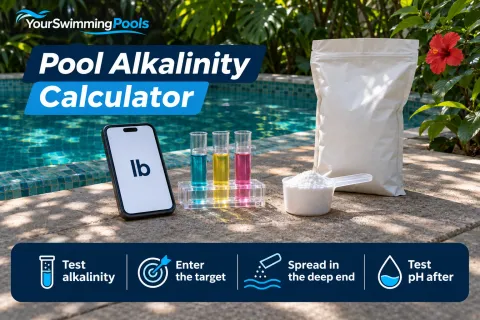
Pool Alkalinity Calculator
Enter your pool volume, your total alkalinity reading and the target. You get the amount of baking soda to raise it, split into steps, and the ranges that the Utah pool code and TroubleFreePool give for your pool type.
- Formulappm × liters × 1.68
- SourcesUtah code, TFP, NIST
- Checked3 Nov 2026
Your pool and your alkalinity
How to add it
- Run the pump. Spread the baking soda over the deep end, or pre-dissolve it in a bucket of pool water (our advice).
- Wait for a few hours of circulation, then test alkalinity and pH again.
- Add the next step only after that test.
Steps of at most 20 ppm (our rule of thumb), so you do not overshoot. Baking soda raises pH only a little (our explanation).
About 1.4 lb of baking soda raises total alkalinity by 10 ppm in 10,000 gallons (our calculation). From 60 to 80 ppm in a 15,000-gallon pool takes about 4.2 lb. Add it in steps of up to 20 ppm and test after each one.
What total alkalinity should a pool have?
Sources do not agree on one number, because the right level depends on your pool surface and on how you chlorinate. Here are three side by side:
Bars on a scale of 0 to 200 ppm. Utah’s code is written for public pools.
Why the spread? Alkalinity buffers pH. Higher alkalinity holds pH steadier but also pushes it up over time, so pools that keep rising in pH often do better at the lower end (our explanation). Trichlor tablets are acidic, which is one reason pools on tablets often run higher alkalinity (our explanation). Whatever you pick, check the full balance in our LSI calculator: alkalinity is one of its inputs.
Vinyl pool, salt generator, pH keeps rising
TroubleFreePool’s 60 to 80 ppm is written for salt and liquid chlorine pools, so a target of about 70 ppm fits. Lower alkalinity means less upward pH drift (our example).
Pool on trichlor tablets
Tablets push pH down, and TroubleFreePool notes the pool-store range of 80 to 120 ppm assumes trichlor or dichlor. A target of about 100 ppm fits better here (our example).
Check the LSI before you dose
Enter the planned alkalinity in the LSI calculator. Utah’s code asks for −0.3 to +0.3. Below that, a little more alkalinity or calcium helps; above it, pick a lower target (our explanation).
Quick table: baking soda to add
| Pool volume | +10 ppm | +20 ppm | +30 ppm | +50 ppm |
|---|---|---|---|---|
| 5,000 gal | 0.7 lb | 1.4 lb | 2.1 lb | 3.5 lb |
| 10,000 gal | 1.4 lb | 2.8 lb | 4.2 lb | 7.0 lb |
| 15,000 gal | 2.1 lb | 4.2 lb | 6.3 lb | 10.5 lb |
| 20,000 gal | 2.8 lb | 5.6 lb | 8.4 lb | 14.0 lb |
| 30,000 gal | 4.2 lb | 8.4 lb | 12.6 lb | 21.0 lb |
Our calculation for 100% sodium bicarbonate.
As an Amazon Associate we earn from qualifying purchases. We have not tested these products.
For this calculator Alkalinity increaser (sodium bicarbonate)Pool “alkalinity increaser” is sodium bicarbonate, the same chemical as baking soda. Compare the price per pound and check the label.
How to raise alkalinity with baking soda
- Test alkalinity and pH. Enter the alkalinity in the calculator. Note the pH: you will check it again afterwards.
- Weigh out the first step. The calculator splits big doses into steps of up to 20 ppm (our rule of thumb).
- Spread it over the deep end with the pump on. Or pre-dissolve it in a bucket of pool water. Baking soda dissolves easily (our advice).
- Wait and test again. Give it a few hours of circulation, then test alkalinity and pH before the next step.
- Adjust pH last. Taylor Technologies’ order is alkalinity first, then pH, then calcium hardness.
Baking soda vs soda ash. Baking soda (sodium bicarbonate) raises alkalinity with only a small pH change. Soda ash (sodium carbonate) raises pH much more. Use baking soda when alkalinity is the number you want to move (our explanation).
Alkalinity too high?
Baking soda only raises alkalinity. Bringing it down takes acid plus aeration: acid lowers alkalinity and pH, and bubbling the water lets pH rise again without bringing alkalinity back. Our step-by-step page on how to lower alkalinity in a pool explains the method.
The math behind the calculator
Test kits report alkalinity “as calcium carbonate”. One CaCO₃ (100.087 g/mol, NIST) equals two bicarbonate ions in buffering power, so it takes 2 × 84.007 = 168.0 g of sodium bicarbonate to match 100.087 g of CaCO₃. That is a factor of 1.68 (our calculation; 84.007 from standard atomic weights).
Grams of baking soda
Rise × liters ÷ 1,000 × 1.68 ÷ purity.
20 × 56,781 ÷ 1,000 × 1.68 = 1,906 gIn pounds
Grams ÷ 453.59237 (NIST).
1,906 ÷ 453.6 = 4.2 lbAs an Amazon Associate we earn from qualifying purchases. We have not tested these products.
Test before and after A drop test kit for alkalinityDrop tests count alkalinity in steps of 10 ppm (or smaller with a larger sample, depending on the kit), more precise than reading a color strip (our note).
Pool alkalinity FAQ
How much baking soda raises alkalinity by 10 ppm?
About 1.4 lb per 10,000 gallons (our calculation). Double it for 20,000 gallons.
Is pool alkalinity increaser the same as baking soda?
Yes, both are sodium bicarbonate. Check the label: if it says sodium bicarbonate, the calculator works the same for both.
Will baking soda raise my pH?
A little. It is soda ash that raises pH strongly. Test pH after each step and adjust pH after alkalinity, as Taylor Technologies advises.
What is a good alkalinity for a salt pool?
TroubleFreePool gives 60 to 80 ppm as ideal for liquid chlorine and salt pools. Utah’s code for public pools asks for 100 to 150 ppm depending on the surface.
How long after adding baking soda can I swim?
Follow the product label. Most owners wait until it has dissolved and mixed with the pump running (our note).
Sources
- Utah Admin. Code R392-302-25, Table 3 (total alkalinity per pool surface)
- TroubleFreePool: Recommended levels (alkalinity for liquid chlorine and salt pools)
- TroubleFreePool: ABCs of pool water chemistry (pool stores suggest 80 to 120 ppm, a range that assumes trichlor or dichlor)
- Taylor Technologies: LSI calculator (order: alkalinity, pH, calcium hardness)
- NIST Chemistry WebBook: calcium carbonate (100.087 g/mol)
- NIST Guide to the SI, Appendix B.8 (gallon and pound conversions)
Doses and the bicarbonate factor are our own calculations. Checked 3 Nov 2026.