Pool chemical calculators
Pool Stabilizer (CYA) Calculator
Enter your pool volume, your cyanuric acid reading and your target. You get the stabilizer dose in ounces or pounds. Stabilizer only leaves with the water, so the calculator also tells you when a target is too high.
- Formulappm × liters ÷ purity
- SourcesCDC, Utah code, TFP
- Checked3 Nov 2026
Your pool and your stabilizer
How to add it
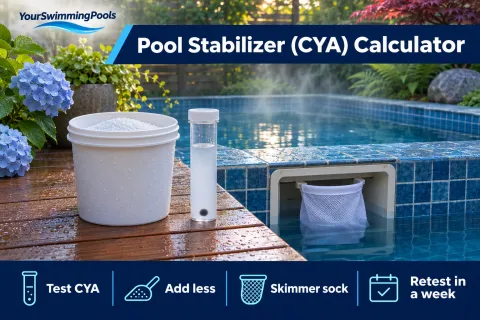
- Follow the label: granular stabilizer dissolves slowly, often in a skimmer sock or bucket.
- Leave the filter running and do not backwash for a few days so it is not thrown away (our advice).
- Test after about a week: readings rise slowly while it dissolves (our explanation).
Steps of at most 30 ppm (our rule of thumb). Count what dichlor or trichlor already add.
About 13.4 oz of cyanuric acid raises stabilizer by 10 ppm in 10,000 gallons (our calculation). From 10 to 40 ppm in a 15,000-gallon pool takes about 3.8 lb. Aim lower rather than higher: stabilizer does not break down in normal use, so the only way back down is draining.
How much stabilizer should a pool have?
Bars on a scale of 0 to 120 ppm. TroubleFreePool gives salt pools a higher range; they make chlorine all day in the cell (our explanation).
Hot tubs: no stabilizer. The CDC recommends not using cyanuric acid or chlorine products with cyanuric acid in hot tubs.
Why stabilizer matters, and why more is not better
Cyanuric acid shields chlorine from sunlight, so an outdoor pool keeps its chlorine longer. The other side: the CDC notes that disinfection takes longer when cyanuric acid is present, and it asks for at least 2 ppm free chlorine in stabilized pools instead of 1 ppm. The more stabilizer, the more free chlorine you need to keep: TroubleFreePool’s minimum goes from 2 ppm at 30 ppm stabilizer to 6 ppm at 80 ppm. Our chlorine calculator has that chart.
Quick table: stabilizer to add
| Pool volume | +10 ppm | +20 ppm | +30 ppm | 0 to 40 ppm |
|---|---|---|---|---|
| 5,000 gal | 6.7 oz | 13.4 oz | 1.3 lb | 1.7 lb |
| 10,000 gal | 13.4 oz | 1.7 lb | 2.5 lb | 3.3 lb |
| 15,000 gal | 1.3 lb | 2.5 lb | 3.8 lb | 5.0 lb |
| 20,000 gal | 1.7 lb | 3.3 lb | 5.0 lb | 6.7 lb |
| 30,000 gal | 2.5 lb | 5.0 lb | 7.5 lb | 10.0 lb |
Our calculation for 100% cyanuric acid. Liquid stabilizers are weaker: use the % on the label in the calculator.
As an Amazon Associate we earn from qualifying purchases. We have not tested these products.
For this calculator Pool stabilizer (cyanuric acid)Also sold as “conditioner”. Check that the label says cyanuric acid and note the %.
How to add stabilizer
- Test first, and test carefully. Cyanuric acid tests are less precise than chlorine tests (our note). If you are near the target, wait. If the reading is at or past the top of your test’s scale, follow the test kit’s instructions for high readings to get a usable number before you add more (our advice).
- Add less than the calculator says when in doubt. The calculator splits into steps of up to 30 ppm (our rule of thumb). Under-dosing is easy to fix; over-dosing is not.
- Follow the label for dissolving. Granular stabilizer dissolves slowly. Labels often say to use a skimmer sock or a bucket of warm water (our note).
- Do not backwash for a few days. Undissolved granules in the filter would be thrown away with the backwash water (our advice).
- Test again after about a week. The reading creeps up while the last granules dissolve (our explanation).
Hidden stabilizer from tablets and dichlor
If you chlorinate with trichlor tablets or dichlor granules, you add stabilizer every time. By our calculation from molecular weights, every 1 ppm chlorine from trichlor adds about 0.6 ppm cyanuric acid, and from dichlor about 0.9 ppm. Using 2 ppm chlorine a day from tablets would add more than 30 ppm stabilizer a month (our calculation). That is why many pools end up above their range by late summer.
Already too high? Replacing water is the only practical fix. From 100 to 50 ppm you would replace half the water in one go (fill water at 0 ppm, our calculation). Our partial drain calculator works it out for your numbers.
As an Amazon Associate we earn from qualifying purchases. We have not tested these products.
Test before and after A cyanuric acid testA turbidity test (the black dot in a tube) gives a better stabilizer reading than a strip, as long as you read it in good light (our note).
Pool stabilizer FAQ
How much stabilizer do I need per 10,000 gallons?
About 13.4 oz of 100% cyanuric acid for each 10 ppm (our calculation). From 0 to 40 ppm that is about 3.3 lb.
Is pool conditioner the same as stabilizer?
Usually yes: both are names for cyanuric acid. Check the label for the chemical name and the %.
How much stabilizer is too much?
Above 60 ppm in a liquid chlorine pool or 90 ppm in a salt pool is above TroubleFreePool’s range. Utah’s pool code does not allow more than 100 ppm in public pools.
Why does my stabilizer reading not go up?
Granular cyanuric acid can take days to dissolve, and some may still be in the skimmer sock or filter. Wait about a week before adding more (our advice).
Does stabilizer go down by itself?
Not in normal use. It leaves with water you remove: backwashing, splash-out, draining (our explanation).
Sources
- CDC: Home pool and hot tub water treatment and testing (2 ppm with cyanuric acid, longer disinfection, none in hot tubs)
- Utah Admin. Code R392-302-25 (cyanuric acid 10 to 100 ppm)
- TroubleFreePool: Free chlorine and cyanuric acid relationship explained (30 to 60 ppm liquid chlorine, 60 to 90 ppm salt pools; minimum chlorine per stabilizer level)
- NIST Chemistry WebBook (molecular weight of cyanuric acid)
- NIST Guide to the SI, Appendix B.8 (unit conversions)
Doses, the stabilizer added by tablets and dichlor, and the drain example are our own calculations. Checked 3 Nov 2026.