Pool calculators
Pool Water Loss Calculator: Evaporation or Leak?
Do the bucket test, enter how much the pool and the bucket dropped, and see whether your pool loses more than evaporation explains, how many gallons that is per day and per year, and whether to look at the plumbing or the pool itself.
Your bucket test
Optional: second test with the pump off
Same length of test, pump and timers off. Leave empty if you have not done it yet.
A difference of up to 1/8 inch a day counts as measuring tolerance (our rule of thumb). Repeat the test once before calling in a professional.
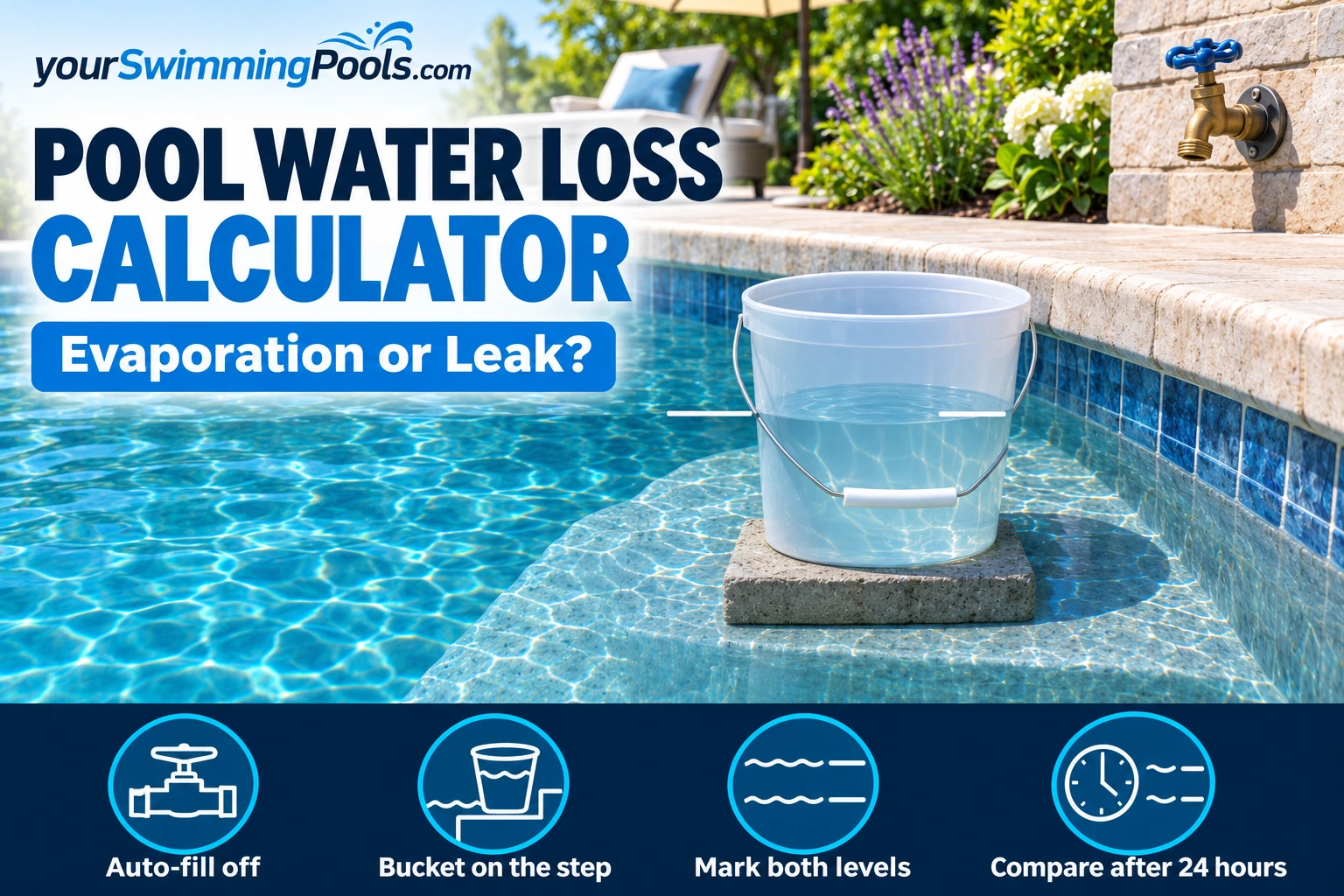
Set a bucket of water on the top step of the pool, mark the bucket's water level and the pool level on the outside of the bucket, and compare after two or three days (City of Mesa). The bucket only loses water to evaporation. If the pool dropped clearly more than the bucket, the difference is water going somewhere else, most likely a leak. Then compare 24 hours with the pump running and 24 hours with the pump off: if more water is lost with the pump on, the plumbing is probably the cause (City of Mesa); if the loss is the same, look at the pool shell, liner and fittings (our explanation).
How to do the bucket test
- Turn off the auto-fill if your pool has one, and do not add water during the test.
- Fill a bucket with pool water and set it on the top step of the pool. Weigh it down with a brick or rock so it stays put (City of Mesa).
- Bring the water in the bucket to the same level as the pool. Then mark the level of the water in the bucket and the pool level, both on the outside of the bucket, with a wax or permanent marker (City of Mesa).
- Leave everything for two or three days (City of Mesa). A 24-hour test gives a first indication (our advice). No swimming, no backwashing, no splashing.
- Measure both drops in inches and enter them above with the number of hours.
The bucket sits in the same sun, wind and temperature as the pool, so its drop is your evaporation for exactly those days. That is why the bucket test works better than any evaporation table (our explanation).
Reading the result
| What you see | What it means |
|---|---|
| Pool and bucket dropped the same | Evaporation. No sign of a leak. |
| Pool dropped up to 1/8 in a day more | Within measuring tolerance (our rule of thumb). Repeat the test to be sure. |
| Pool dropped clearly more than the bucket | Water is leaving the pool another way: most likely a leak. |
| Bucket dropped more than the pool | Check the bucket for leaks and whether water was added to the pool (our advice). |
Pump on vs pump off: where is the leak?
Repeat the test once with the pump running and once with the pump off, each for the same length of time. Fill in the second test under "Optional" in the calculator.
More loss with the pump on
The City of Mesa: the plumbing is probably the cause. Think of the return lines, the pump, the filter or the valves (our explanation).
Same loss either way
Points to the pool itself: the shell or liner, or a fitting such as a light, skimmer or return (our explanation).
Level stops at a fitting
If the level falls and then stays at a skimmer, light or return, the leak is often at that height (our explanation).
What a small leak adds up to
The City of Phoenix's water department puts it plainly: about one in 20 pools leak, and a minor leak of an inch per day can waste up to 100,000 gallons of water a year, enough to fill a typical pool four times. Our calculator agrees: one inch a day in a pool with about 274 gallons per inch (around 440 sq ft of surface) is about 100,000 gallons a year.
Beyond the water itself, a leaking pool needs topping up all the time, and every top-up dilutes your chlorine and stabilizer. A leak can also wash out soil under the pool or equipment (our explanation). Worth finding early.
If it is a leak: next steps
Our advice for a first look, before you call someone in:
- Check the equipment pad for damp ground, drips at the pump, filter, valves and unions.
- Look around fittings: skimmer throat, returns, lights and the main drain, and along any liner seams or cracks.
- Use leak detection dye near a suspected spot with the pump off: dye pulled into a crack or fitting shows the leak.
- Call a pool professional when you cannot find it. The City of Phoenix notes that some have leak-detection equipment.
A squeeze bottle of colored dye: release it near a crack or fitting with the pump off and watch whether it gets pulled in.
As an Amazon Associate we earn from qualifying purchases. We have not tested these products.
See leak detection dye on AmazonMore on causes and fixes: why your pool is losing water. Need to top up while you investigate? The pool refill time calculator tells you how long it takes.
Pool water loss FAQ
How do I know if my pool is leaking or evaporating?
Do the bucket test. The bucket loses water only to evaporation; if the pool loses clearly more over the same time, the extra is most likely a leak.
How long should a bucket test run?
The City of Mesa compares the levels after two or three days, and uses 24 hours each for the pump-on and pump-off comparison. Keep the pool closed and the auto-fill off.
Why do the test with the pump off?
If the pool loses more with the pump running, the plumbing is probably the cause (City of Mesa). If it is the same, look at the pool itself (our explanation).
How much water does a leaking pool lose?
The City of Phoenix says a minor leak of an inch a day can waste up to 100,000 gallons a year. Use the calculator with your own gallons per inch for your pool.
Does rain spoil the test?
Rain falls in both the pool and the bucket, but heavy rain and wind make the result unreliable. Pick a dry, calm stretch of days (our advice).
Can I fix a pool leak myself?
Small liner tears and loose fittings often can be; hidden plumbing leaks usually need a professional with leak-detection equipment (our view).
Sources
- City of Phoenix Water Services: Outdoor leaks (one in 20 pools leak, an inch a day up to 100,000 gallons a year, pool professionals with leak-detection equipment)
- City of Mesa: Is your pool leaking? (bucket test on the top step, compare after two or three days, pump on vs off for 24 hours each)
Daily, weekly and yearly figures are our own calculations from your test results.