Calcium does not evaporate. When the water level drops, the calcium stays, and topping up with hard water adds more. So calcium hardness only goes one way, until you replace water.
The short version: share of water to replace = (calcium now − target) ÷ (calcium now − calcium in your fill water). From 600 to 400 ppm with fill water at 150 ppm, you replace about 44% of the water (our calculation). Test your fill water first: it decides how much you need.
Part of: Pool Water Balance: Calcium, Scale and the LSI, our overview of water balance.
Worked examples
| From → to | Fill water | Replace |
|---|---|---|
| 600 → 400 ppm | 150 ppm | 44.4% |
| 800 → 450 ppm | 100 ppm | 50% |
| 700 → 500 ppm | 300 ppm | 50% |
Our calculation with the formula above. The harder your fill water, the more you replace. If the fill water is at or above your target, no amount of draining gets you there (our note). Use the partial drain calculator for your own numbers.
As an Amazon Associate we earn from qualifying purchases. We have not tested these products.
Test kit A test kit that reads calcium hardnessCalcium hardness is one of the five numbers the saturation index needs, together with pH, alkalinity, temperature and dissolved solids.
When to act
TroubleFreePool's acceptable maximum is 550 to 650 ppm, and it says calcium above 650 ppm can cause scale on pool walls and in salt cells. If you are high but the saturation index is still in range, lowering pH within its range buys time (our advice, based on how the index works).
Step by step
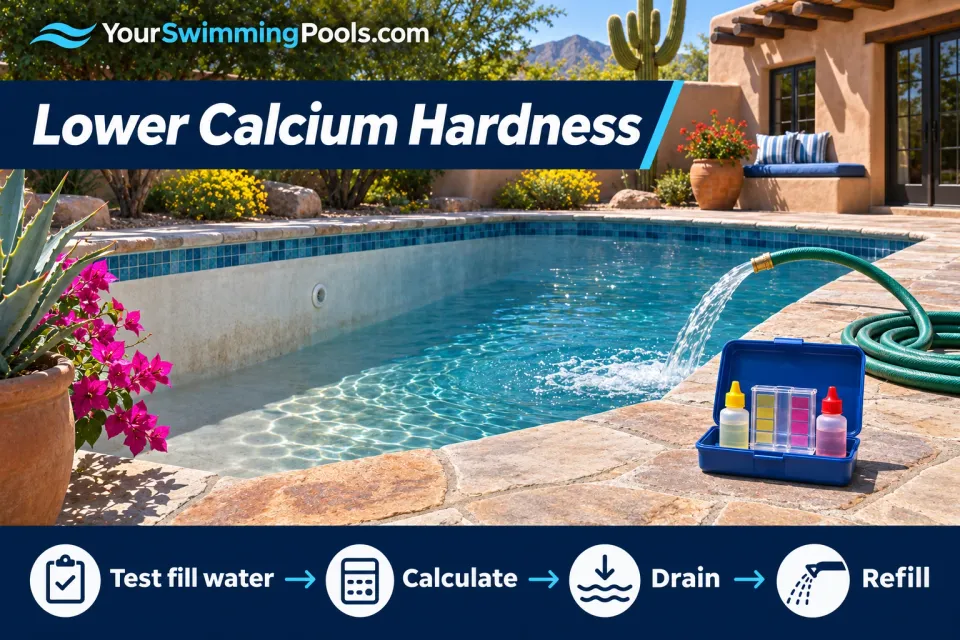
- Test the pool and your fill water for calcium hardness.
- Calculate the share and the gallons.
- Ask before you drain. Draining, even partly, can damage some pools: depending on the shell, the groundwater and other conditions, a pool can crack, shift or lift (our note). Ask your pool manufacturer or a qualified pool professional first, and check your local rules on where pool water may be discharged.
- Check your pool manual for how low the water may go; split into rounds if needed (rounds use a little more water in total, our calculation).
- Drain, refill, run the pump, retest, then rebalance in Taylor's order: alkalinity, pH, calcium.
As an Amazon Associate we earn from qualifying purchases. We have not tested these products.
For this job A submersible utility pumpA small electric pump with a garden hose outlet drains a pool down to a set mark. Check the hose size and the cord length.
Slowing the build-up
- TroubleFreePool: with hard fill water, keep calcium at the low end of your range.
- Cal-hypo shock adds calcium: by our calculation at least about 0.7 ppm calcium hardness per 1 ppm chlorine. Liquid chlorine does not (TroubleFreePool).
Sources
- TroubleFreePool: Recommended levels (acceptable maximum)
- TroubleFreePool: ABCs of pool water chemistry (above 650 ppm, hard fill water)
- TroubleFreePool: How to chlorinate your pool (what each chlorine type adds)
- Taylor Technologies: LSI calculator and target ranges (order of adjustment)
Sources read on November 6, 2026, unless a date is given. Product labels change: the label on the product you buy always wins.
