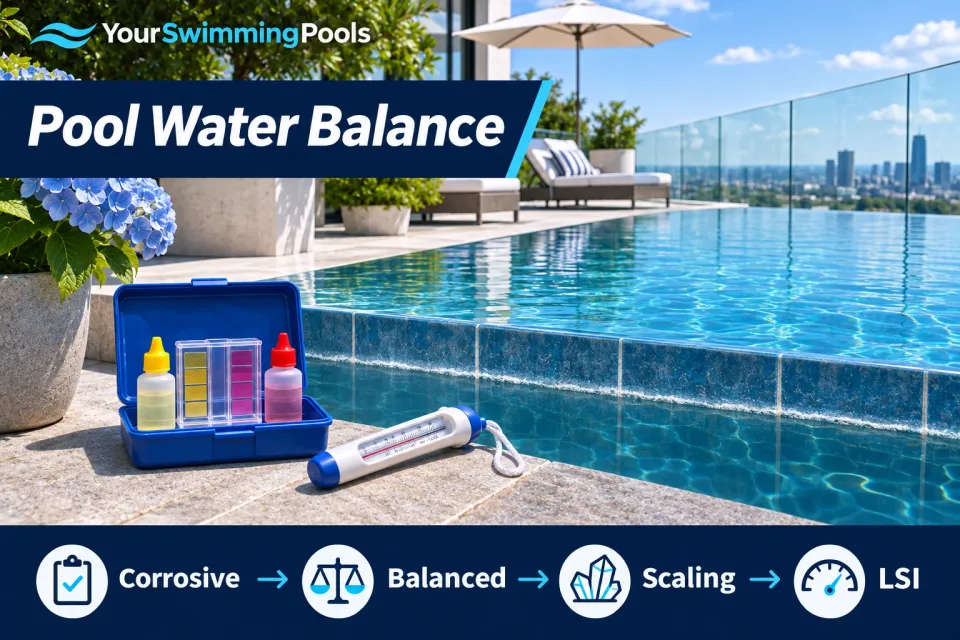
Balanced water neither eats your pool nor coats it. Water that is out of balance does one of the two: it dissolves calcium from plaster and grout, or it leaves calcium behind as scale. The saturation index (LSI) tells you which way your water leans.
The short version: Taylor Technologies' ideal LSI range is −0.30 to +0.30, and it advises acting at −0.50 or +0.50. Low means corrosive (etching of plaster, metal corrosion); high means scaling (cloudy water, scale on surfaces). Adjust in Taylor's order: total alkalinity first, then pH, then calcium hardness.
As an Amazon Associate we earn from qualifying purchases. We have not tested these products.
Test kit A test kit that reads calcium hardnessCalcium hardness is one of the five numbers the saturation index needs, together with pH, alkalinity, temperature and dissolved solids.
The LSI in one table
| LSI | Water | What you may see (Taylor) |
|---|---|---|
| −0.50 or lower | Corrosive: act now (Taylor's action threshold) | Pitting or etching of plaster, metal corrosion |
| Below −0.30, above −0.50 | Leaning corrosive: outside the ideal range | Correct it before it reaches −0.50 (our advice) |
| −0.30 to +0.30 | Balanced | Ideal range, no treatment needed |
| Above +0.30, below +0.50 | Leaning scaling: outside the ideal range | Correct it before it reaches +0.50 (our advice) |
| +0.50 or higher | Scaling: act now (Taylor's action threshold) | Cloudy water, scale on surfaces |
The index combines five numbers: pH, water temperature, calcium hardness, alkalinity and dissolved solids. Our pool LSI calculator does the math and corrects alkalinity for stabilizer.
Three examples
| Water | pH | Temp | Calcium | Alkalinity | LSI |
|---|---|---|---|---|---|
| Balanced | 7.5 | 84 °F | 300 ppm | 100 ppm | +0.08 |
| Scale-forming | 7.8 | 84 °F | 400 ppm | 120 ppm | +0.58 |
| Corrosive | 7.2 | 76 °F | 100 ppm | 60 ppm | −1.02 |
Our calculation with Utah's LSI formula: temperature and dissolved-solids factors from its Table 2 (dissolved solids about 1,000 ppm), calcium and alkalinity factors as exact log values, as on our LSI calculator page. No stabilizer.
Calcium hardness targets
| Source | Calcium hardness |
|---|---|
| Taylor Technologies, pools | 200 to 400 ppm |
| Taylor Technologies, spas | 150 to 250 ppm |
| TroubleFreePool, plaster and fiberglass | ideal 350 to 550 ppm |
| TroubleFreePool, vinyl | ideal 50 to 550 ppm |
| Utah pool code, public pools | at least 200 ppm |
The TroubleFreePool rows are its ranges, not a manufacturer standard. Pool-shell and equipment makers can give different numbers, including for fiberglass: follow your own pool and equipment manuals where they give a range (our note).
More in calcium hardness in pools.
Which page fixes your problem?
| Your situation | Go to |
|---|---|
| Calcium too low | how to raise calcium hardness |
| Calcium too high | how to lower calcium hardness |
| White crust at the waterline | white scale on pool tile |
| Rough plaster, etched grout, corroded metal | corrosive pool water |
| Not sure which number matters | saturation index vs calcium hardness |
| Balance changes with the seasons | does water temperature change pool balance? |
Sources
- Taylor Technologies: LSI calculator and target ranges (LSI ranges, action threshold, calcium targets, order of adjustment)
- Utah Admin. Code R392-302-25 (public pools) (LSI formula and factors, calcium minimum)
- TroubleFreePool: Recommended levels (calcium ranges by surface)
Sources read on November 6, 2026, unless a date is given. Product labels change: the label on the product you buy always wins.
