High total alkalinity is the quiet troublemaker of pool chemistry. You lower the pH, and two days later it is back up. You add acid again, and again. Most of the time the real problem is not the pH but the alkalinity behind it. Here is how to bring it down, including the trick pool owners use to lower alkalinity without ending up with a pH that is far too low.
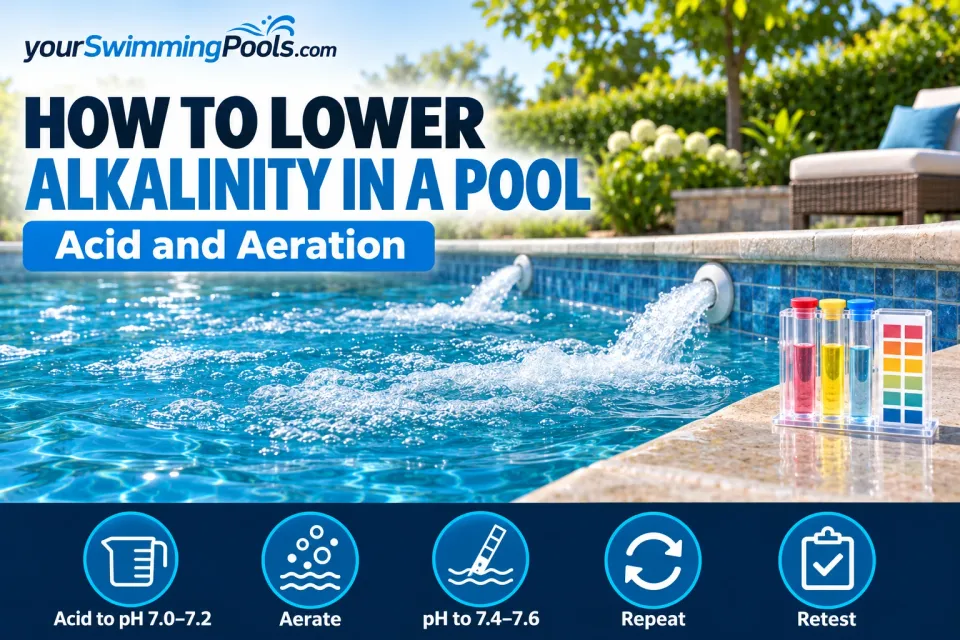
The short version: among common pool chemicals, only acid lowers total alkalinity: muriatic acid or dry acid (sodium bisulfate). Replacing part of the water with lower-alkalinity water also brings it down (our explanation). Baking soda raises it. If your alkalinity is just a bit high, keeping pH in range with acid brings it down over time. To lower it faster, use the acid-and-aeration method: add acid until pH is 7.0 to 7.2, aerate until pH climbs back to 7.4 to 7.6, and repeat. Each round lowers alkalinity a little, while pH ends up where you want it.
Part of: Pool pH and Alkalinity: How They Work Together, our overview of every pH and alkalinity fix, including raising pH and alkalinity.
What total alkalinity does
Total alkalinity is the water's buffer: it resists changes in pH. Some buffer is good, because pH then stays steady. Too much, and pH keeps drifting up and every pH correction costs more acid. HTH puts it this way: if pH won't come down even after dosing, high total alkalinity is usually the cause, and it will keep pushing pH back up.
What should total alkalinity be?
| Source | Total alkalinity |
|---|---|
| Taylor Technologies (pools) | 80 to 120 ppm |
| TroubleFreePool (recommended) | 60 to 90 ppm |
| HTH pH Down page | Do not let it drop below 80 ppm |
Why the difference? TroubleFreePool aims lower on purpose: a TA of 60 to 90 slows pH rise and lowers the risk of scale. Taylor's 80 to 120 ppm is the test-kit maker's range. Pick one range and stick with it. If the alkalinity is high, your pool LSI may also be high, meaning the water leans towards scale.
Do you really need to lower it fast?
Not always. TroubleFreePool's advice: if your TA is close to range, just keep pH in its range with muriatic acid. Every dose of acid also lowers TA a little, so it comes down over time. The faster method below is worth it when:
- your TA is above range and you need acid very often to hold pH, or
- high TA pushes the water towards scale (a high saturation index), or
- you live in a dry climate with high-alkalinity fill water and lots of evaporation, so TA keeps rising (TroubleFreePool).
In that dry-climate case, TroubleFreePool notes that long-term control may be better served by an acid dosing system than by repeating the method below.
How to lower alkalinity: the acid and aeration method
This is the method TroubleFreePool describes:
- Add acid until pH is between 7.0 and 7.2. This also lowers TA.
- Aerate until pH rises to about 7.4 to 7.6.
- Repeat steps 1 and 2 until you reach the TA you want.
Why it works: acid lowers both TA and pH. Aeration drives dissolved CO₂ out of the water, and that raises pH but does not raise TA. So each round removes some alkalinity and gives you your pH back. CO₂ escapes fastest at low pH, around 7.0 to 7.2, which is why you let pH drop that far before aerating (TroubleFreePool).
How fast? The acid step is quick: within about 30 minutes with the pump running. The aeration step takes longer. TroubleFreePool reports a 30,000-gallon pool that dropped TA by 10 ppm in about 12 hours with this method. Expect several rounds, not one big dose.
How to aerate a pool
- Point the return jets up so they break the water surface.
- Run spa jets, waterfalls or fountains.
- Let the kids splash: TroubleFreePool lists that too.
- Lots of very tiny bubbles work better than a few big ones (TroubleFreePool).
If you build an aerator with a sump pump in the pool, TroubleFreePool's rule is strict: nobody in the pool while the pump is in the water, plugged in or not. If you have a heater with a bypass, bypass it during the process (TroubleFreePool).
How much acid to lower alkalinity?
Follow the label of your product: strengths and directions differ per brand. With the acid-and-aeration method you are not dosing "for alkalinity" anyway: you dose to bring pH down to 7.0 to 7.2 each round, then let aeration do the rest. Our how to lower pH page has an example dosage table (HTH pH Down) and the step-by-step for adding acid safely.
Never add acid while people are in the pool, always add chemicals to the water and not the other way around, and never mix chemicals (HTH quick tips).
Common mistakes
- Raising pH with soda ash afterwards. Soda ash raises pH but also raises alkalinity (Taylor's chemical reference). After lowering TA, let aeration raise pH instead.
- Using baking soda. Sodium bicarbonate increases total alkalinity (Taylor). It is the opposite of what you need here.
- One huge dose of acid. You overshoot pH far below 7.0, outside the CDC range. Small rounds, retest each time (our advice).
- Going too low. HTH warns not to let alkalinity drop below 80 ppm when you keep dosing acid.
FAQ
How do I lower alkalinity quickly?
Use the acid and aeration method: acid to pH 7.0 to 7.2, aerate back to 7.4 to 7.6, repeat. The faster pH rises with aeration, the sooner you can start the next round (our explanation).
Will shocking the pool lower alkalinity?
No. Shock is for sanitizing. In Taylor's chemical reference, only muriatic acid and dry acid lower total alkalinity. HTH even says to adjust alkalinity and pH before you shock.
Does baking soda lower alkalinity?
No, it raises it. Baking soda is sodium bicarbonate, which Taylor lists as the chemical to increase total alkalinity.
Should I adjust alkalinity or pH first?
Alkalinity first, then pH, then calcium hardness. That is Taylor Technologies' order, because changing alkalinity also moves pH.
Can I have high alkalinity but a good pH?
Yes, for a while: right after an acid dose the pH can read fine while TA is still high. If pH keeps creeping back up after each dose, that is the sign to lower TA (our explanation, in line with HTH's note above).
Is it safe to swim with high alkalinity?
High alkalinity mainly pushes pH up, and the CDC's concern is that chlorine works less well as pH rises, especially above 8.0. Keep pH within 7.0 to 7.8 and chlorine at the CDC minimum, and fix the alkalinity over the following days.
Can I lower alkalinity and pH at the same time?
Yes: the same acid lowers both. HTH notes its pH Down often addresses both at once. If you want pH to stay where it is while TA drops, that is what the aeration step is for.
Sources
- TroubleFreePool: Lower total alkalinity (acid and aeration method, why it works, aeration tips, recommended range)
- Taylor Technologies: LSI calculator (target ranges, order of adjustments, chemical reference)
- HTH Pool Care pH Down (high TA pushes pH up, do not drop below 80 ppm, quick safety tips)
- HTH Pool Care Shock Advanced (adjust alkalinity and pH before shocking)
- CDC: Home pool and hot tub water treatment and testing (pH and chlorine)
