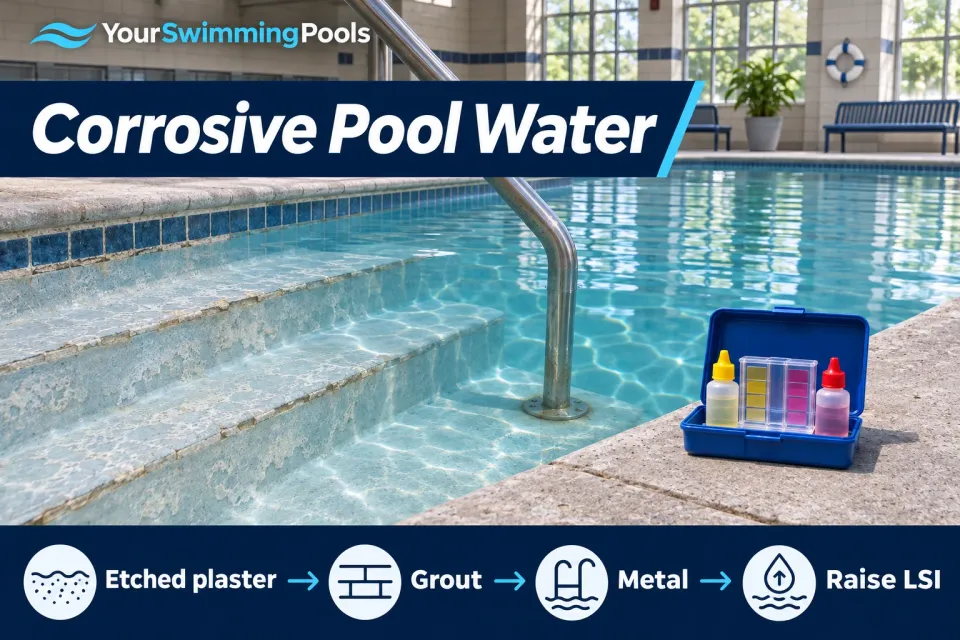
Water that is out of balance on the low side does not leave a mark you can wipe off. It takes something away: calcium from plaster and grout, metal from fittings and heaters.
The short version: Taylor Technologies links an LSI of −0.30 or lower to pitting or etching of plaster and metal corrosion, and calls corrosive water "damaging to surfaces and equipment". TroubleFreePool: calcium below 250 ppm can leach calcium from plaster, grout, tile or stone. Fix alkalinity, then pH, then calcium.
Part of: Pool Water Balance: Calcium, Scale and the LSI, our overview of water balance.
The signs
| Where | What you may see |
|---|---|
| Plaster | Pitting or etching, rough surfaces (Taylor; TroubleFreePool) |
| Grout, tile, stone | Calcium leached out, etching (TroubleFreePool) |
| Metal | Corrosion (Taylor) |
These signs are a reason to test, not a diagnosis: rough plaster, worn grout or corroded metal can have other causes too (our note). The LSI tells you whether the water is the likely cause.
Vinyl liners do not contain calcium, so they do not etch this way (our explanation); metal parts in the system can still corrode.
As an Amazon Associate we earn from qualifying purchases. We have not tested these products.
Test kit A test kit that reads calcium hardnessCalcium hardness is one of the five numbers the saturation index needs, together with pH, alkalinity, temperature and dissolved solids.
What makes water corrosive
Anything that pulls the saturation index down: low pH, low alkalinity, low calcium, cold water (our explanation of the LSI formula). Example: pH 7.2, 76 °F, calcium 100 ppm and alkalinity 60 ppm, with about 1,000 ppm dissolved solids, gives an LSI of about −1.02 (our calculation with Utah's LSI formula). Fresh fill water that is soft can do it too (our note).
How to fix it
- Test pH, alkalinity, calcium, temperature; run the LSI calculator.
- Adjust in Taylor's order: total alkalinity first, then pH, then calcium hardness. See pool pH and alkalinity and how to raise calcium hardness.
- Aim for Taylor's ideal range, −0.30 to +0.30.
- Retest after a day; check again when the water temperature changes a lot.
As an Amazon Associate we earn from qualifying purchases. We have not tested these products.
Raises calcium Calcium hardness increaserCalcium chloride for pools. Check whether the bag says 77% or 94% (or another number): the dose depends on it.
Already damaged?
Balancing the water stops further damage; it does not repair etched plaster or corroded parts (our note). For surface repairs, ask a pool professional.
Sources
- Taylor Technologies: LSI calculator and target ranges (LSI −0.30 and lower: etching, corrosion, order of adjustment)
- TroubleFreePool: ABCs of pool water chemistry (calcium below 250 ppm leaches calcium)
- Utah Admin. Code R392-302-25 (public pools) (negative index means corrosive tendencies)
Sources read on November 6, 2026, unless a date is given. Product labels change: the label on the product you buy always wins.
