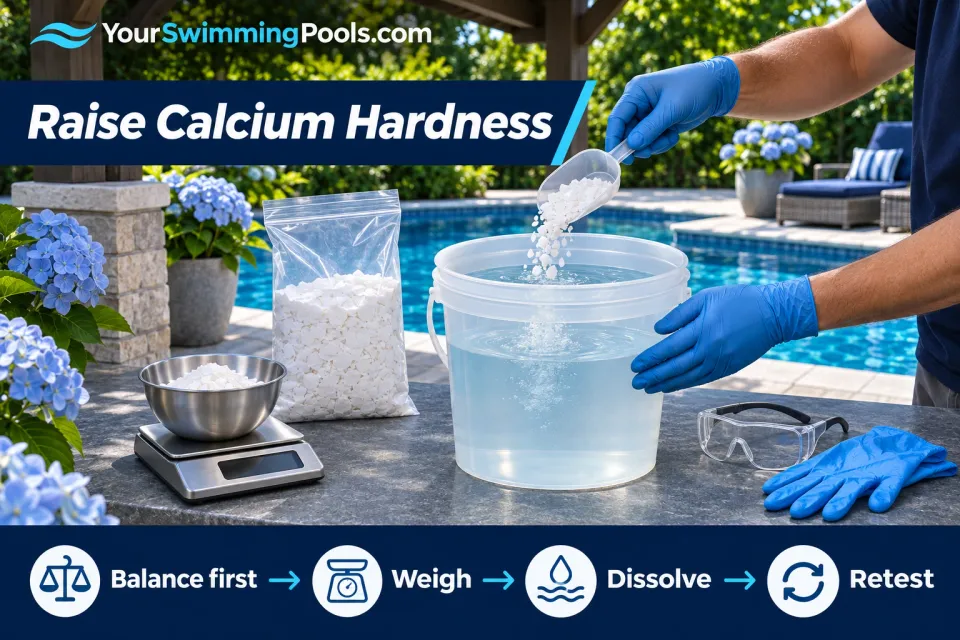
If your plaster feels rough or your test reads well below your surface's range, calcium chloride brings calcium hardness up. It works fast; the care is in the dissolving and in not overshooting.
The short version: about 15.8 oz of 94% calcium chloride raises calcium hardness by 10 ppm in 10,000 gallons (our calculation). Balance alkalinity and pH first, as Taylor Technologies advises, then add calcium in steps of up to 50 ppm (our rule of thumb).
Part of: Pool Water Balance: Calcium, Scale and the LSI, our overview of water balance.
As an Amazon Associate we earn from qualifying purchases. We have not tested these products.
Raises calcium Calcium hardness increaserCalcium chloride for pools. Check whether the bag says 77% or 94% (or another number): the dose depends on it.
How much calcium chloride (94%)
| Pool volume | +10 ppm | +25 ppm | +50 ppm |
|---|---|---|---|
| 5,000 gal | 7.9 oz | 1.2 lb | 2.5 lb |
| 10,000 gal | 15.8 oz | 2.5 lb | 4.9 lb |
| 15,000 gal | 1.5 lb | 3.7 lb | 7.4 lb |
| 20,000 gal | 2.0 lb | 4.9 lb | 9.8 lb |
Our calculation: calcium hardness is measured as calcium carbonate, so we convert with the molecular weights (calcium chloride 110.98, calcium carbonate 100.09) and divide by 0.94. With 77% flakes you need about 22% more. Our calcium hardness calculator does other percentages.
Step by step
- Test calcium, pH and alkalinity. Taylor's order: total alkalinity first, pH second, calcium hardness last.
- Check the whole balance in the LSI calculator with your target calcium: if it comes out above +0.30, lower pH or alkalinity first (our advice, from Taylor's ranges).
- Weigh one step of up to 50 ppm (our rule of thumb).
- Dissolve it in a bucket of pool water. Calcium chloride gets hot when it dissolves: add the product to the water, never water onto the product, and wear eye protection (our advice; follow your label).
- Pour it slowly around the pool with the pump on, away from the skimmer.
- Test after a day of circulation, then decide on the next step.
How high to go
Taylor: 200 to 400 ppm. TroubleFreePool for plaster: 350 to 550 ppm; for vinyl it can be much lower. Details in calcium hardness in pools.
As an Amazon Associate we earn from qualifying purchases. We have not tested these products.
Test kit A test kit that reads calcium hardnessCalcium hardness is one of the five numbers the saturation index needs, together with pH, alkalinity, temperature and dissolved solids.
Sources
- Taylor Technologies: LSI calculator and target ranges (order of adjustment, 200 to 400 ppm, LSI range)
- TroubleFreePool: Recommended levels (ranges by surface)
Sources read on November 6, 2026, unless a date is given. Product labels change: the label on the product you buy always wins.
