Your alkalinity reading is low. What does that mean for the water, and can you still swim?
The short answer: whether you can swim right now depends on your current pH and chlorine readings, not on alkalinity: pH 7.0 to 7.8 and free chlorine at least 1 ppm (2 ppm with stabilizer), both from the CDC. Low alkalinity is mainly a pH problem: with little buffer, pH swings (Better Health Channel, TroubleFreePool). So test pH and chlorine before each swim, and raise alkalinity with baking soda to stop the swings.
Part of: Pool pH and Alkalinity: How They Work Together, our overview of every pH and alkalinity fix.
What low alkalinity does
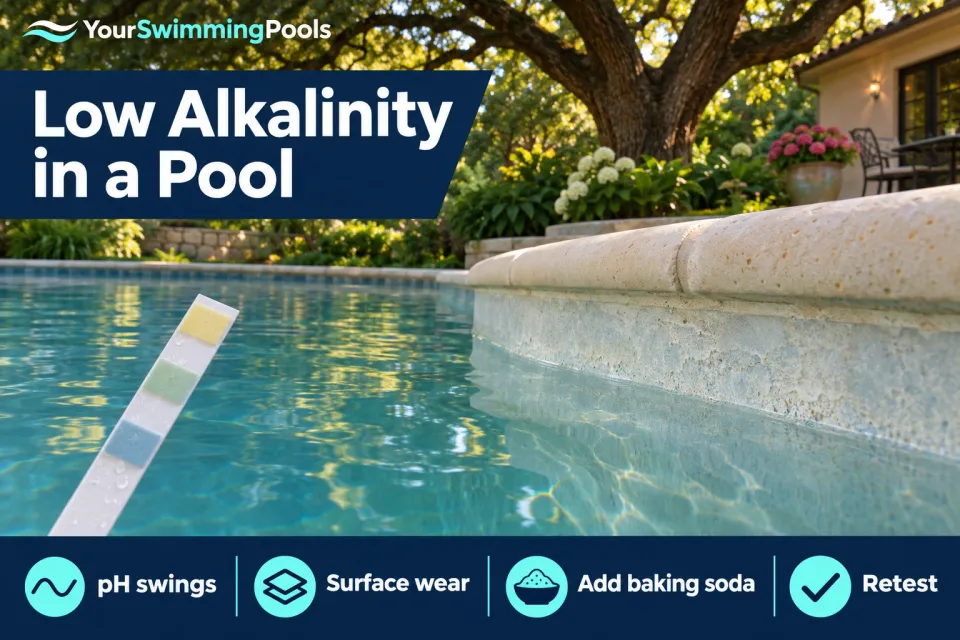
- Unstable pH. "Low TA leads to unstable pH levels" (TroubleFreePool). The Better Health Channel says the same.
- Wear on surfaces. The Better Health Channel: concrete and painted pool surfaces will also deteriorate over time.
- Corrosive water, through pH. If pH drops below 7.0, the CDC says pipes are more likely to corrode or break down. Taylor's LSI page lists corrosion, pitting and etching of plaster for corrosive water. Check with the LSI calculator.
How low is too low?
| Source | Raise alkalinity when it is below |
|---|---|
| Taylor Technologies | 80 ppm (range 80 to 120) |
| Arm & Hammer | especially below 80 ppm |
| TroubleFreePool (liquid chlorine or salt) | 50 ppm |
Can you swim with low alkalinity?
None of our sources says low alkalinity by itself makes swimming unsafe. The swim check is pH and chlorine: pH within 7.0 to 7.8 and chlorine at least 1 ppm (2 ppm with stabilizer), both from the CDC. If pH has dropped below 7.0, fix that first: the Better Health Channel says low pH can sting the eyes.
How to fix it
Add baking soda (sodium bicarbonate): about 1.4 lb per 10,000 gallons raises alkalinity by 10 ppm (our arithmetic; Arm & Hammer rounds it to 1.5 lb). Full steps and a table by pool size: how to raise alkalinity with baking soda, or use the pool alkalinity calculator.
As an Amazon Associate we earn from qualifying purchases. We have not tested these products.
Raises alkalinity Alkalinity increaser (sodium bicarbonate)Pool alkalinity increasers are usually sodium bicarbonate, the same chemical as baking soda. Check the label for the active ingredient.
Sources
- TroubleFreePool: ABCs of pool water chemistry (low alkalinity and unstable pH, raise below 50 ppm)
- Better Health Channel (Victoria State Government): Swimming pools, water quality (unstable pH, surfaces deteriorate, low pH stings eyes)
- CDC: Home pool and hot tub water treatment and testing (pH 7.0 to 7.8, corrosion below 7.0, chlorine minimums)
- Taylor Technologies: LSI calculator (range 80 to 120 ppm, corrosive water)
- Arm & Hammer: How to use baking soda for pool maintenance (raise below 80 ppm, 1.5 lb per 10,000 gallons)
Sources read on November 4, 2026. Product labels change: the label on the product you buy always wins.
