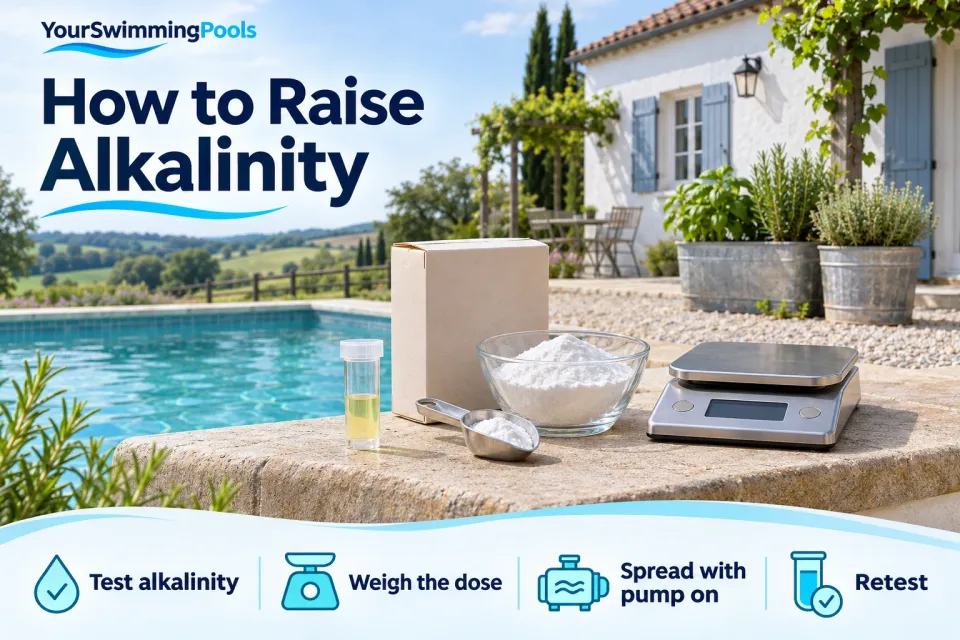
Low total alkalinity is one of the easier pool fixes: the chemical is plain baking soda, and the dose is simple arithmetic. This page gives the dose by pool size and the steps that keep you from overshooting.
The short version: about 1.4 to 1.5 lb of baking soda per 10,000 gallons raises total alkalinity by about 10 ppm (Arm & Hammer's rule of thumb is 1.5 lb; the chemistry gives 1.4 lb). Add it with the pump running, start with part of the dose, and retest after it has mixed. Baking soda raises pH a little too.
Part of: Pool pH and Alkalinity: How They Work Together, our overview of every pH and alkalinity fix.
When should you raise alkalinity?
The sources disagree on the floor. Taylor Technologies' range is 80 to 120 ppm, and Arm & Hammer says to raise it especially when it is below 80 ppm. TroubleFreePool, which assumes liquid chlorine or a salt system, says there is no reason to raise alkalinity unless it is below 50 ppm. If you use chlorine tablets, the higher range applies (TroubleFreePool). Low alkalinity makes pH unstable (Better Health Channel, TroubleFreePool).
Which target should you use?
- You chlorinate with tablets (trichlor or dichlor): use the 80 to 120 ppm range (Taylor). TroubleFreePool says that common range assumes tablets.
- You use liquid chlorine or a salt system: TroubleFreePool's 50 to 90 ppm range applies, and it only raises alkalinity below 50 ppm.
- Your test kit or product maker gives its own range: you can follow that instead.
Whichever you pick, stay with it, so you are not adjusting toward a different number every week (our advice).
How much baking soda? Dose by pool size
| Pool volume | Baking soda to raise alkalinity by 10 ppm |
|---|---|
| 5,000 gal | 0.70 lb (11 oz) |
| 10,000 gal | 1.40 lb |
| 15,000 gal | 2.10 lb |
| 20,000 gal | 2.80 lb |
| 25,000 gal | 3.50 lb |
| 30,000 gal | 4.20 lb |
Our arithmetic: grams = ppm rise × liters ÷ 1000 × 1.6787 (the ratio of two moles of sodium bicarbonate to one mole of calcium carbonate, from NIST molecular weights, the same formula as our pool alkalinity calculator). For 20 ppm, double the number. Arm & Hammer's rule of thumb, 1.5 lb per 10,000 gallons for about 10 ppm, is a little higher and rounds up.
Not sure of the gallons? Use the pool volume calculator first.
Step by step
- Test total alkalinity and pH.
- Work out the dose from the table or the calculator. If you are new to it, Arm & Hammer suggests starting with one-half to three-fourths of the amount.
- Make sure nobody is in the pool and run the pump.
- Add the baking soda the way your product label says (our note: pool alkalinity increasers are usually sodium bicarbonate too, with their own directions).
- Let it circulate. Arm & Hammer: wait at least six hours, and retest pH and alkalinity between 6 and 24 hours after adding it. TroubleFreePool retests 30 minutes after each small dose.
- Repeat in steps until you reach the target.
As an Amazon Associate we earn from qualifying purchases. We have not tested these products.
Raises alkalinity Alkalinity increaser (sodium bicarbonate)Pool alkalinity increasers are usually sodium bicarbonate, the same chemical as baking soda. Check the label for the active ingredient.
Will baking soda raise my pH?
Yes, a little. Arm & Hammer says it raises both pH and alkalinity; Taylor lists sodium bicarbonate as a "slight" pH raiser. If pH is fine and only alkalinity is low, expect pH to move a bit and retest. If pH is the main problem, see how to raise ph in a pool.
As an Amazon Associate we earn from qualifying purchases. We have not tested these products.
Test kit A test kit that reads pH and total alkalinityEvery step on this page starts and ends with a test. A drop-based (liquid) kit or test strips both work; follow the kit's own instructions.
FAQ
Can I use household baking soda?
Arm & Hammer's own pool page uses its baking soda for this. Baking soda is sodium bicarbonate, the usual active chemical in pool alkalinity increasers: compare the labels.
Will baking soda lower alkalinity?
No, it raises it. To lower alkalinity you need acid: see how to lower alkalinity in a pool.
How much can I add at once?
Arm & Hammer mentions amounts from 1.5 lb up to 8 to 10 lb, depending on how low the alkalinity is. We suggest adding in steps of about 10 to 20 ppm and retesting in between, so one wrong test does not turn into a big overshoot (our advice).
Sources
- Arm & Hammer: How to use baking soda for pool maintenance (1.5 lb per 10,000 gallons rule, start with part of the dose, waiting time, raises pH)
- Taylor Technologies: LSI calculator (range 80 to 120 ppm, bicarbonate raises alkalinity and slightly raises pH)
- TroubleFreePool: ABCs of pool water chemistry (raise only below 50 ppm with liquid chlorine or salt, retest after 30 minutes)
- Better Health Channel (Victoria State Government): Swimming pools, water quality (low alkalinity and unstable pH)
Sources read on November 4, 2026. Product labels change: the label on the product you buy always wins.
