Most pools fight a pH that keeps going up. If yours keeps going down, something is adding acid to the water. Here is how to find it.
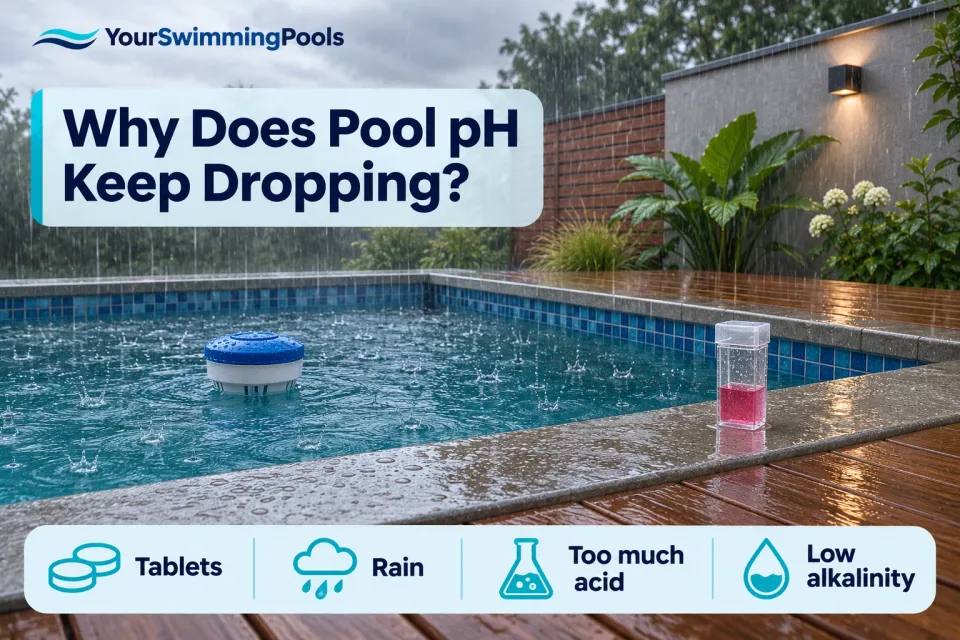
The short version: the usual causes are acidic chlorine tablets (trichlor or dichlor), rain, adding too much acid, and low total alkalinity, which lets pH swing. Check alkalinity first; raise it with baking soda if it is low, then raise pH if needed.
Part of: Pool pH and Alkalinity: How They Work Together, our overview of every pH and alkalinity fix.
What pulls pH down
1. Chlorine tablets or sticks
TroubleFreePool calls trichlor and dichlor tablets "highly acidic". If a floater or feeder runs all the time, it keeps adding acid (our note). The CDC mentions dichlor and trichlor as chlorine products that contain cyanuric acid; check the label of yours.
2. Rain
The EPA says normal rain has a pH of about 5.6, and acid rain usually 4.2 to 4.4. The Better Health Channel lists heavy rain among the things that affect a pool's pH. After a big storm, test before you dose (our advice).
3. Too much acid
A second acid dose before the first one has mixed is the classic overshoot (our note). Follow the waiting time on your acid's label and retest before adding more. See how to lower ph in a pool.
4. Low total alkalinity
Low alkalinity leads to unstable pH (TroubleFreePool); the Better Health Channel says the same. With little buffer, a small amount of acid moves pH a lot (our explanation).
How to fix it
- Test pH and total alkalinity.
- If alkalinity is low, raise it first: how to raise alkalinity with baking soda. Taylor's order is alkalinity, then pH.
- Retest pH. If it is still low, use aeration or soda ash.
- Remove the cause: switch from tablets to another chlorine source or use fewer tablets (our suggestion), and test after heavy rain.
As an Amazon Associate we earn from qualifying purchases. We have not tested these products.
Raises alkalinity Alkalinity increaser (sodium bicarbonate)Pool alkalinity increasers are usually sodium bicarbonate, the same chemical as baking soda. Check the label for the active ingredient.
As an Amazon Associate we earn from qualifying purchases. We have not tested these products.
Test kit A test kit that reads pH and total alkalinityEvery step on this page starts and ends with a test. A drop-based (liquid) kit or test strips both work; follow the kit's own instructions.
FAQ
Will shocking a pool lower pH?
It depends on the shock product, so read its label. Dichlor-based products are acidic (TroubleFreePool); balance pH and alkalinity before you shock, as HTH's shock directions say (see our pH page).
What does low pH do to a pool?
The CDC: below pH 7.0, pipes are more likely to corrode or break down. The Better Health Channel: it can sting swimmers' eyes.
Sources
- TroubleFreePool: ABCs of pool water chemistry (trichlor and dichlor are highly acidic, low alkalinity and unstable pH)
- EPA: What is acid rain? (pH of normal rain and acid rain)
- Better Health Channel (Victoria State Government): Swimming pools, water quality (rain and chemicals affect pH; low alkalinity)
- CDC: Home pool and hot tub water treatment and testing (pH range, low pH and corrosion, dichlor and trichlor)
- Taylor Technologies: LSI calculator (order of adjustment)
- HTH Pool Care Shock Advanced (read 3 Nov 2026) (balance alkalinity and pH before shocking)
Sources read on November 4, 2026. Product labels change: the label on the product you buy always wins.
