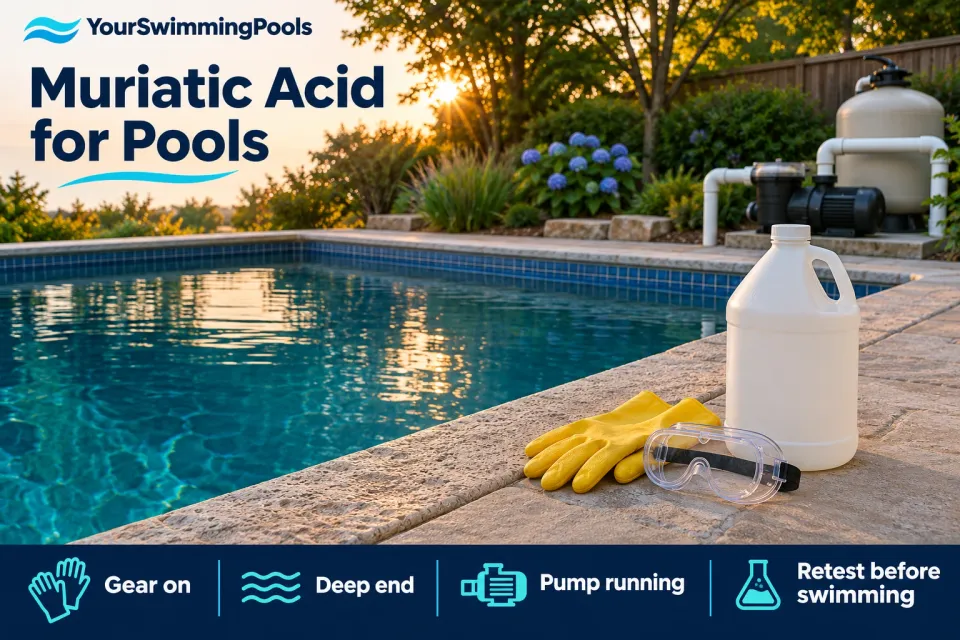
Muriatic acid is a common way to bring pool pH and alkalinity down, and it needs careful handling: its label calls it a corrosive liquid and vapor. Here is how much to use and how to handle it, taken from a real product label.
The short version: muriatic acid is hydrochloric acid. The Sunnyside label (31.45%) says to add approximately one pint per 10,000 gallons, as indicated by a pH test kit, at the deepest end, away from metal parts and the skimmer, and to keep swimmers out until it is mixed and pH is 7.2 to 7.6. Wear rubber gloves and safety glasses, and never mix it with chlorine.
Part of: Pool pH and Alkalinity: How They Work Together, our overview of every pH and alkalinity fix.
How much muriatic acid to add
The Sunnyside label gives one starting point: approximately one pint per 10,000 gallons, as indicated by a pH test kit, aiming for pH 7.2 to 7.6. It is a first dose for this one product, not a general dose for every acid: acids of a different strength need a different amount, so use the label of your bottle, add in steps and retest. Scaled to other pool sizes (our arithmetic, same proportion):
| Pool volume | Starting dose, Sunnyside 31.45% acid only |
|---|---|
| 5,000 gal | about ½ pint (8 fl oz) |
| 10,000 gal | about 1 pint (16 fl oz) |
| 15,000 gal | about 1½ pints (24 fl oz) |
| 20,000 gal | about 2 pints (32 fl oz, 1 quart) |
| 25,000 gal | about 2½ pints (40 fl oz) |
The label does not tie this amount to a specific pH change, so test after it has mixed before you add more. Volume unknown? Pool volume calculator.
How to add it
- Put on rubber gloves, plastic safety glasses and protective clothing (Sunnyside label). The CDC also advises masks, gloves and goggles when handling pool chemicals.
- Work outdoors with air movement: the label says never to use acid in a confined space.
- Run the pump (our advice, so the acid mixes).
- Add the acid at the deepest end, away from metal parts and the skimmer (label). Avoid splashing.
- Keep swimmers out until the acid is thoroughly mixed and pH reads 7.2 to 7.6 (label). The label also says to test pH in the area where the acid was added.
As an Amazon Associate we earn from qualifying purchases. We have not tested these products.
Protective gear Rubber gloves and safety gogglesThe acid label and the CDC both say to wear protective gear when you handle pool chemicals.
Safety rules
- Never mix it with chlorine. The label: do not mix with chlorine-type bleaches or any other chemicals or household products; acid may react to form toxic gases. Add pool chemicals separately (our advice, following the label).
- Store it apart. The CDC's pool chemical safety page (written for pool operators) says to store each pool chemical separately, keep incompatible chemicals away from each other, store below 95°F out of direct sunlight, and keep chemicals in their original labeled containers.
- Keep the cap tight and the bottle upright (label), and away from children and pets (CDC).
- Fumes damage things. The label: muriatic acid and its fumes can damage or discolor metal, wood, stone, masonry, fabrics and plants.
First aid (from the label)
- Skin: wash with large amounts of water for at least 15 minutes.
- Eyes: flush immediately with running water for at least 15 minutes.
- Swallowed: drink large quantities of water or milk; do not induce vomiting.
- Breathed in: move to fresh air.
- In all cases, call a physician immediately.
As an Amazon Associate we earn from qualifying purchases. We have not tested these products.
Lowers pH and alkalinity Muriatic acid (hydrochloric acid) for poolsLiquid acid; strength differs per bottle, so the dose on your bottle's label is the one to follow. Shipping rules differ by product and state.
FAQ
Muriatic acid or dry acid?
Both lower pH and alkalinity; TroubleFreePool prefers muriatic acid, especially for plaster and salt pools. See muriatic acid vs dry acid.
Sources
- Sunnyside Muriatic Acid label, 31.45% hydrochloric acid (strength, pool dose, how to add, safety, first aid, storage)
- Sunnyside Muriatic Acid product page (add gradually, retest before swimmers enter)
- CDC: Guidelines for keeping your pool safe and healthy (protective gear, follow labels, keep away from children and pets)
- CDC: Pool chemical safety (written for pool operators) (storage rules)
- TroubleFreePool: ABCs of pool water chemistry (muriatic acid preferred over dry acid)
Sources read on November 4, 2026. Product labels change: the label on the product you buy always wins.
