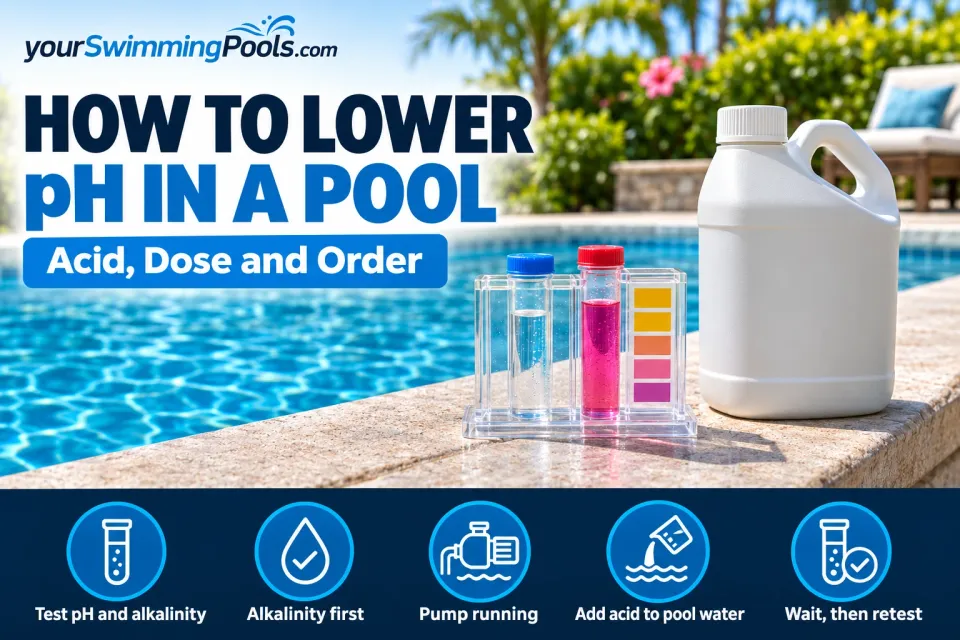
Your pH test came back high again, the water looks a bit dull and your eyes sting after a swim. The fix is simple: acid. The trick is adding the right amount, in the right order, and stopping it from creeping back up a day later. This page walks through it.
The short version: the CDC's range for home pools is pH 7.0 to 7.8; test-kit and chemical makers aim a little narrower (Taylor 7.4 to 7.6, HTH 7.2 to 7.6). To lower pH you add an acid: muriatic acid (liquid) or dry acid (sodium bisulfate). Check total alkalinity first, because high alkalinity keeps pushing pH back up. Add acid with the pump running, in small doses, and retest before adding more. There is no "natural" way to lower pH in a pool: aeration and splashing make it go up.
Part of: Pool pH and Alkalinity: How They Work Together, our overview of every pH and alkalinity fix, including raising pH and alkalinity.
What pH should a pool be?
| Source | pH range |
|---|---|
| CDC (home pools) | 7.0 to 7.8 |
| Taylor Technologies (test kits) | 7.4 to 7.6 |
| HTH pH Down (product page) | 7.2 to 7.6 |
The CDC range is the outer limit; the narrower ranges are where pool chemical makers like to keep the water. Why it matters: the CDC says chlorine's ability to kill germs goes down as pH goes up, especially above 8.0. HTH lists the other effects of high pH (above 7.8): cloudy water, scale on surfaces and equipment, and irritated eyes.
Why does pool pH keep rising?
Pool water holds dissolved carbon dioxide. When that CO₂ escapes into the air, pH rises, and anything that stirs the surface speeds it up: waterfalls, spa jets, returns pointed up, swimmers splashing, a salt chlorine generator (TroubleFreePool). Some sanitizers push pH up too. And if total alkalinity is high, there is more "fuel" for that rise, so pH keeps creeping back after every dose. HTH puts it plainly: if pH won't come down even after dosing, high total alkalinity is usually the cause.
Alkalinity or pH first?
Alkalinity first. Taylor Technologies gives the order total alkalinity, then pH, then calcium hardness, because adjusting alkalinity changes pH too. HTH says the same on its pH Down label: adjust total alkalinity first to help prevent pH drift. If your alkalinity is above about 120 ppm (Taylor's pool range is 80 to 120 ppm), start with how to lower alkalinity in a pool. The good news: the same acid lowers both, so one job often fixes the other.
What lowers pH in a pool?
| Muriatic acid | Dry acid (sodium bisulfate) | |
|---|---|---|
| Form | Liquid (hydrochloric acid) | Granules or powder |
| Lowers | pH and total alkalinity | pH and total alkalinity |
| Handling | Gives off fumes: follow the safety text on the bottle | Dust can irritate: avoid breathing it |
| Dose | By the label of your bottle (strength varies) | By the label; example table below |
Taylor lists both as the two ways to bring pH and alkalinity down. Sold as "pH Down", "pH Minus" or "pH Reducer", most granular products are sodium bisulfate: HTH pH Down is 92% sodium bisulfate.
How much acid to lower pH?
It depends on the product, your pool volume, your starting pH and your alkalinity, so the label of the product you bought always wins. As an example, this is the dosage table on the HTH pH Down product page (sodium bisulfate):
| Pool volume | pH 8.0 to 8.4 | pH above 8.4 |
|---|---|---|
| 5,000 gal | 8 oz | 12 oz |
| 10,000 gal | 16 oz | 24 oz |
| 15,000 gal | 24 oz | 36 oz |
| 20,000 gal | 32 oz | 48 oz |
Source: HTH Pool Care pH Down product page, read November 3, 2026. Only for that product; other brands and muriatic acid have their own tables.
Not sure of your pool volume? The volume helper in our pump runtime calculator gives a quick estimate for rectangular pools.
How to lower pH, step by step
- Test pH and total alkalinity. If alkalinity is high, deal with that first (see above).
- Read the label and work out the dose for your pool volume and pH. When in doubt, start with less: you can always add more, but overshooting means raising pH again.
- Make sure nobody is in the pool. HTH: never add chemicals to pool water when people are in the pool.
- Turn on the pump and keep it running.
- Add the acid to the pool water, never the other way around (HTH). For granular pH Down, HTH says to broadcast it evenly over the deepest part of the pool and never pre-dissolve it in a plastic bucket. For muriatic acid, follow the method on your bottle.
- Wait, then retest. Use the waiting time on the label of the product you bought. Even HTH's own pH Down page gives two different times: its directions say to wait at least 48 hours before retesting, while its FAQ says to retest after 4 to 6 hours of circulation. Either way, do not add a second dose before the first one has mixed and you have retested: that is how pools end up too low (our advice).
- Just shocked the pool? HTH: wait 4 to 6 hours after a shock treatment before adding pH Down, to avoid off-gassing.
Safety rules for pool acid
- Wear goggles and rubber gloves (HTH label; the CDC also advises masks, gloves and goggles when handling pool chemicals).
- Never mix pool chemicals with each other (HTH). Add them separately.
- Store them cool, dry and out of direct sun (HTH), and keep them secure and away from children and pets (CDC).
- Splashed in the eyes or on skin: rinse with plenty of water for 15 to 20 minutes and call a poison control center (HTH label first aid).
How to keep pH from rising again
- Keep total alkalinity in range. Lower alkalinity means slower pH rise (TroubleFreePool). This is the single biggest lever.
- Expect more rise with aeration. Waterfalls, spa spillovers and a salt cell all push pH up; that is normal, not a fault (TroubleFreePool).
- Test regularly. The CDC advises testing pH and chlorine at least twice a day for home pools in use. Our weekly pool maintenance checklist puts it in a routine.
- Check the whole balance. pH is one of the five inputs of the pool LSI calculator, which tells you whether the water as a whole is balanced, corrosive or scale-forming.
FAQ
How do I lower pH in a pool quickly?
Add a measured dose of muriatic acid or dry acid with the pump running. TroubleFreePool notes the acid lowers pH and alkalinity within about 30 minutes with the pump running, but give it time to mix and follow the label's waiting time before you retest; adding a second dose too early is the usual way to overshoot.
Can I lower pool pH naturally?
No. Aeration, rain splashing and swimmers drive CO₂ out of the water, which makes pH rise, not fall. Lowering pH needs an acid.
Does lowering pH also lower alkalinity?
Yes. Muriatic acid and dry acid lower both pH and total alkalinity. HTH notes you can often address both at once, and advises smaller doses when alkalinity is already in range, so it does not drop below 80 ppm.
Is high pH dangerous to swim in?
The CDC's concern is that chlorine kills germs less effectively as pH rises, especially above 8.0. HTH adds eye irritation, cloudy water and scale. Bring it back to 7.0 to 7.8 before swimming.
Should I shock or lower pH first?
Balance first. HTH's shock directions say to test and adjust total alkalinity and pH before shocking, and its pH Down page says to wait 4 to 6 hours after shocking before adding pH Down. See how to shock a pool.
Sources
- CDC: Home pool and hot tub water treatment and testing (pH 7.0 to 7.8, chlorine and pH, testing twice a day)
- CDC: What you can do to stay healthy in swimming pools (label, protective gear, storage)
- HTH Pool Care pH Down (target range, dosage table, steps, waiting times, safety)
- Taylor Technologies: LSI calculator (order of adjustments, chemicals, target ranges)
- TroubleFreePool: Lower total alkalinity (why pH rises, aeration)
