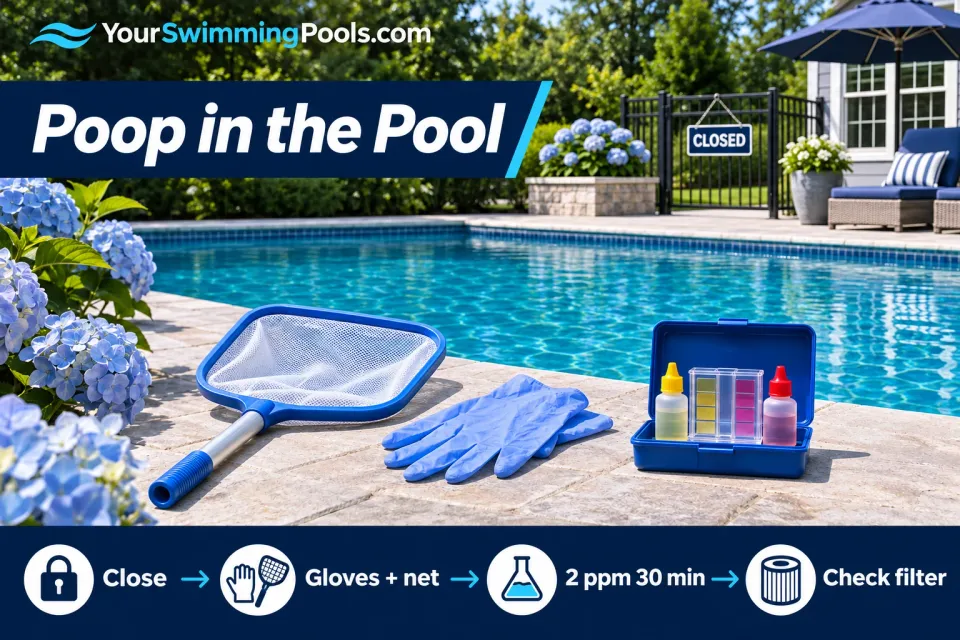
It can happen in any pool used by small children. The CDC has a short, clear procedure, and one important note for backyard pools.
The short version: close the pool, put on disposable gloves, remove the poop with a net or bucket (do not vacuum it), raise free chlorine to or keep it at 2 ppm with pH 7.5 or less for 30 minutes, and check that the filter runs properly (CDC). The CDC's very high chlorine treatment for diarrhea is for public pools: it says it does not apply to backyard pools.
Part of: Pool Shock: Types, Timing and Safety, our overview of pool shock.
The CDC steps
- Close the pool to swimmers.
- Put on disposable gloves.
- Remove the poop using a net or bucket. Do not vacuum the poop from the pool.
- Clean as much poop as possible from the net or bucket and dispose of it in a sanitary manner.
- Remove and dispose of the gloves, and wash your hands thoroughly with soap and water.
- Raise the free chlorine to, or maintain it at, 2 ppm and keep the pH at 7.5 or less for 30 minutes.
- Confirm that the filtration system is operating properly.
As an Amazon Associate we earn from qualifying purchases. We have not tested these products.
Step 3 A pool skimmer netThe CDC says to remove the poop with a net or bucket, not with a pool vacuum.
As an Amazon Associate we earn from qualifying purchases. We have not tested these products.
Step 2 Disposable glovesThe CDC's first steps: close the pool, then put on disposable gloves.
Formed poop or diarrhea?
The CDC: germs in formed poop are less likely to be released into the water, because they are mostly contained within it. A diarrheal incident is a high-risk Cryptosporidium event. For public pools the CDC then asks for very high chlorine for hours; for backyard pools it says that recommendation does not apply, because it raises the risk of pool chemical injuries for pool owners. Crypto can survive more than 7 days in properly treated water (CDC), which is why the CDC's basic rule matters most: stay out of the pool if you have diarrhea.
How fast chlorine works (CDC)
| Germ | Time at 1 ppm free chlorine |
|---|---|
| E. coli O157:H7 | less than 1 minute |
| Hepatitis A | about 16 minutes |
| Giardia | about 45 minutes |
| Cryptosporidium | about 15,300 minutes (10.6 days) |
Those times are for pH 7.5 or less at 77 °F or warmer, and only for water without cyanuric acid: the CDC says disinfection times are longer with it. See cyanuric acid in pools.
In a hot tub
The CDC's hot tub steps go further than the pool steps: remove the poop, drain the hot tub and its piping, scrub the surfaces, clean or replace the filter media, refill, and then hold pH 7.0 to 7.8 and at least 3 ppm free chlorine for 30 minutes.
As an Amazon Associate we earn from qualifying purchases. We have not tested these products.
Test kit A test kit that reads free and total chlorineThe CDC calls a DPD test kit the most accurate option for home pools; test strips are less accurate. Follow the kit's own instructions.
Sources
- CDC: What to do when there is poop in the pool (all steps, formed vs diarrhea, backyard pools, kill times, hot tubs)
- CDC: Guidelines for keeping your pool safe and healthy (Crypto survives more than 7 days, stay out with diarrhea)
- CDC: Home pool and hot tub water treatment and testing (longer disinfection with cyanuric acid)
Sources read on November 6, 2026, unless a date is given. Product labels change: the label on the product you buy always wins.
