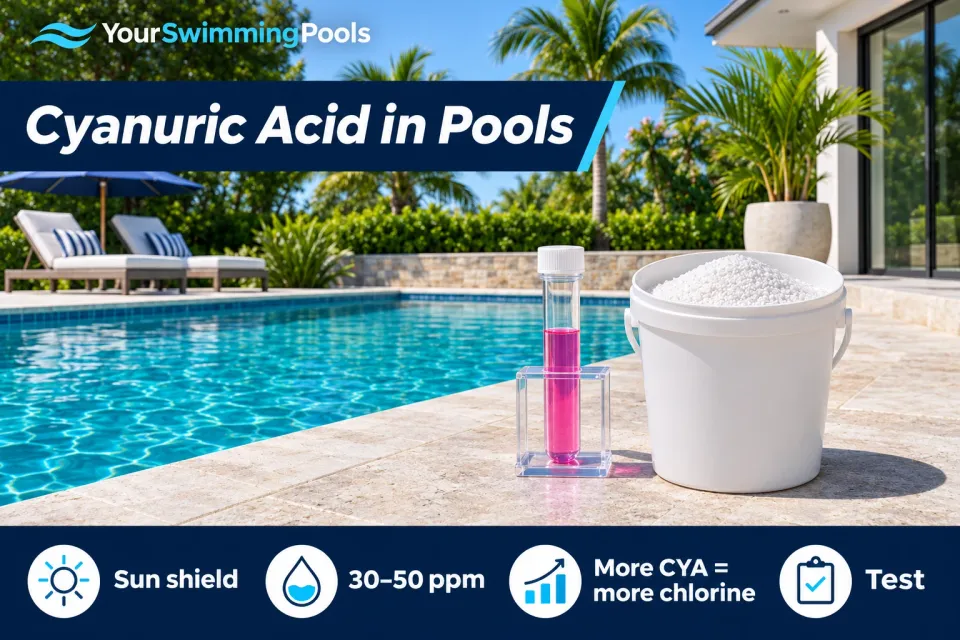
Cyanuric acid, sold as stabilizer or conditioner, is the chemical that keeps the sun from burning off your chlorine. Too little and chlorine disappears on a sunny afternoon; too much and the chlorine you have works more slowly. This page gives the numbers and points you to the right fix.
The short version: Taylor Technologies gives 30 to 50 ppm for pools and does not recommend stabilizer in spas. TroubleFreePool's ideal is 40 to 50 ppm for liquid chlorine pools and 70 to 80 ppm for saltwater pools. With stabilizer in the water the CDC asks for at least 2 ppm free chlorine instead of 1 ppm, because disinfection takes longer when cyanuric acid is present.
As an Amazon Associate we earn from qualifying purchases. We have not tested these products.
Test kit A test that reads stabilizer (cyanuric acid)Your chlorine target depends on your stabilizer level, so test it before you add or drain anything.
What stabilizer does
The CDC lists sunlight among the things that reduce chlorine levels. TroubleFreePool explains that cyanuric acid protects chlorine from sunlight, so less free chlorine is used up by the sun. The trade-off, in TroubleFreePool's words: the higher your CYA level, the more free chlorine you need to keep.
Target ranges
| Source | Range | For |
|---|---|---|
| Taylor Technologies | 30 to 50 ppm | Pools (spas: not recommended) |
| TroubleFreePool, liquid chlorine | ideal 40 to 50 ppm (minimum 30 to 40, maximum 50 to 60) | Vinyl, plaster and fiberglass |
| TroubleFreePool, saltwater | ideal 70 to 80 ppm (minimum 60 to 70, maximum 80 to 90) | Vinyl, plaster and fiberglass |
| TroubleFreePool, FC/CYA page | target 30 to 60 ppm (liquid), 60 to 90 ppm (salt) | The ranges in our stabilizer calculator |
| Hayward AquaRite manual | raise to 40 ppm | Outdoor pools with this salt system |
| Utah pool code | 10 to 100 ppm | Public pools (a law, not a target) |
The sources differ because they answer different questions. Taylor gives one range for all pools; TroubleFreePool sets salt pools higher; Utah sets legal limits for public pools (our reading). The CDC gives no ppm range for home pools, only the higher chlorine minimum.
Your chlorine target moves with it
The floor: with stabilizer in the water, the CDC minimum is 2 ppm free chlorine. TroubleFreePool's targets go further: for liquid chlorine pools, its minimum free chlorine goes from 2 ppm at 30 ppm stabilizer to 6 ppm at 80 ppm; salt pools have their own column in its chart. The chart is in our pool chlorine calculator; the CDC minimums are in what chlorine level should a pool have?
Which page fixes your problem?
| Your situation | Go to |
|---|---|
| Stabilizer too low (or 0) | how to raise cyanuric acid |
| Stabilizer too high | how much stabilizer is too much? and how to lower cyanuric acid |
| Choosing tablets or liquid | stabilized vs unstabilized chlorine |
| A bucket that says "conditioner" | is pool conditioner the same as stabilizer? |
| A hot tub | why stabilizer does not belong in a hot tub |
| Chlorine "won't hold" | "chlorine lock" explained |
A note on public pools
The CDC's Model Aquatic Health Code for public pools now asks for immediate action when cyanuric acid reaches 300 ppm or higher (2024 edition). That is a limit for public venues, far above any home-pool target above.
Sources
- Taylor Technologies: LSI calculator and target ranges (pool 30 to 50 ppm, spa not recommended)
- TroubleFreePool: Recommended levels (liquid and salt ranges)
- TroubleFreePool: ABCs of pool water chemistry (protects chlorine from sunlight, more CYA needs more FC)
- TroubleFreePool: Free chlorine and cyanuric acid relationship (FC minimum by CYA level)
- CDC: Home pool and hot tub water treatment and testing (sunlight, 2 ppm with CYA, longer disinfection, hot tubs)
- Hayward AquaRite owner's manual (092538 Rev D) (raise to 40 ppm)
- Utah Admin. Code R392-302-25 (public pools) (10 to 100 ppm)
- CDC: Model Aquatic Health Code, changes in the 2024 edition (public pools) (300 ppm remediation)
Sources read on November 6, 2026, unless a date is given. Product labels change: the label on the product you buy always wins.
