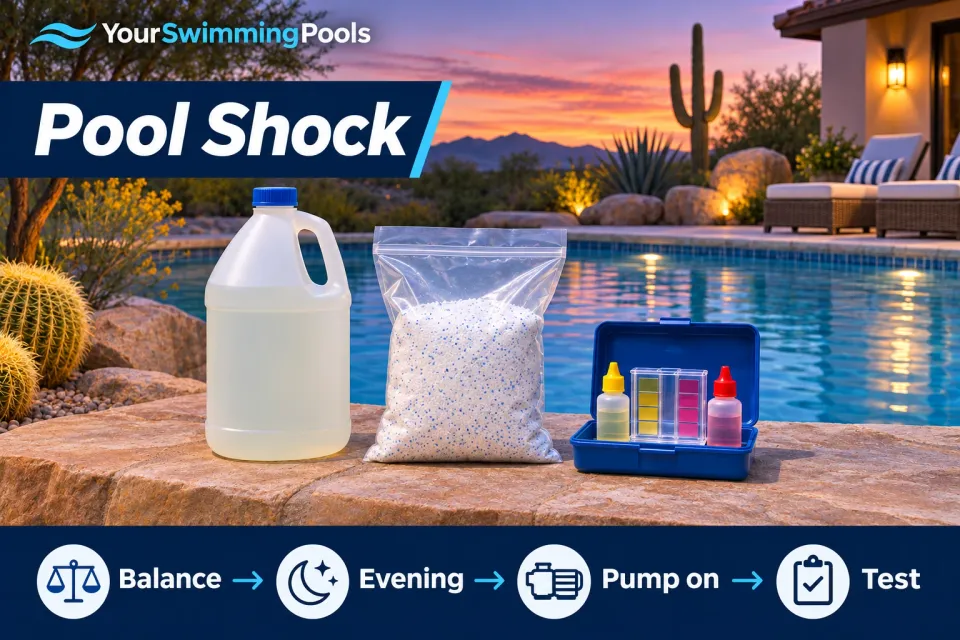
"Shock the pool" is the answer to half the questions pool owners ask. This page puts the shock questions in one place: which product, when, how long, and when people can swim again.
The short version: shocking means a large dose of chlorine or another oxidizer. Balance alkalinity and pH first, shock in the evening with the pump running, and keep people out until free chlorine is back in range: 1 to 4 ppm on HTH's label (read 3 Nov 2026), but at least 2 ppm if your pool has stabilizer (CDC). Full steps: how to shock a pool.
As an Amazon Associate we earn from qualifying purchases. We have not tested these products.
Test kit A test kit that reads free and total chlorineThe CDC calls a DPD test kit the most accurate option for home pools; test strips are less accurate. Follow the kit's own instructions.
Shock types
| Type | Also adds | Source |
|---|---|---|
| Calcium hypochlorite (cal-hypo) | Calcium; no stabilizer | HTH, TroubleFreePool |
| Dichlor | Stabilizer (cyanuric acid) | CDC |
| Liquid chlorine | A little salt | TroubleFreePool |
| Salt system "super chlorinate" | Nothing: the cell makes more chlorine | Hayward AquaRite manual |
"Shock" covers different products, and each label has its own dose and re-entry rule. The HTH numbers on this page are for that product; follow the label of the shock you use.
More: cal-hypo pool shock, stabilized vs unstabilized chlorine, shocking a saltwater pool.
Your shock questions
| Question | Go to |
|---|---|
| How do I shock, step by step? | how to shock a pool |
| When can we swim again? | how long after shocking a pool can you swim? |
| How long does it take to work? | how long does pool shock take to work? |
| Can I shock during the day? | can you shock a pool during the day? |
| Which shock product? | cal-hypo pool shock |
| I have a salt system | shocking a saltwater pool |
| Someone pooped in the pool | poop in the pool |
Safety in four lines
- Read and follow the label (CDC).
- Never mix pool chemicals; add them separately (HTH label).
- Never add chemicals while people are in the pool (HTH label).
- Chlorine above about 10 ppm can bleach out a DPD test and show a false low (CDC): a "zero" right after shocking is not a green light.
Sources
- HTH Pool Care Shock Advanced, label directions (read 3 Nov 2026) (evening, pump, 1 to 4 ppm re-entry, no stabilizer, mixing)
- CDC: Guidelines for keeping your pool safe and healthy (typical range 1 to 4 ppm, follow the label)
- CDC: Home pool and hot tub water treatment and testing (dichlor contains cyanuric acid, 2 ppm with stabilizer, test bleach-out above 10 ppm)
- TroubleFreePool: How to chlorinate your pool (what each chlorine type adds)
- Hayward AquaRite owner's manual (092538 Rev D) (super chlorinate mode)
Sources read on November 6, 2026, unless a date is given. Product labels change: the label on the product you buy always wins.
