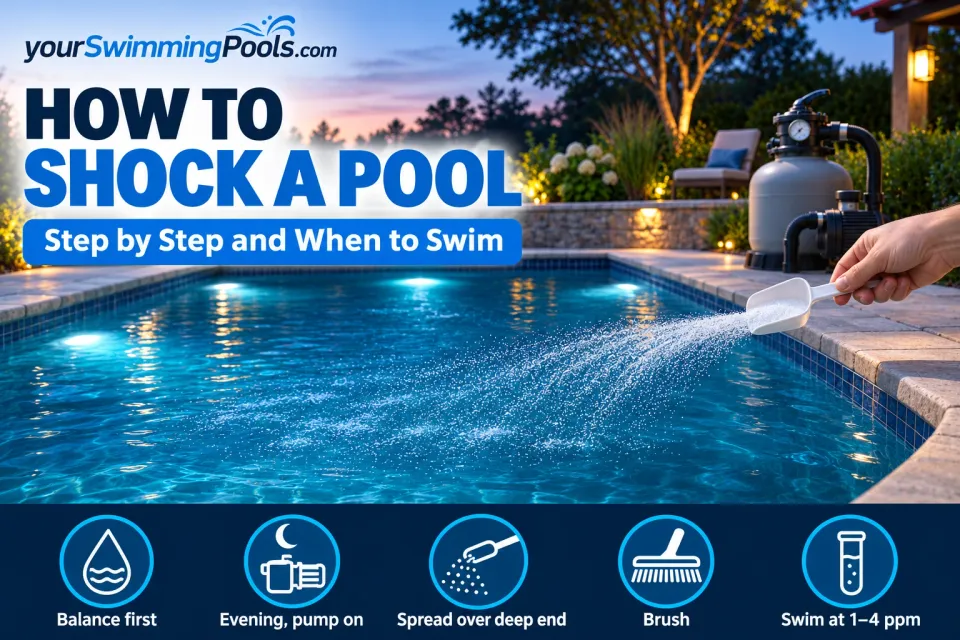
"Shock the pool" is the advice for almost every pool problem, from cloudy water to a pool party aftermath. It is also easy to get wrong: wrong time of day, granules sitting on the liner, or someone jumping in an hour later. Here is how to do it properly, step by step, and when you can swim again.
The short version: shocking means adding a large dose of chlorine (or another oxidizer) to clear out what normal chlorine levels cannot keep up with. Test and adjust alkalinity and pH first. Shock in the evening with the pump running, spread it over the deep end, and brush any granules that settle. Do not swim until free chlorine is back at 1 to 4 ppm: that is the re-entry rule on HTH's shock label, and the CDC's typical range for home pools.
More on chlorine: Pool Chlorine: Types, Levels and How to Keep Them Steady, including free vs total chlorine and the chlorine smell.
What is pool shock?
Pool shock is a concentrated dose of sanitizer or oxidizer. Most shock products are chlorine. The common types:
| Type | What to know |
|---|---|
| Calcium hypochlorite (cal-hypo) | Granular chlorine. Does not add stabilizer (HTH). Raises calcium hardness slightly (Taylor). |
| Dichlor | Stabilized chlorine: it contains cyanuric acid (CDC). Raises your stabilizer level with every dose. |
| Liquid chlorine (sodium hypochlorite) | Chlorine in liquid form. Follow the label for strength and dose. |
| Non-chlorine shock | An oxidizer, not a chlorine dose. Read the label for what it does and does not replace. |
Using stabilizer matters for your chlorine target: the CDC's minimum is 1 ppm free chlorine in a pool without cyanuric acid, and 2 ppm with it.
When should you shock a pool?
- Routinely: HTH's label for its Shock Advanced says to shock at least once a week for routine oxidation.
- When free chlorine drops below your minimum and does not recover with your normal chlorinating (CDC minimums above).
- After heavy use, such as a pool party (our advice).
- After a storm, once debris is out and the power is back (UF/IFAS). See how weather affects your pool.
- Cloudy or green water. Shock is part of the fix: see cloudy pool water and green pool water.
Before you shock: balance first
HTH's shock directions start with: test pool water and adjust total alkalinity and pH before application. The CDC explains why pH matters: chlorine kills germs less effectively as pH rises, especially above 8.0. So a shock dose at pH 8.2 works less well than the same dose at 7.4. Fix things in this order:
- Total alkalinity
- pH
- Then shock.
How to shock a pool, step by step
These are the directions on HTH's Shock Advanced (cal-hypo) label. Other products have their own label: always follow yours.
- Wait for the evening. Add the shock during evening hours, with the filter pump running.
- Clear the pool. Never add chemicals while people are in the pool (HTH).
- Measure the dose. For this product: 1 lb (one bag) per 13,500 gallons for the weekly treatment. Use the whole bag once it is opened. Not sure of your volume? Use the volume helper in our pump runtime calculator.
- Spread it. Broadcast it evenly over a wide area of the pool, preferably the deepest part. Do not put it in a floater or feeder.
- Brush. If granules settle on the floor, brush until they dissolve: undissolved granules can bleach or damage pool surfaces.
- Keep the pump running overnight so the shock mixes.
- Test the next day and wait until free chlorine is back at 1 to 4 ppm before anyone swims.
Pre-dissolve or not? Some shock products ask you to dissolve the granules in a bucket of water first, others (like HTH's) say to broadcast them. It depends on the product, so check your label. Do not assume the same goes for other chemicals: HTH's pH Down says never to pre-dissolve it.
When can you swim after shocking?
When free chlorine is back down to 1 to 4 ppm. That is the re-entry rule on HTH's shock label, and 1 to 4 ppm is also the typical chlorine range on the CDC's healthy swimming page. After an evening shock that is often the next day (our estimate), but test, do not guess.
One catch from the CDC: if chlorine is above about 10 ppm, the color test can bleach out and show a false low reading, even 0 ppm. A "zero" right after shocking is not a green light. Wait, and test again.
After shocking: other chemicals
- Do not mix chemicals. Add them separately (HTH).
- pH Down after shock: HTH says to wait 4 to 6 hours after a shock treatment before adding pH Down, to avoid off-gassing.
- Using cal-hypo every week? Calcium hardness creeps up slightly (Taylor). Check it now and then in the pool LSI calculator.
- Using dichlor every week? Stabilizer (cyanuric acid) creeps up with every dose (our explanation). The CDC sets a higher chlorine minimum with cyanuric acid (2 ppm) and notes disinfection takes longer when it is present.
Poop in the pool: what the CDC says
The CDC's steps when there is poop in the pool:
- Close the pool to swimmers.
- Remove the poop (do not vacuum it).
- Raise free chlorine to, or keep it at, 2 ppm with pH 7.5 or lower for 30 minutes.
- Check that the filter system is running properly.
The CDC's very high chlorine treatment for diarrhea is meant for public pools. The CDC says it does not apply to backyard pools, because handling that much chlorine raises the risk of chemical injuries at home. And the CDC's basic rule: stay out of the pool if you have diarrhea.
Safety rules
- Read and follow the label (CDC).
- Wear eye protection and gloves; avoid breathing the dust (HTH label; CDC).
- Never mix pool chemicals together, and store them cool, dry and out of direct sun (HTH). Keep them secure and away from children and pets (CDC).
- Always add chemicals to the pool water, never water to the chemicals (HTH).
FAQ
Do I really need to shock my pool every week?
HTH's label for its weekly shock says at least once a week for routine oxidation. Follow the label of the product you use, and let your tests guide you: if free chlorine keeps dropping below the CDC minimum, shock (our advice).
What is the best time to shock a pool?
In the evening, with the pump running (HTH label). The pump then has the whole night to mix it.
Can I just pour shock into my pool?
Some products, yes: HTH says to broadcast its shock over the deep end and brush any granules that settle. Others ask you to pre-dissolve first. Your label decides.
What happens if you swim right after shocking?
HTH's label says not to enter until free chlorine is back at 1 to 4 ppm. That is the limit on the label, so follow it.
Is shock the same as chlorine?
Most shock products are chlorine, just a much bigger dose at once (our explanation). Your regular chlorine (tablets, liquid or a salt cell) keeps the daily level up; shock is the occasional big push.
Does shocking lower alkalinity?
No. Lowering alkalinity takes acid: see how to lower alkalinity in a pool.
Sources
- HTH Pool Care Shock Advanced (directions, dose, evening, brushing, 1 to 4 ppm re-entry, weekly use, no stabilizer)
- HTH Pool Care pH Down (wait 4 to 6 hours after shock, quick safety tips)
- CDC: Home pool and hot tub water treatment and testing (chlorine minimums, pH, test bleach-out above 10 ppm)
- CDC: What you can do to stay healthy in swimming pools (typical 1 to 4 ppm chlorine, safety)
- CDC: What to do when there is poop in the pool
- Taylor Technologies: LSI calculator (cal-hypo and calcium hardness)
- UF/IFAS Extension: Pools and hurricanes (shock after a storm, once debris is out and power is back)
