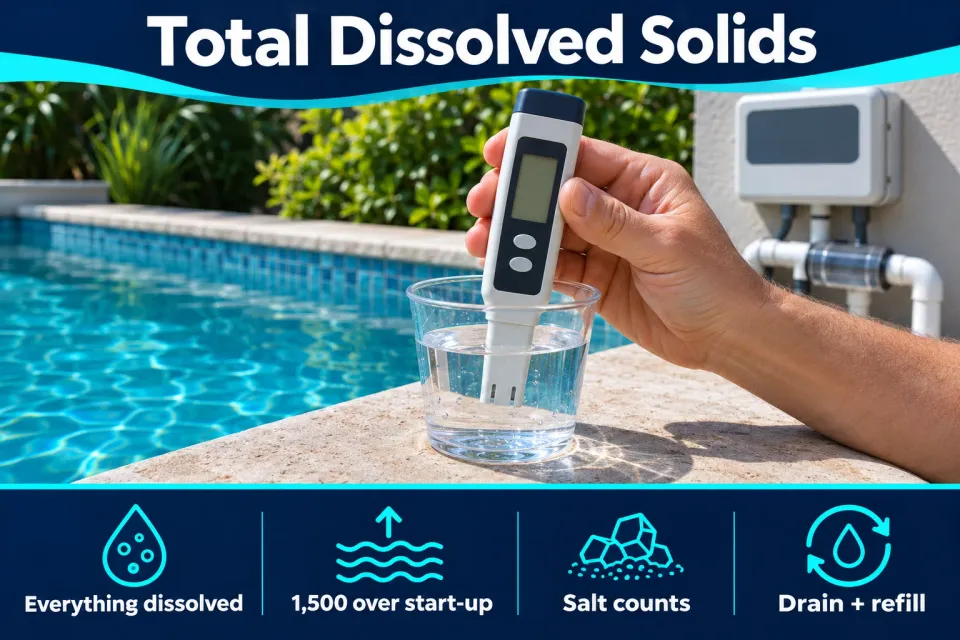
Total dissolved solids, TDS, is everything dissolved in your pool water at once. Pool professionals disagree on how much it matters, so this page gives both views.
The short answer: the PHTA guideline (published by Taylor) is a maximum of 1,500 ppm over the TDS at start-up, including salt from a chlorine generator. PHTA's water quality committee advised a monthly TDS test in home pools (2020 article), and the fix for high TDS is replacing water. TroubleFreePool says TDS "is not very important for pool care" and manages the individual numbers instead.
Part of: Metals, Phosphates and Other Things in Pool Water, our overview of the less common things in pool water.
What TDS includes
TroubleFreePool: salt, calcium hardness, free chlorine, alkalinity, stabilizer and anything else dissolved. The PHTA committee adds minerals, metals and contaminants, and says true TDS also includes "oils, lotions, cosmetics and other swimmer waste".
Two views
| PHTA water quality committee | TroubleFreePool | |
|---|---|---|
| How much it matters | High TDS can point to contamination and cause problems (list below) | "Not very important for pool care"; "a relic of a bygone era" |
| Limit | 1,500 ppm over start-up, start-up salt included | None; manage salt, calcium, alkalinity and the rest one by one |
| Testing | Monthly in home pools (2020 article) | A TDS meter estimates TDS from conductivity against a standard solution, so for salt use the meter's salt (NaCl) setting or a salt test |
What high TDS can do (PHTA)
- Point to high organic contamination, which can make the sanitizer less effective.
- Raise the conductivity of the water, with possible corrosion of fixtures, lights and equipment.
- Surface staining or etching, and problems with masonry materials in decks.
Salt pools
The salt in a salt pool is part of the TDS. The PHTA committee: for years 3,000 ppm was seen as the maximum TDS for pools, which changed when salt chlorine generators became common, because their salt pushes TDS above that. The 1,500 ppm rule counts from the start-up level, and Taylor's table notes that this includes the salt from a chlorine generator; we read that as the reason it is relative (our reading). It also says to ask your salt system maker at what point high TDS causes problems. Salt itself: pool salt calculator.
TDS and water balance
Taylor: TDS is one of the five factors of water balance and plays "a minor role". In the saturation index formula in Utah's pool code, the dissolved-solids factor is 12.1 up to 999 ppm, 12.2 from 1,000 to 1,999 ppm, and higher in steps above that: 12.4 at 3,000 to 3,999 ppm, a typical salt pool. That puts a salt pool about 0.3 lower in the index than fresh water with the same other numbers (our calculation). Our LSI calculator takes it into account.
How to lower TDS
The PHTA committee: partially or completely drain the pool and refill it with fresh water that has a lower TDS, provided drought rules or other bans on draining do not apply.
Before you drain: draining, even partly, can damage some pools: depending on the shell, the groundwater and other conditions, a pool can crack, shift or lift (our note). Ask your pool manufacturer or a qualified pool professional first, and check your local rules on where pool water may be discharged. The partial drain calculator gives the gallons.
Our take
Test the individual numbers you can act on: chlorine, pH, alkalinity, calcium, stabilizer and, in a salt pool, salt (our advice). If you want to follow the PHTA rule, measure TDS right after filling or refilling, so you have a start-up number to compare with.
Sources
- Taylor Technologies: Technical FAQs, with the PHTA guideline table (last reviewed by Taylor 12 Aug 2026) (PHTA table: TDS 1,500 over start-up including generator salt)
- PHTA Recreational Water Quality Committee: Total dissolved solids explained (ICC Building Safety Journal, 2020; first in AQUA Magazine, Feb 2019) (what TDS includes, monthly testing, 1,500 ppm rule, salt pools and 3,000 ppm, effects, draining)
- TroubleFreePool: TDS (not very important, what it includes, meters read all conductive ions against the 442 standard, salt setting)
- Taylor Technologies: 3 important tips for pool or spa owners (29 Apr 2025) (five factors, minor role)
- Utah Admin. Code R392-302-25 (public pools) (dissolved-solids factors in the saturation index formula (Table 2))
Sources read on November 6, 2026, unless a date is given. Product labels change: the label on the product you buy always wins.
