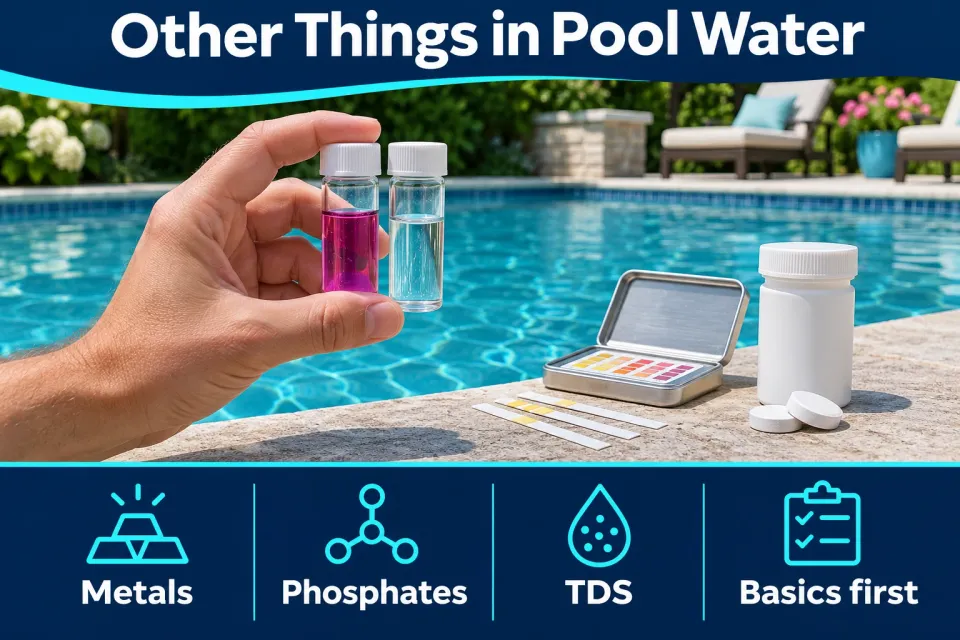
Chlorine, pH, alkalinity, calcium and stabilizer are the numbers you test every week. A few other things in the water only matter some of the time: metals, phosphates and total dissolved solids. This page says when each one matters and points you to the page that deals with it.
The short version: metals (iron, copper) cause stains and can turn blond hair green; the PHTA guideline for heavy metals in pool water is "none". Phosphates feed algae but do not use up chlorine directly (HASA, a maker of phosphate removers). Total dissolved solids: PHTA's guideline maximum (not a law) is 1,500 ppm over the level at start-up, salt included, while TroubleFreePool calls TDS meaningless for pool care.
What, where from, and what you notice
| In the water | Where it comes from | What you may notice | Go to |
|---|---|---|---|
| Metals (iron, copper) | Fill water, such as some well water (TroubleFreePool); algaecides, pipes, or the water itself (Taylor) | Stains; a purple endpoint in the calcium hardness test (Taylor) | metals in pool water |
| Copper on hair | Most often tap or pool water high in copper; copper algaecides added again and again without replacing water raise pool copper (2022 medical case report) | A green tint on blond hair | why pool water can turn blond hair green |
| Phosphates | Tap water and metal sequestrants (HASA); leaves, dirt, fertilizer, runoff, lotions (Inyo Pools) | Nothing by itself; algae get more to feed on when chlorine slips | phosphates in pool water |
| Total dissolved solids | Everything dissolved: salt, calcium, alkalinity, chlorine, stabilizer and more (TroubleFreePool) | Nothing directly | total dissolved solids in pools |
Get the basics right first
Most of what is on this page becomes a problem when the basics slip (our reading of the sources below). Metals that are not held by a sequestrant come out of the water when pH and chlorine are high (TroubleFreePool). Phosphates matter most when free chlorine drops below the minimum for your stabilizer level (TroubleFreePool). So check these first: your chlorine level, your stabilizer and pH and alkalinity.
The guideline numbers
| What | Guideline | Source |
|---|---|---|
| Heavy metals | None (minimum, ideal and maximum) | PHTA guideline table, as published by Taylor (a guideline, not a law) |
| Total dissolved solids | At most 1,500 ppm over start-up, including salt from a chlorine generator | PHTA table, as published by Taylor |
| TDS testing, home pools | Monthly | PHTA water quality committee article (2020); other schedules exist, so follow your pool professional or test kit if they say otherwise |
| Phosphates | No PHTA number. Sellers: below 500 ppb, ideally 200 (HASA); below 100 ppb ideal (Inyo Pools) | Product sellers, not a standard |
Not covered yet
Nitrates are often mentioned next to phosphates. We have not written that page yet, because we could not read and check a pool source for it. It follows when we can.
Sources
- Taylor Technologies: Technical FAQs, with the PHTA guideline table (last reviewed by Taylor 12 Aug 2026) (PHTA table: heavy metals none, TDS 1,500 over start-up; metals from algaecides, pipes or the water; purple endpoint)
- PHTA Recreational Water Quality Committee: Total dissolved solids explained (ICC Building Safety Journal, 2020; first in AQUA Magazine, Feb 2019) (what TDS is, monthly testing)
- TroubleFreePool: Sequestrant (metals in some well water; phosphates matter most when free chlorine drops below the minimum)
- TroubleFreePool: Ascorbic acid treatment (metals usually from the fill water; metals stain at high pH and chlorine)
- TroubleFreePool: TDS (TDS meaningless for pool care, what TDS includes)
- TroubleFreePool: Free chlorine and cyanuric acid relationship (chlorine minimum by stabilizer level)
- HASA: Are phosphates really a problem in swimming pools? (a maker of phosphate removers) (phosphate sources, do not use up chlorine, 500 / 200 ppb)
- Inyo Pools: What are phosphates in pools (a pool supply retailer, 29 Oct 2025) (phosphate sources, 100 ppb)
- Tomas X. et al., "Pseudo Green Hair", International Journal of Trichology, 2022 (green hair and copper algaecides)
Sources read on November 6, 2026, unless a date is given. Product labels change: the label on the product you buy always wins.
