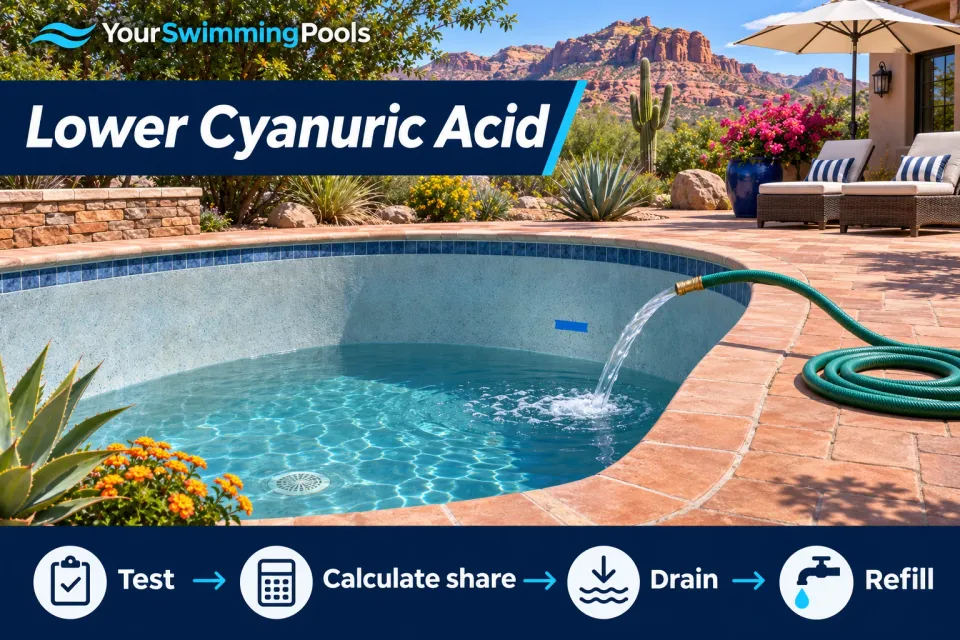
Stabilizer is not used up by chlorine and does not leave with evaporation (our explanation). When the reading is too high, the practical way down is to replace some of the water with fresh water. The good news: the amount is simple to calculate.
The short version: share of water to replace = (stabilizer now − target) ÷ (stabilizer now − stabilizer in your fill water). If your fill water has none (test it; our note), from 100 to 50 ppm you replace half the water: 7,500 gallons in a 15,000-gallon pool (our calculation).
Part of: Cyanuric Acid in Pools: What It Does and the Level to Aim For, our overview of stabilizer.
Worked examples (fill water 0 ppm, 15,000-gallon pool)
| From → to | Replace | Gallons |
|---|---|---|
| 80 → 50 ppm | 37.5% | 5,625 gal |
| 100 → 50 ppm | 50% | 7,500 gal |
| 120 → 60 ppm | 50% | 7,500 gal |
| 150 → 50 ppm | 66.7% | 10,000 gal |
Our calculation with the formula above. The partial drain calculator does it for your own numbers, including fill water that is not zero.
One drain or several rounds?
Many pools cannot be drained very low in one go. Rounds work, but each round throws away some of the fresh water from the round before. From 100 to 50 ppm: one round of 50%, or two rounds of 29.3% each, 58.6% in total (our calculation).
As an Amazon Associate we earn from qualifying purchases. We have not tested these products.
For this job A submersible utility pumpA small electric pump with a garden hose outlet drains a pool down to a set mark. Check the hose size and the cord length.
Step by step
- Test twice. Cyanuric acid tests are less precise than chlorine tests (our note). Confirm a high reading before you drain.
- Ask before you drain. Draining, even partly, can damage some pools: depending on the shell, the groundwater and other conditions, a pool can crack, shift or lift (our note). Ask your pool manufacturer or a qualified pool professional first, and check your local rules on where pool water may be discharged.
- Check your manual for how low your pool may go, and whether to switch off the pump and heater while the water is below the skimmer (our advice).
- Mark the target level on the wall. The pool volume calculator gives gallons per inch.
- Drain, refill, run the pump, retest. Then rebalance pH and alkalinity, and bring free chlorine back to your new target.
Keep it from coming back
High stabilizer usually comes from tablets or dichlor (CDC: both contain cyanuric acid). Switching part of your chlorine to liquid chlorine or cal-hypo slows the build-up (our advice). See stabilized vs unstabilized chlorine.
As an Amazon Associate we earn from qualifying purchases. We have not tested these products.
Test kit A test that reads stabilizer (cyanuric acid)Your chlorine target depends on your stabilizer level, so test it before you add or drain anything.
What public pools do
The CDC's 2024 Model Aquatic Health Code also lowers cyanuric acid by draining and refilling: it added "dilution credits" for that step in its response to diarrhea in public pools. The method is the same; the rules are written for pool operators.
Sources
- CDC: Home pool and hot tub water treatment and testing (dichlor and trichlor contain cyanuric acid)
- CDC: Model Aquatic Health Code, changes in the 2024 edition (public pools) (dilution credits when draining and refilling)
- TroubleFreePool: Recommended levels (target ranges)
- Taylor Technologies: LSI calculator and target ranges (30 to 50 ppm)
Sources read on November 6, 2026, unless a date is given. Product labels change: the label on the product you buy always wins.
