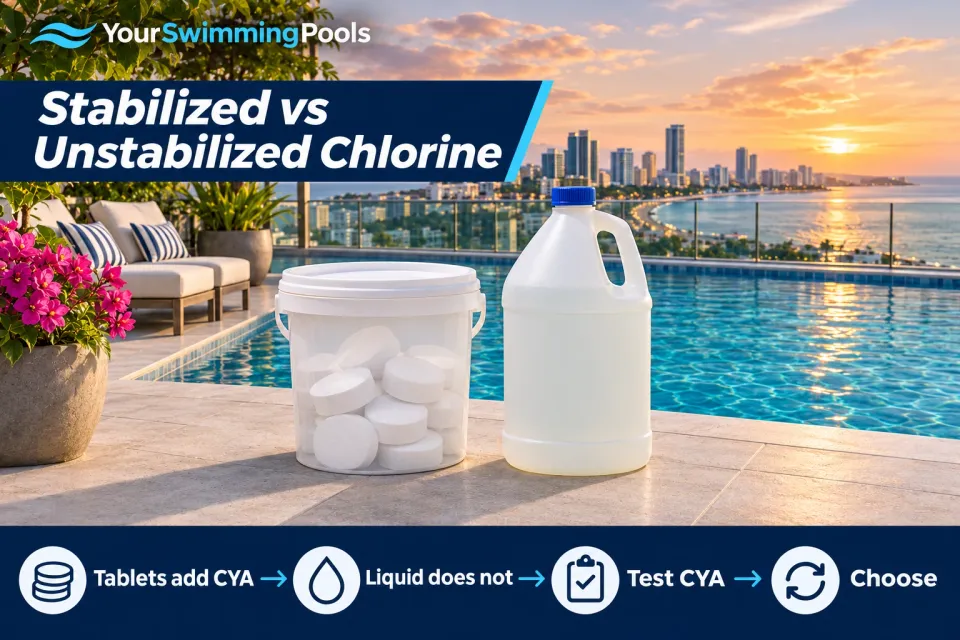
"Stabilized" chlorine carries its own sun protection: every dose adds cyanuric acid. That is handy at the start of the season and a problem by the end of it.
The short version: trichlor and dichlor are stabilized: they contain cyanuric acid (CDC). Liquid chlorine and cal-hypo are unstabilized: liquid adds a little salt, cal-hypo adds calcium (TroubleFreePool). By our calculation, every 1 ppm chlorine from trichlor adds about 0.6 ppm stabilizer, and from dichlor about 0.9 ppm.
Part of: Cyanuric Acid in Pools: What It Does and the Level to Aim For, our overview of stabilizer.
| Stabilized | Unstabilized | |
|---|---|---|
| Products | Trichlor (tablets), dichlor (granules) | Liquid chlorine, cal-hypo |
| Adds stabilizer | Yes, every dose | No |
| Also adds | Lowers pH (TroubleFreePool) | Liquid: a little salt. Cal-hypo: calcium |
| CDC chlorine minimum | at least 2 ppm | at least 1 ppm (if no stabilizer in the water at all) |
The CDC numbers are minimums, not daily targets. Once stabilizer is in the water, from tablets or from earlier doses, the 2 ppm minimum applies whatever chlorine you add next, and TroubleFreePool's minimum rises with the stabilizer level (see the chart).
How fast stabilizer builds up
Our calculation from molecular weights: 0.6 ppm cyanuric acid per 1 ppm chlorine from trichlor, 0.9 ppm from dichlor. A pool that uses 2 ppm chlorine a day from tablets gains about 36 ppm stabilizer in a month (2 × 0.6 × 30). So a pool on tablets can pass the top of its range within one season (our calculation).
As an Amazon Associate we earn from qualifying purchases. We have not tested these products.
Stabilized 3-inch chlorine tablets (trichlor)Slow-release chlorine that adds stabilizer as it dissolves. Use the dose on the label of the product you buy.
As an Amazon Associate we earn from qualifying purchases. We have not tested these products.
Unstabilized Liquid chlorine (sodium hypochlorite)Adds chlorine without stabilizer. Check the strength (%) on the label: the dose depends on it.
How to choose
- Stabilizer low: tablets or dichlor raise it while they chlorinate (our advice).
- Stabilizer in range or high: unstabilized chlorine keeps it where it is (our advice).
- Plaster pool with high calcium: cal-hypo adds more calcium; liquid chlorine does not (TroubleFreePool).
- Hot tub: the CDC recommends no cyanuric acid and no chlorine products with cyanuric acid.
You can also combine them, for example tablets until stabilizer is in range and liquid after that (our advice). Keep testing stabilizer whatever you use.
Sources
- CDC: Home pool and hot tub water treatment and testing (dichlor and trichlor contain cyanuric acid, minimums, hot tubs)
- TroubleFreePool: How to chlorinate your pool (what each chlorine type adds)
- TroubleFreePool: Free chlorine and cyanuric acid relationship (FC minimum by CYA level)
Sources read on November 6, 2026, unless a date is given. Product labels change: the label on the product you buy always wins.
