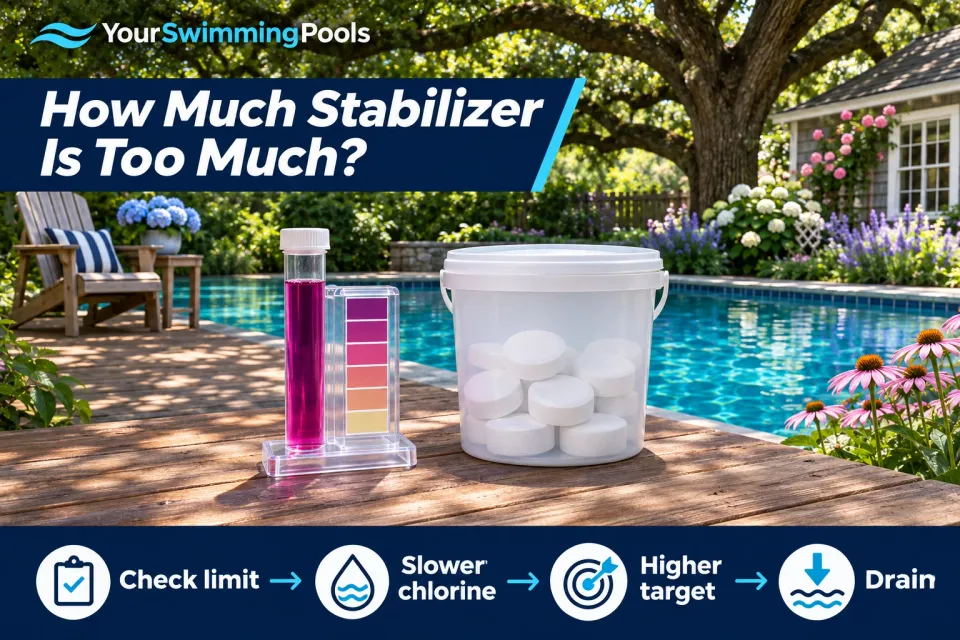
There is no single number where stabilizer suddenly becomes dangerous. What happens is gradual: the more cyanuric acid, the more chlorine you need to keep the same germ-killing power.
The short answer: for a home pool on liquid chlorine, above about 50 to 60 ppm is too much by TroubleFreePool's maximum; Taylor's range tops out at 50 ppm. Salt pools run higher (TroubleFreePool maximum 80 to 90 ppm). Utah's public pool law allows up to 100 ppm, but that is a legal limit for public pools, not a home-pool target.
Part of: Cyanuric Acid in Pools: What It Does and the Level to Aim For, our overview of stabilizer.
The upper limits side by side
| Source | Upper number | What it means |
|---|---|---|
| Taylor Technologies | 50 ppm | Top of its pool range |
| TroubleFreePool, liquid chlorine | 50 to 60 ppm | Acceptable maximum |
| TroubleFreePool, saltwater | 80 to 90 ppm | Acceptable maximum |
| Utah pool code | 100 ppm | Legal maximum for public pools |
| CDC Model Aquatic Health Code (2024) | 300 ppm | Public pools: immediate remediation |
What high stabilizer does
- Slower disinfection. The CDC says disinfection times are longer in the presence of cyanuric acid. Its kill times for germs in a fecal incident are only valid for pools without it.
- A higher chlorine target. The CDC minimum with stabilizer is 2 ppm. Above that, for liquid chlorine pools, TroubleFreePool's minimum free chlorine rises from 2 ppm at 30 ppm stabilizer to 6 ppm at 80 ppm (salt pools have their own column in its chart).
- Harder clean-ups. TroubleFreePool: very high CYA can make it difficult to keep the proper chlorine level or complete its SLAM process.
This is what people often call "chlorine lock": the chlorine is there, it just needs to be at a higher level to do the same job.
As an Amazon Associate we earn from qualifying purchases. We have not tested these products.
Test kit A test that reads stabilizer (cyanuric acid)Your chlorine target depends on your stabilizer level, so test it before you add or drain anything.
The fix
Replace part of the water: how to lower cyanuric acid. Until then, keep free chlorine at the level that matches your stabilizer reading (chart in our pool chlorine calculator).
Sources
- Taylor Technologies: LSI calculator and target ranges (30 to 50 ppm)
- TroubleFreePool: Recommended levels (maximum ranges)
- TroubleFreePool: Free chlorine and cyanuric acid relationship (FC minimum by CYA level)
- TroubleFreePool: ABCs of pool water chemistry (very high CYA and SLAM)
- Utah Admin. Code R392-302-25 (public pools) (100 ppm maximum)
- CDC: Model Aquatic Health Code, changes in the 2024 edition (public pools) (300 ppm)
- CDC: Home pool and hot tub water treatment and testing (longer disinfection and 2 ppm with cyanuric acid)
- CDC: What to do when there is poop in the pool (kill times only without cyanuric acid)
Sources read on November 6, 2026, unless a date is given. Product labels change: the label on the product you buy always wins.
