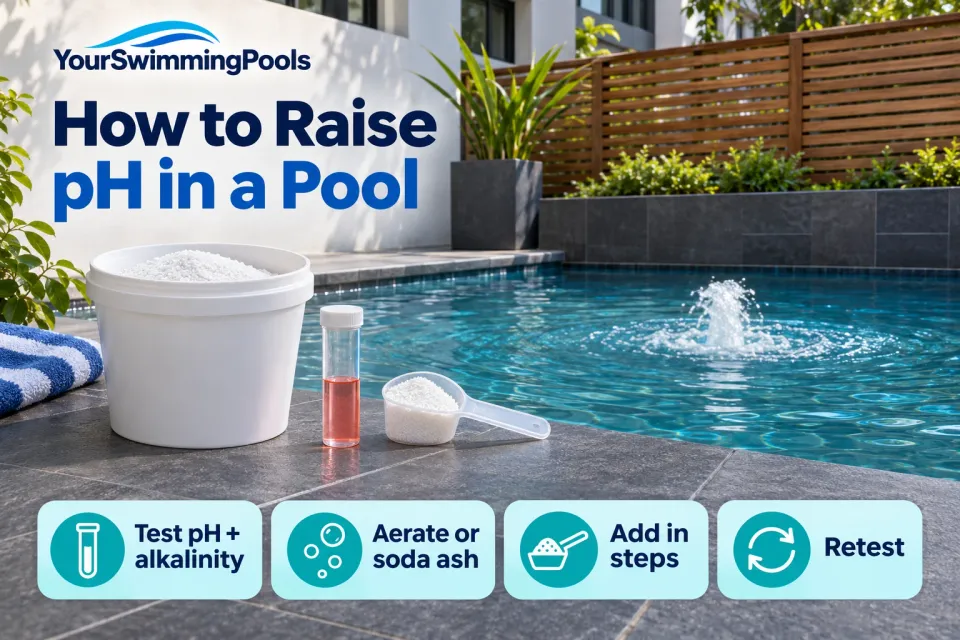
A low pH test, and maybe eyes that sting after a swim. Raising pH is easy; the trick is not to drag total alkalinity up too far at the same time. This page shows which method fits your reading.
The short version: the CDC's range is pH 7.0 to 7.8. Test total alkalinity first. If alkalinity is low, raise it with baking soda and retest pH: that often fixes both. If alkalinity is fine and only pH is low, raise pH with aeration (no chemicals) or soda ash (sodium carbonate), which raises pH more than alkalinity (Taylor).
Part of: Pool pH and Alkalinity: How They Work Together, our overview of every pH and alkalinity fix.
Why low pH matters
The CDC says that as pH goes down, especially below 7.0, chlorine kills germs better, but pool and hot tub pipes are more likely to corrode or break down. The Better Health Channel adds that a pH below 7 can sting swimmers' eyes.
Step 1: check alkalinity first
Taylor Technologies' order is total alkalinity first, then pH, and it notes that adjusting alkalinity affects pH, so retest after each change. TroubleFreePool's view: unless alkalinity is below 50 ppm there is no reason to raise it; if it is, raise it with baking soda in small steps, retesting 30 minutes after each dose. To raise pH itself, TroubleFreePool uses aeration or 20 Mule Team Borax.
| Your test | What to do |
|---|---|
| pH low, alkalinity low | Baking soda first (dose by pool size), then retest pH |
| pH low, alkalinity in range | Aeration, or soda ash by the label |
| pH low, alkalinity high | Aeration only: soda ash would push alkalinity higher (our note, from Taylor's chemical table) |
Already in range? If pH is inside the target range you use (the CDC's 7.0 to 7.8, or a narrower one such as Taylor's 7.4 to 7.6), stop here: there is no need to add soda ash to chase a higher number (our advice).
Method 1: aeration (no chemicals)
When carbon dioxide leaves the water, pH rises, and it leaves faster when the water is aerated (TroubleFreePool). TroubleFreePool lists spas, waterfalls, fountains, rain and kids splashing as aeration. In practice (our suggestion): point the return jets up so they break the surface, run a waterfall or fountain if you have one, and retest after a few hours. Aeration raises pH without adding alkalinity, which is why it is the method of choice when alkalinity is already high.
Method 2: soda ash (sodium carbonate)
Pool "pH Up", "pH Plus" or "pH Increaser" products are often soda ash (our note): check the active ingredient on the label. In Taylor's chemical reference, soda ash raises pH and gives only a slight rise in alkalinity, while sodium bicarbonate does the opposite.
- Test pH and total alkalinity, and know your pool volume (pool volume calculator).
- Work out the dose on the label of your product. Start with less: overshooting means adding acid again (our advice).
- Make sure nobody is in the pool, and run the pump.
- Add it the way the label says (CDC: read and follow all directions on product labels), and add pool chemicals one at a time (our advice).
- Let it circulate and retest before adding more.
As an Amazon Associate we earn from qualifying purchases. We have not tested these products.
Raises pH pH increaser (soda ash, sodium carbonate)Sold as "pH Up", "pH Plus" or "pH Increaser". Check the label for sodium carbonate and use the dose on the label of the product you buy.
Can baking soda raise pH?
A little. Arm & Hammer says baking soda raises both pH and alkalinity, and Taylor lists sodium bicarbonate as a "slight" pH raiser. Baking soda is the right choice when alkalinity is low too; for pH alone, soda ash or aeration does more with less alkalinity. See soda ash vs baking soda.
Why did pH drop in the first place?
Acidic chlorine tablets, rain and too much acid are the usual suspects. See why does pool pH keep dropping?
As an Amazon Associate we earn from qualifying purchases. We have not tested these products.
Test kit A test kit that reads pH and total alkalinityEvery step on this page starts and ends with a test. A drop-based (liquid) kit or test strips both work; follow the kit's own instructions.
FAQ
How long does it take to raise pH?
Follow the waiting time on your product's label. TroubleFreePool retests pH 30 minutes after a baking soda dose; Arm & Hammer waits at least six hours and retests between 6 and 24 hours. Aeration is slower and depends on how much the surface is broken up.
Can I swim with low pH?
The CDC's range is 7.0 to 7.8; below 7.0, pipes are more likely to corrode, and the Better Health Channel says low pH can sting the eyes. Raise it back into range first (our advice).
Does adding chlorine lower pH?
It depends on the product. TroubleFreePool calls trichlor and dichlor tablets highly acidic. Liquid chlorine and salt systems are a different story: see why does pool pH keep rising?
Sources
- CDC: Home pool and hot tub water treatment and testing (pH range, low pH and corrosion)
- Better Health Channel (Victoria State Government): Swimming pools, water quality (low pH stings eyes)
- Taylor Technologies: LSI calculator (order of adjustment, soda ash vs bicarbonate)
- TroubleFreePool: ABCs of pool water chemistry (alkalinity 50 rule, aeration, retest after 30 minutes, acidic tablets)
- TroubleFreePool: Lower total alkalinity (CO2 outgassing and aeration raise pH)
- Arm & Hammer: How to use baking soda for pool maintenance (baking soda raises pH and alkalinity, waiting time)
- CDC: Guidelines for keeping your pool safe and healthy (read and follow product labels)
Sources read on November 4, 2026. Product labels change: the label on the product you buy always wins.
