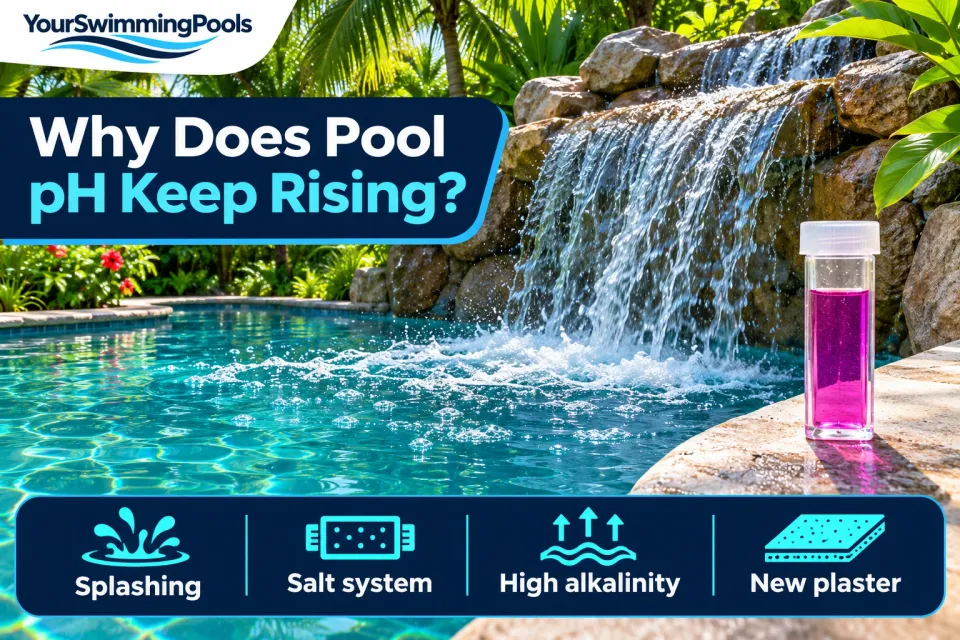
You add acid, pH comes down, and a few days later it is back up. That is not a broken test kit: in most pools pH rises on its own. Here are the usual causes and what slows the climb.
The short version: pool water loses carbon dioxide to the air, and every time it does, pH rises (TroubleFreePool). Aeration, a salt system, high total alkalinity and new plaster all speed that up. You cannot stop it, but keeping alkalinity lower slows it, and a dose of acid brings pH back.
Part of: Pool pH and Alkalinity: How They Work Together, our overview of every pH and alkalinity fix.
The six usual causes, with a check for each
| Cause | What the source says | Check or action |
|---|---|---|
| Carbon dioxide leaving the water | "When CO2 outgasses, pH rises." (TroubleFreePool) | Normal; plan small acid doses (how to lower ph in a pool) |
| Aeration | CO2 leaves faster when the water is aerated: spas, waterfalls, fountains, rain, kids splashing (TroubleFreePool) | Turn waterfalls and fountains off when nobody swims; point returns below the surface (our suggestion) |
| Salt water chlorine generator | Among the things that continuously drive pH up (TroubleFreePool) | Expect it; test pH more often and keep alkalinity lower |
| Some sanitizers | Also on TroubleFreePool's list | Check the label of your chlorine product (our note) |
| High total alkalinity | Makes pH drift upward more quickly, so you need acid more often (TroubleFreePool) | Test alkalinity; if high, use the acid and aeration method. TroubleFreePool's 60 to 90 ppm slows pH rise |
| New plaster | Faster pH rise, especially in the first month, continuing for 6 to 18 months (TroubleFreePool) | Test more often in that period |
What else slows it down
- A solar cover. TroubleFreePool: a solar cover slows pH rise.
- Regular small acid doses instead of one big one (our advice). See muriatic acid for pools.
As an Amazon Associate we earn from qualifying purchases. We have not tested these products.
Lowers pH and alkalinity Muriatic acid (hydrochloric acid) for poolsLiquid acid; strength differs per bottle, so the dose on your bottle's label is the one to follow. Shipping rules differ by product and state.
Is a rising pH a problem?
Only when it leaves the range. The CDC's range is 7.0 to 7.8, and above 8.0 chlorine's ability to kill germs drops. TroubleFreePool's view is that high alkalinity "will simply cause the pH to rise faster", not harm the pool by itself. The LSI calculator shows whether high pH and high alkalinity together push the water toward scale.
As an Amazon Associate we earn from qualifying purchases. We have not tested these products.
Test kit A test kit that reads pH and total alkalinityEvery step on this page starts and ends with a test. A drop-based (liquid) kit or test strips both work; follow the kit's own instructions.
FAQ
Will pool pH go down on its own?
Usually not: the natural drift is upward. pH drops mainly from acidic products, rain or acid you add. See why does pool pH keep dropping?
Should I add chlorine if pH is high?
Keep chlorine in range, but bring pH back too: the CDC says chlorine kills germs less well as pH rises, especially above 8.0. Lowering pH makes the chlorine you have work better.
Sources
- TroubleFreePool: Lower total alkalinity (CO2 outgassing, aeration, salt systems, sanitizers, alkalinity 60 to 90 ppm)
- TroubleFreePool: ABCs of pool water chemistry (aeration examples, new plaster, solar cover, high alkalinity and pH drift)
- CDC: Home pool and hot tub water treatment and testing (pH 7.0 to 7.8, chlorine above pH 8.0)
Sources read on November 4, 2026. Product labels change: the label on the product you buy always wins.
