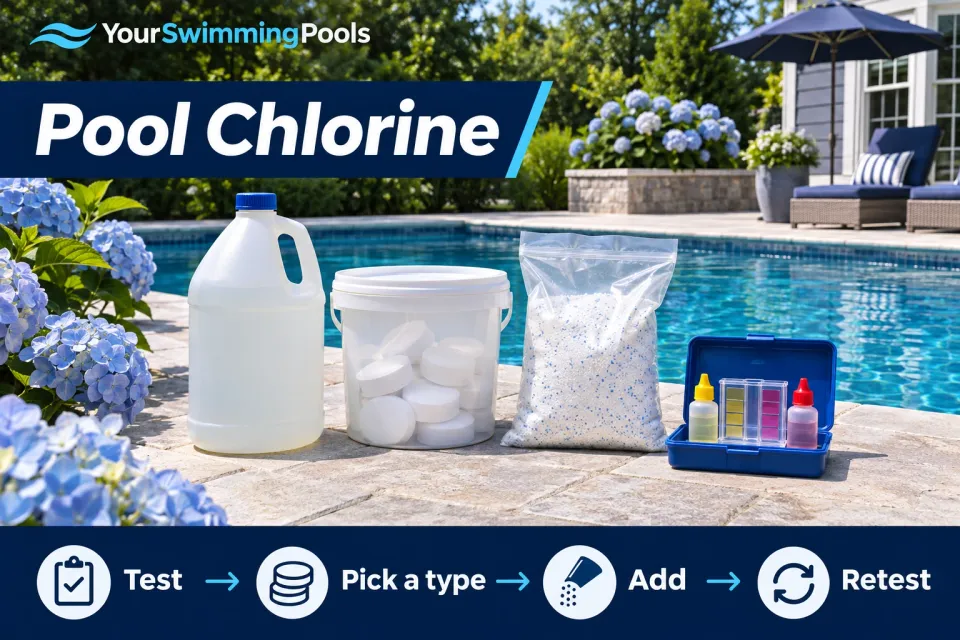
Chlorine is what keeps pool water safe, and it is also the chemical pool owners argue about most: which type, how much, and why the pool smells of it. This page gives the numbers and points you to the fix for your situation.
The short version: the CDC's minimum for home pools is 1 ppm free chlorine, or 2 ppm if you use stabilizer (cyanuric acid) or stabilized chlorine such as trichlor or dichlor. Free chlorine is the chlorine that is still working; combined chlorine is chlorine that has already reacted. Liquid chlorine adds only chlorine and a little salt; tablets and dichlor add stabilizer, cal-hypo adds calcium (TroubleFreePool).
As an Amazon Associate we earn from qualifying purchases. We have not tested these products.
Test kit A test kit that reads free and total chlorineFree chlorine and total chlorine are two separate readings. The CDC calls a DPD test kit the most accurate option for home pools; test strips are less accurate. Follow the kit's own instructions.
The numbers
| What | Number | Source |
|---|---|---|
| Free chlorine, pool without stabilizer | at least 1 ppm | CDC |
| Free chlorine, pool with stabilizer | at least 2 ppm | CDC |
| Free chlorine, hot tub | at least 3 ppm (CDC: no stabilizer in hot tubs) | CDC |
| pH | 7.0 to 7.8 | CDC |
| Combined chlorine | 0.4 ppm or less (most health departments, public pools) | CDC |
| Free chlorine by stabilizer level | see the FC/CYA chart | TroubleFreePool |
More in what chlorine level should a pool have?
Which page fixes your problem?
| Your situation | Go to |
|---|---|
| Free chlorine too low | how to raise free chlorine |
| Free chlorine too high | too much chlorine in the pool |
| Free and total chlorine differ | free vs total chlorine |
| Strong chlorine smell | why does my pool smell like chlorine? |
| Chlorine "disappears" or "won't hold" | "chlorine lock" explained |
| Choosing a chlorine type | trichlor vs dichlor vs cal-hypo vs liquid and liquid vs granular chlorine |
| Tablets, floaters, stabilizer build-up | chlorine tablets and stabilizer |
| Adding chlorine the right way | how to add chlorine to a pool |
| Bleach, minerals, no chlorine at all | is pool chlorine just bleach?, pool mineral systems, can you run a pool without chlorine? |
The four chlorine types in one table
| Type | Form | Also adds |
|---|---|---|
| Liquid chlorine (sodium hypochlorite) | Liquid | A small amount of salt |
| Trichlor | Tablets | Stabilizer (CYA); lowers pH |
| Dichlor | Granules (our note) | Stabilizer (CYA); lowers pH |
| Cal-hypo (calcium hypochlorite) | Usually powder | Calcium |
From TroubleFreePool's "How to chlorinate your pool". Full comparison: trichlor vs dichlor vs cal-hypo vs liquid chlorine.
Balance first
The CDC says chlorine kills germs less well as pH rises, especially above 8.0. Get pH and alkalinity right first: pool pH and alkalinity. Then use the pool chlorine calculator for the dose.
Sources
- CDC: Home pool and hot tub water treatment and testing (chlorine minimums, pH, hot tubs, test kits)
- CDC: Chloramines and pool operation (written for pool operators) (combined chlorine, 0.4 ppm)
- TroubleFreePool: How to chlorinate your pool (chlorine types and what they add)
- TroubleFreePool: Free chlorine and cyanuric acid relationship (FC/CYA relationship)
Sources read on November 4, 2026. Product labels change: the label on the product you buy always wins.
